






 Portuguese
  Spanish
  3 min of reading
  0 comments


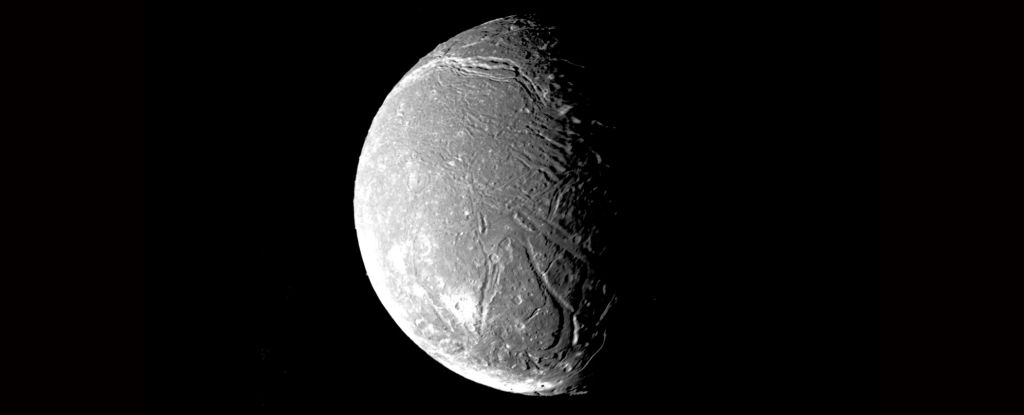
New Evidence Suggests That The Moon Ariel Of Uranus May Have A Liquid Ocean Below Its Frozen Surface. This Discovery Opens New Possibilities
In the depths of the Solar System, a new mystery intrigues scientists: the moon Ariel of Uranus may hide a liquid ocean beneath its frozen surface.
Recent evidence points out that the deep abysses of Ariel may be portals to investigate its interior, offering clues about the geological processes occurring far from human sight.
Abysses That Reveal Internal Mysteries Of The Moon Of Uranus
The surface of Ariel features deep abysses marked by parallel grooves, characteristics that intrigue researchers.
-
Helicopter Drops 180 Tons of Sand and Gravel on Swedish River to Revive Ecosystem Damaged by Decades of Exploitation

-
Brazilian Company Launches Retro Smartphone with 48 MP Camera, T9 Keyboard, and Privacy Features for Social Media-Free Use

-
Self-Taught Chinese Farmer Builds 5-Ton Submarine from Scrap, Launches It in Anhui River
-
Invisible Induction Technology Enables Wireless Power for Blenders, Coffee Makers, and Air Fryers, Reducing Countertop Cables





These grooves, considered some of the youngest formations on the moon, may have been caused by spreading processes — a phenomenon similar to what occurs at terrestrial volcanic ridges, where material from the Earth’s interior emerges and forms new crust.
According to planetary geologist Chloe Beddingfield from Johns Hopkins University, these abysses are the best bet to investigate deposits of carbon dioxide and explore the moon’s interior. “No other surface feature shows evidence of facilitating the movement of materials from inside Ariel, making this discovery particularly exciting“, Beddingfield states.

Planet. Sci. J. , 2025)
A Process Similar To That Of Earth
Using formation models and observational data, Beddingfield and her team demonstrated that the spreading process could be responsible for the observed marks.
By simulating the closing of the abysses, the edges fit perfectly, indicating that materials were deposited over time, as occurs in oceanic expansion zones on Earth.
This process may be the result of tectonic forces driven by the moon’s internal heating. In past moments, Uranus’s moons, including Ariel, underwent orbital resonances — gravitational alignments that cause internal melting and re-freezing. This heating cycle may have created conditions for a subsurface ocean.
Indications Of A Hidden Ocean
Recent observations from the James Webb Space Telescope (JWST) strongly suggest the presence of a liquid ocean on Ariel.
This ocean, if confirmed, could be responsible for the carbon dioxide deposits detected in the moon’s abysses. However, many questions remain unanswered.
Beddingfield emphasizes that it is still unknown whether these deposits are directly linked to the grooves, as the images from the Voyager 2 probe, which visited Uranus in 1986, did not have adequate instruments to map the distribution of ices. “There is much we do not know,” she comments.
“The size of the possible ocean on Ariel and its depth below the surface can only be estimated, but it may be too isolated to interact with expansion centers,” she stated.
The Next Step
The findings on Ariel reinforce the need for new missions to explore Uranus and its moons. Despite growing interest, no dedicated mission has been launched since the Voyager 2 flyby.
Researchers argue that investigating these formations could be crucial to understanding the internal processes not only of Ariel but of other icy bodies in the Solar System.
The possibility of a hidden ocean on Ariel opens new perspectives for space exploration and for understanding the habitability of distant moons.
With technological advancements, such as the James Webb Telescope, and a possible future mission to Uranus, scientists hope to reveal the mysteries hidden under the ice of this enigmatic moon.
Now is the right time for space agencies to prioritize this exploration and expand our knowledge of the hidden oceans beyond Earth.
The research was published in The Planetary Science Journal.





Be the first to react!