





 Portuguese
  English
  Spanish
  2 min of reading
  0 comments


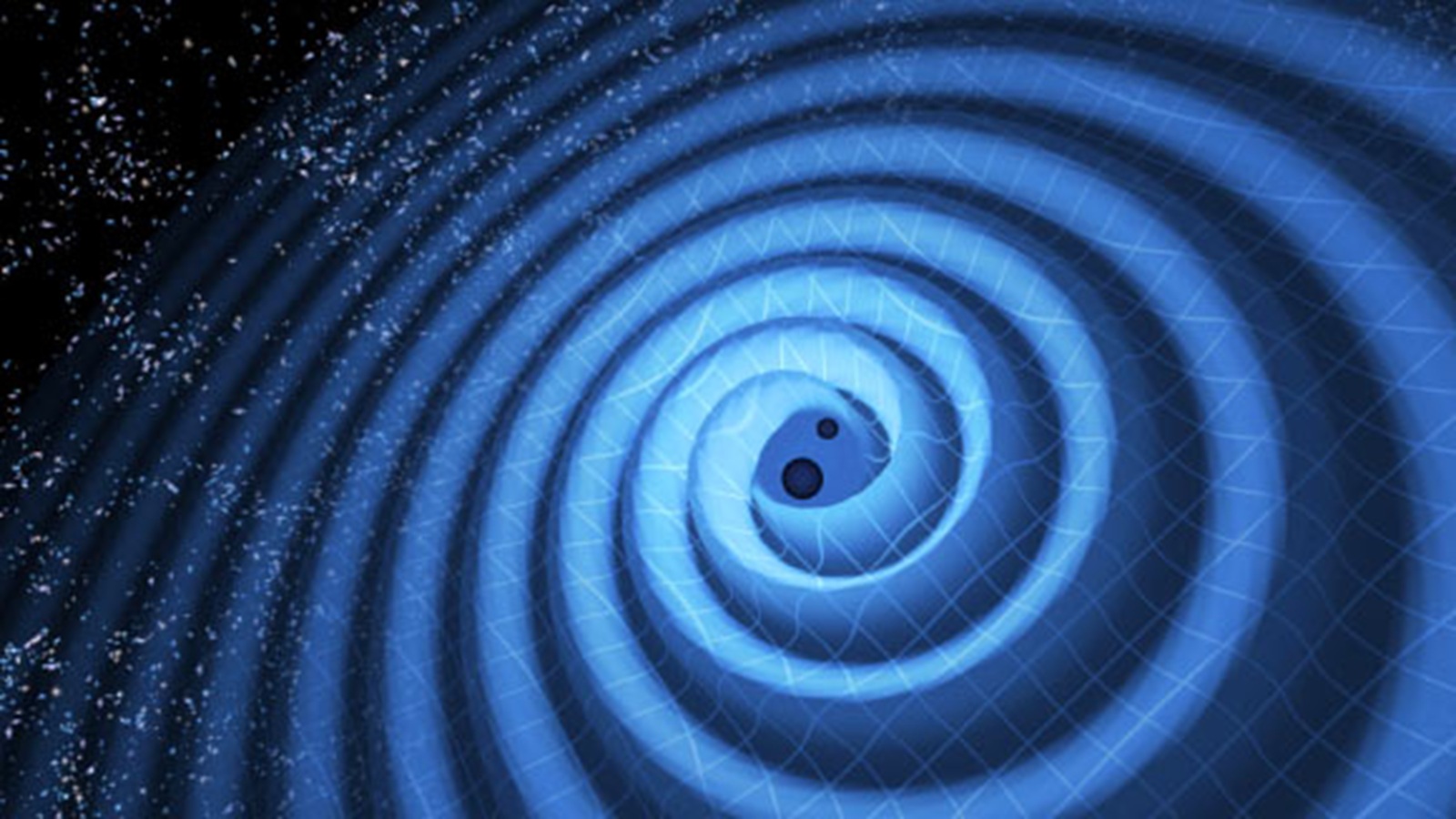
Research published in Physical Review Letters developed a model to identify possible dark matter signatures in gravitational waves emitted by colliding black holes, after analysis of LIGO-Virgo-KAGRA signals indicated provisional evidence in specific events, still without sufficient statistical confirmation
Study published in Physical Review Letters proposes a model to search for dark matter signatures in gravitational waves generated by black hole mergers, after analysis of LIGO-Virgo-KAGRA signals indicated possible hints in specific events, still without sufficient statistical confirmation.
More than 85% of the Universe’s matter may be dark matter, and a study published in Physical Review Letters suggests that black hole mergers may carry signals of this invisible component in gravitational waves detected on Earth.
Dark matter may leave marks in cosmic collisions
Dark matter does not interact with light, magnetic fields, or forms of electromagnetic energy. Therefore, its existence is inferred by gravity, especially by the curvature around distant galaxies.
-
A 400-meter colossus powered by natural gas has just set sail from Shanghai to Europe, carrying over 24,000 containers. It is the world’s largest dual-fuel container ship and can cross the planet without refueling even once.

-
A new study overturns the central idea we learned about planets and suggests that Earth is the exception rather than the rule; most rocky worlds in the galaxy may not have a core or mantle, just a single turbulent fluid extending to the center.
-
Scientists reanimated a 48,500-year-old virus in the laboratory that had been frozen in the Siberian permafrost since before the extinction of the Neanderthals, and it was still capable of infecting living organisms after tens of millennia dormant in the ice.
-
The oldest nuclear aircraft carrier still in operation in the world is currently on Brazilian soil making its final journey before retirement, and two American military planes landed in Salvador and Fortaleza to support the mission.



One of the hypotheses analyzed involves light scalar particles, much less massive than electrons. Near rapidly rotating black holes, they could behave as coordinated waves and gain density through superradiance.
In this process, part of the black hole’s rotational energy would be transferred to dark matter. At high densities, this scalar environment could alter the dynamics of the merger and imprint marks on the gravitational waves.
MIT model analyzed LIGO-Virgo-KAGRA signals
To search for these signatures, Josu Aurrekoetxea and colleagues developed a semi-analytical waveform model for binaries in scalar environments. The method was validated with numerical relativity simulations.
The team applied Bayesian analysis to the LIGO-Virgo-KAGRA catalog, gravitational wave observatories. Among 28 clear signals from the first three observation runs, 27 were compatible with mergers in a vacuum.
The GW190728 signal showed possible hints of an environment associated with dark matter. The study summary also mentions GW190814, in which the vacuum was outside the 95% confidence region.
Researchers treat result as provisional
The authors emphasize that there has been no confirmed detection of dark matter. The statistical significance does not yet allow for a discovery claim, and independent verifications are necessary before any confirmation.
Even so, the method opens a path to investigate dark matter on smaller scales, using black holes as natural amplifiers and upcoming LVK data to search for new physics.








Be the first to react!