






 Portuguese
  Spanish


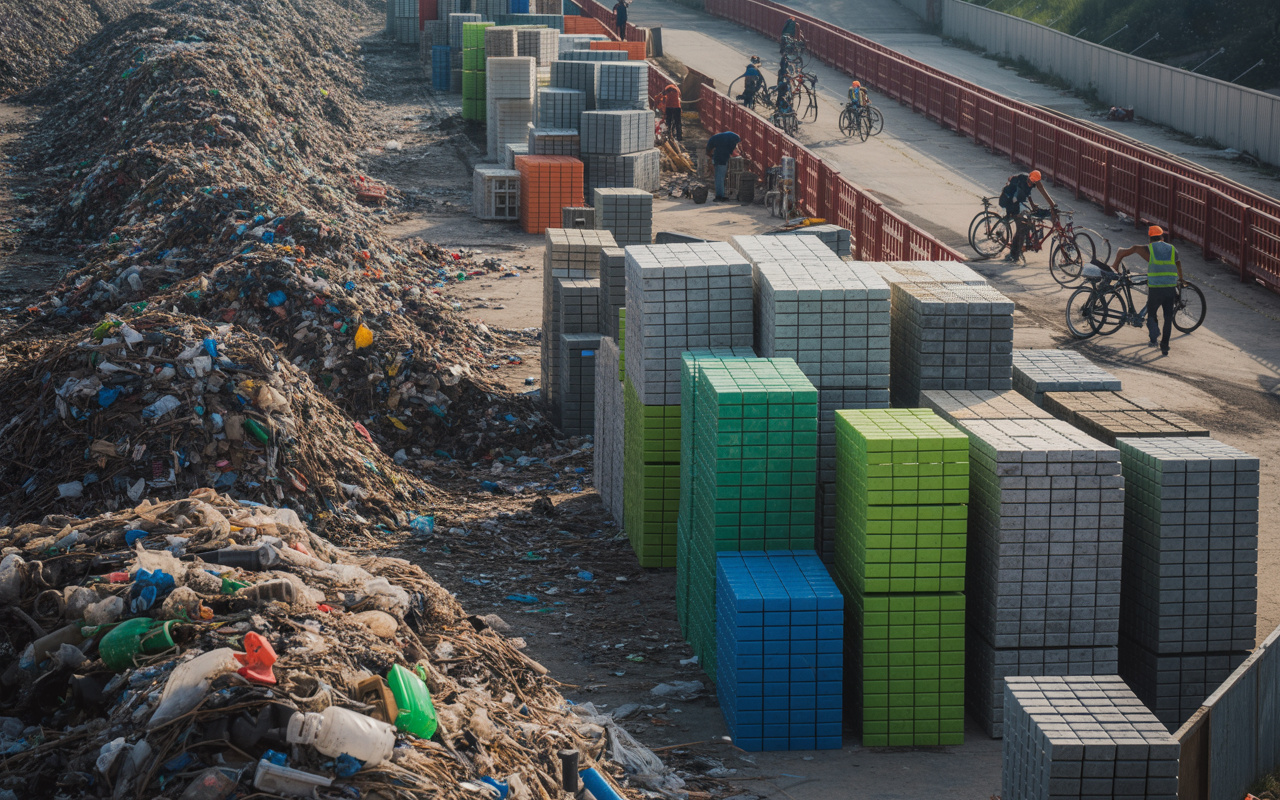


Plastic Waste Turns Into Bricks and Modular Plates, Entering Civil Construction and Transforming Urban Waste Into Walls, Pavements, and Bike Lanes.
The global plastic problem has always been less about quantity and more about quality. While PET bottles find buyers and established markets, flexible plastic, contaminated with organic material and lacking commercial value, has accumulated for decades. Bags, agricultural films, laminated packaging, and thin plastics make up a large part of the waste flooding landfills, ditches, and rivers. This material was not economically recyclable—not for lack of technology, but for lack of destination.
At the same time, in tropical areas and large urban centers, the construction industry faces another type of scarcity: expensive aggregates, long-distance transport, and slow logistics. It was precisely at this point that researchers, engineers, and cooperatives began to see an unlikely marriage: transforming worthless waste into construction components.
How Contaminated Plastic Becomes Structural Component
The great innovation of this trend does not lie in melting plastic to produce new objects, but in skipping costly steps. Instead of washing, separating, and refining, the process shreds mixed waste, heats, and compacts it into standardized molds. It’s simple, robust, and works with low-quality polymers.
-
Scientists Convert Food Waste into Aviation Fuel, Successfully Test 50% Blend with Conventional Kerosene to Cut Emissions and Promote Sustainable Flights

-
OnePlus N6 Smartphone to Launch in India with 8,000mAh Battery and 45W SuperVOOC Charging, Lasting Up to Three Days
-
Scientists Plan to Release Air Bubbles Underwater to Protect Antarctica’s “Doomsday Glacier” from Melting

-
Chinese R6000 Drone Combines Airplane and Helicopter Features, Carries Up to 12 People for Multiple Missions




Polyethylene (PE) and polypropylene (PP), found in common packaging, have sufficient mechanical strength and flexibility to generate modules, blocks, and plates that can replace masonry in low-rise constructions or external pavements. And since the material does not absorb water, it does not rot or suffer biological attacks, outperforming wood and stabilized earth in several aspects.
This logic transformed what was once plastic debris into interlocking blocks for walls, plates for draining sidewalks, and silent bike lanes that dispense with cement.
Bricks, Plates, and Bike Lanes: When Waste Becomes Structural
In recent years, different uses have begun to emerge:
- Structural bricks: used in one or two-story buildings, with good impact resistance and low water absorption.
- Modular plates: applied in sidewalks, bike lanes, and outdoor areas, reducing noise, cracks, and installation time.
- Draining blocks: with geometry that allows for surface infiltration, helping to reduce puddles, runoff, and minor flooding.
In some African and Asian countries, cooperatives have started to produce plastic components to meet housing shortages where cement is expensive or scarce. In European regions, usage has grown for bike lanes and silent sidewalks due to the flexibility of the material. And in Latin American cities, compacted plastic blocks have been adopted in community works as they do not require concreting.
Why This Is Relevant for Engineering and Waste Chain
Civil engineering has always sought lightweight, modular, and durable materials. Recycled plastic meets this triad precisely. The environmental gain, however, goes beyond: by shredding contaminated plastic without washing it, the highest cost of traditional recycling is eliminated.
The waste chain also changes. Instead of generating a product with uncertain value, it creates an input for a massive market: construction. And when a waste enters a market that moves trillions, its destination shifts from the ocean to urban infrastructure.
For tropical countries, there is also another gain: since the material does not absorb moisture, it does not crack or become a termite nest, replacing wood and masonry in community works with more durability.
What’s Next and Why This Could Scale Globally
The next steps are already noticeable: cities testing plastic pavements, cooperatives creating modular factories, and startups producing interlocking systems that reduce labor. Materials engineering is investigating additives, fibers, and composites to enhance modulus of elasticity, fire resistance, and thermal behavior.
The central point is that waste has ceased to be merely an environmental liability. It is becoming a construction material. And the scale is what is impressive: if just a fraction of the polymers going to landfills become pavement or modular blocks, we are talking about billions of tons changing their destination from the ocean to civil works.
It is a rare scenario where engineering, climate, and economy converge—and it can transform today’s dirty plastic into tomorrow’s walls, bike lanes, and sidewalks.






O lixo do Japão está acabando. Eles construíram inúmeras usinas que transformam o lixo em energia para, principalmente, aquecedores. Mas o lixo está acabando.
Soluções: ou importam lixo ou exportam algumas usinas.
*meu !!!!!* você aborda um assunto tão importante para a natureza, para os seres humanos, para o saneamento básico no planeta inteiro e traz uma reportagem tão fraca no que se refere ao processo/tecnologia, aos países/cidades que estão utilizando, as empresas ou comunidades que fazem adotaram.
POR FAVOR, COMPLEMENTE ESTA MATÉRIA COM MAIS INFORMAÇÕES
Guau! Ya era hora!.