





 Portuguese
  English
  Spanish
  5 min of reading
  1 comment


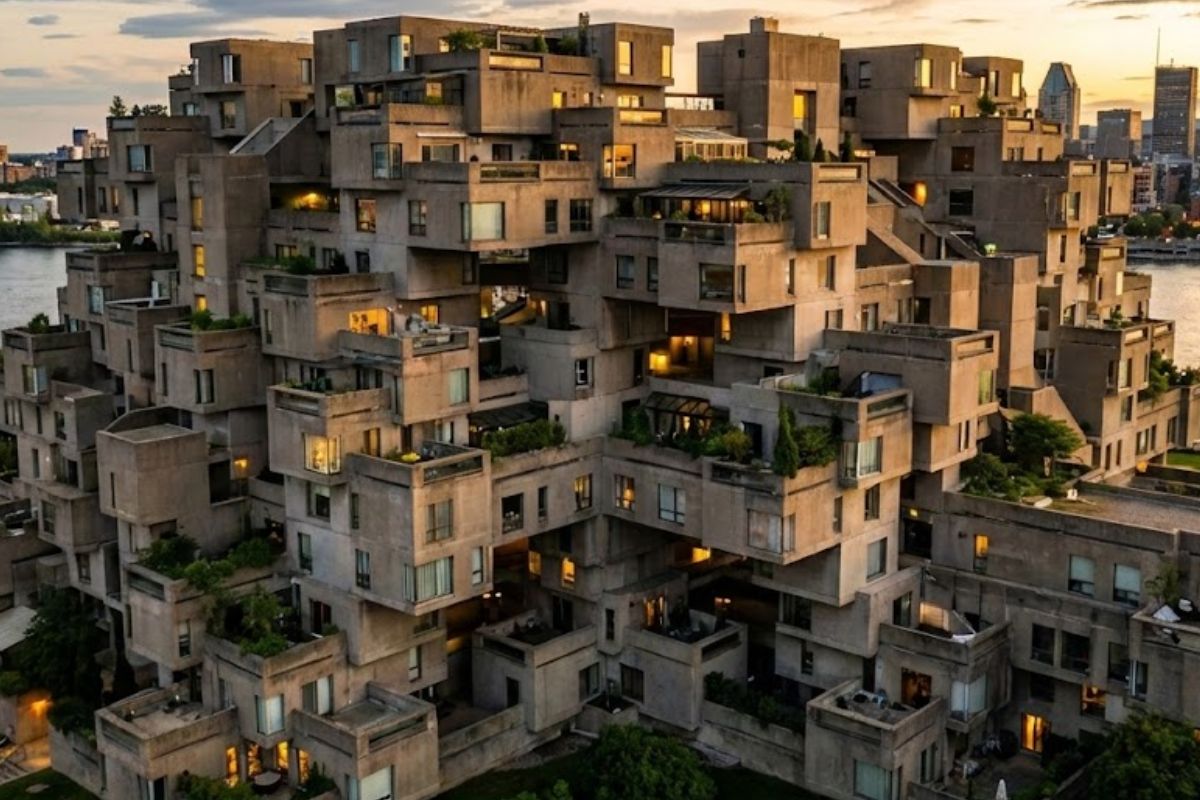


Habitat 67 Transformed Concrete Cubes Into Unique Homes, Creating High Density Without the Feeling of a Repetitive Tower. Designed for Expo 67 by Moshe Safdie, the Complex Uses Asymmetrical Joints and Steel Bars to Ensure Rigidity, Light, Ventilation, and Private Green Roof Terraces in the Heart of Montreal.
On the horizon of Montreal, the concrete cubes of Habitat 67 form an irregular mass that captures attention even before any technical explanation. There are 354 modules stacked as if they were blocks of a jigsaw puzzle, but with a very concrete ambition: to make a building deliver the feeling of home, with privacy, air, and light.
Behind the aesthetics that seem unstable, there is a design logic that relies on industrial repetition and a personalized outcome. Each of the 158 housing-units has its own configuration, and this difference doesn’t only appear in the design: it reorganizes circulation, views, ventilation, and even access to outdoor areas, in a complex designed for high urban density.
The “Instability” That Deceives the Eye and Reveals the Strategy

At first glance, the impression is that some concrete cubes are about to slip, as if the construction is always on the brink of balance.
-
Friends have been building a small “town” for 30 years to grow old together, with compact houses, a common area, nature surrounding it, and a collective life project designed for friendship, coexistence, and simplicity.

-
This small town in Germany created its own currency 24 years ago, today it circulates millions per year, is accepted in over 300 stores, and the German government allowed all of this to happen under one condition.

-
Curitiba is shrinking and is expected to lose 97,000 residents by 2050, while inland cities in Paraná such as Sarandi, Araucária, and Toledo are experiencing accelerated growth that is changing the entire state’s map.

-
Tourists were poisoned on Everest in a million-dollar fraud scheme involving helicopters that diverted over $19 million and shocked international authorities.

This sensation arises from the asymmetrical stacking and the presence of volumes advancing over others, a type of composition that strays from the predictable alignment of traditional towers and creates an immediate visual impact.
The detail is that the design was not made to look “different” just for style. The asymmetry here works as a tool, creating voids between the units and fragmenting the built mass.
This fragmentation alters how the wind “reads” the complex, reducing pressure on a continuous wall and helping to form the characteristic silhouette of Habitat 67 in the Montreal skyline.
Home Privacy Within a Complex of Apartments
The starting point of the project was simple to explain and difficult to execute: to offer the privacy of an individual home within an apartment building.
Instead of repeating identical layouts in vertical stacks, the concrete cubes were combined to generate 158 residences with unique arrangements, reducing the feeling of neighboring walls being right next to each other, common in many buildings.
In practice, this changes how light enters and how people experience the space. By having windows on multiple faces, each unit tends to escape the “one facade only” model typical of more conventional layouts.
More than one opening front also favors ventilation and allows for spaces less dependent on internal hallways, reinforcing the perception of independent housing, even within a collective complex.
354 Prefabricated Modules and What Modularity Truly Delivers
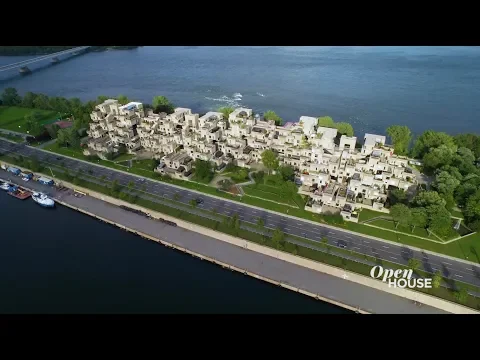

The choice of 354 prefabricated blocks is not a behind-the-scenes detail: it is the technology that makes the concept possible. With concrete cubes produced as modules, the project works with industrial repetition without falling into spatial repetition.
The standardization of the module does not force a standardization of the way of living, as the irregular fit allows for multiple combinations.
This also helps to understand why Habitat 67 became a reference when it comes to high density with residential quality.
Modularity appears not only as a construction method, but as urban language: independent units, staggered volumes, natural setbacks, and private outdoor areas created by the stacking itself, without relying on large common areas to “compensate” for the lack of individual space.
High Resistance Steel as the Invisible Seam of the Structure
The question that almost everyone asks in front of the complex is the same, even without realizing it: how does this hold up?
The answer lies in how the concrete cubes are interconnected and locked together, with high-strength steel bars ensuring rigidity and structural continuity. What looks like an improvised pile actually functions as a tied system.
This structural “seaming” allows the asymmetrical design to be both aesthetic and functional.
It is not a sculptural whim disconnected from engineering: it is an arrangement that needs to be rigid so that the voids, advances, and overlaps fulfill their spatial function, without compromising the stability, comfort, and durability of the complex.
Rooftop Gardens and the Rule That Changes the Living Experience
Moshe Safdie advocated a straightforward rule: every roof should be a garden.
In Habitat 67, this turns into a cascading solution: the roof of one concrete cube transforms into the landscaped terrace of the neighbor living above, creating a network of private outdoor areas distributed throughout the complex, rather than concentrated on the ground floor.
The result is an intriguing coexistence between the harshness of brutalism and the softness of greenery. The garden does not enter as an ornament, but as a real extension of the home, offering an outdoor space that, in traditional towers, often becomes a distant common area or simply does not exist.
Here, the green area is glued to daily life, associated with privacy and direct use, not as a “shared equipment.”
Why Habitat 67 Remains a Reference and How It Can Be Viewed Today
Compared to the traditional model, the modular complex stands out in three points that appear in daily living: lighting from multiple faces, enhanced privacy from independent units, and the presence of private outdoor areas, thanks to the staggering of the concrete cubes.
In many conventional buildings, light tends to come from a main face, privacy is conditioned to continuous neighboring walls, and greenery is often common, when present.
Even being a prestigious residential address, Habitat 67 also opens up to the public through guided tours aimed at those interested in architecture and design.
Located in Cité du Havre, the complex offers striking views of the St. Lawrence River and downtown Montreal, reinforcing the contrast between the fragmented design of the complex and the surrounding urban landscape.
And here comes the most interesting part: if the “machine” of Habitat 67 does not rely on fantasy, but on modularity, structure, and a clear decision about privacy and light, what prevents similar ideas from returning with force in other cities?
If you could choose, would you live in a place where concrete cubes create private rooftops, even with the appearance of bold stacking?
What matters most to you when it comes to living: home privacy, natural light from multiple faces, or the feeling of living in a traditional tower with everything else being predictable? And, looking at your city, where would a project like this make real sense?










Favela Chic ehehehe