






 Portuguese
  Spanish
  5 min of reading
  0 comments


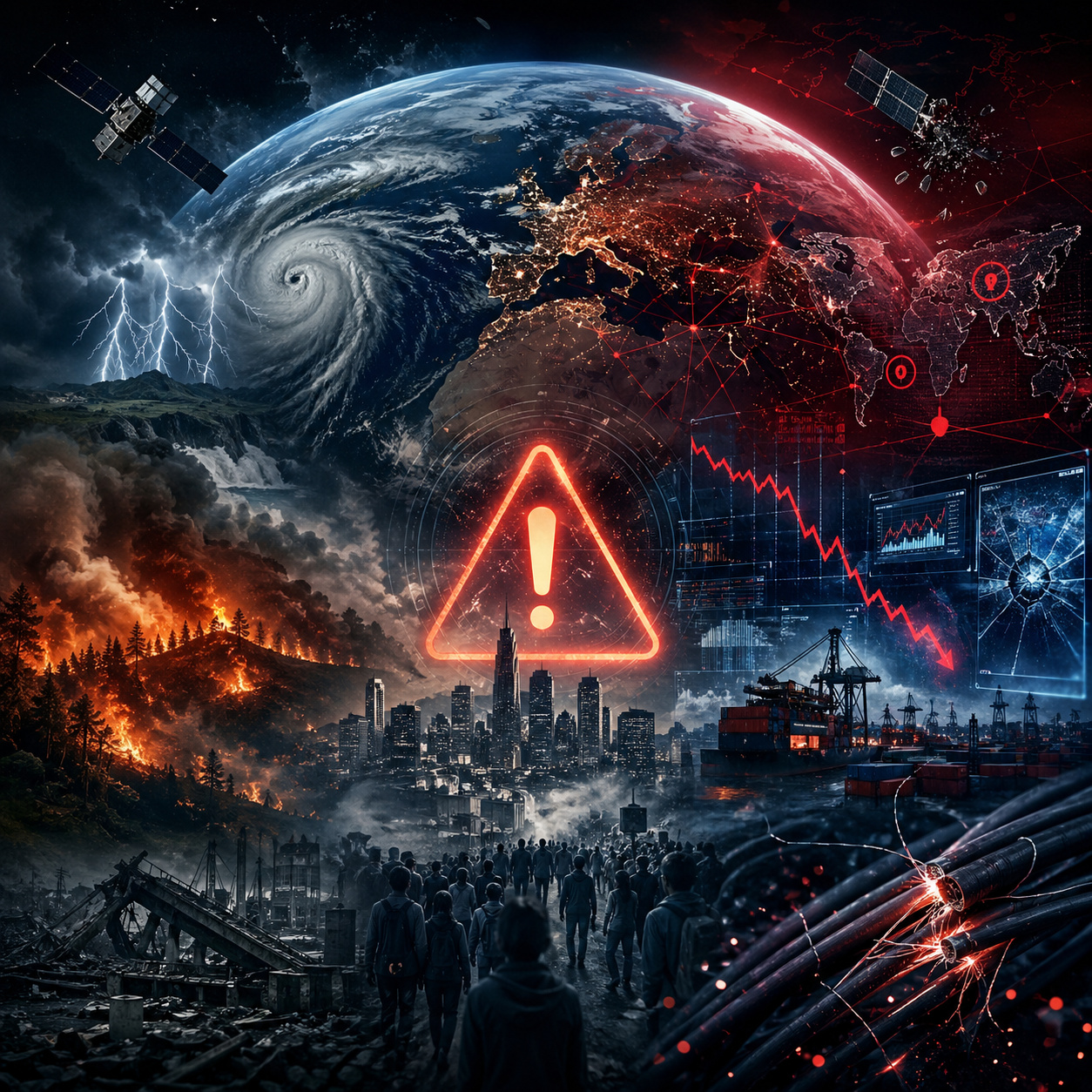
Global report warns of a decade of combined risks involving climate, geopolitics, economy, and technology until 2036.
On January 14, 2026, the World Economic Forum published the 21st edition of the Global Risks Report, consolidating the perceptions of over 1,300 experts and leaders from academia, businesses, governments, international organizations, and civil society. The document analyzes global risks across three horizons, 2026, 2028, and 2036, and points out that the crisis is no longer seen as a sequence of isolated events but as a system of simultaneous shocks.
The most sensitive point of the report is the escalating interconnection between geopolitical, economic, technological, social, and environmental risks. According to the Forum, wars, the use of economic instruments as strategic weapons, institutional fragmentation, technological acceleration, and environmental decline can produce chain effects, amplifying impacts across countries, markets, and critical infrastructures.
Below, understand why the 2026 report describes a new phase of global competition and how different risks can reinforce each other simultaneously, creating scenarios that are more difficult to predict and control.
-
Businessman puts modern 1,100 square meter fortress in Russia up for sale for $550,000, featuring high walls, archer towers, a 1.2-hectare plot, and an isolated location on the banks of the Don River.

-
Small shops in the interior of São Paulo have been around for up to 70 years, maintaining credit accounts, preserving artisanal preserves, and showing how small rural businesses have turned customers into friends, families, and guardians of stories that remain alive even after the advance of sugarcane, the end of coffee plantations, and the arrival of large commercial chains.

-
Chinese students build a 6.06-meter remote-controlled paper airplane, achieve a flight of almost 15 minutes, and turn a school pastime into an engineering project to attempt a world record.
-
He started with a jigsaw, his father’s screwdriver, and many drawings made during classes; years later, the young man who built a roller coaster in his own backyard went viral on the internet, was hired by Cacau Park, and now coordinates Brazilian and foreign professionals in the installation of an attraction weighing 737 tons, 55 meters high, one kilometer long, featuring moments of zero gravity and a speed of 120 km/h, in a journey that turned curiosity, calculations, and persistence into a professional career.


Extreme weather emerges as a dominant risk with increasing impact
Among the analyzed factors, extreme weather events continue to occupy a central position. Heatwaves, droughts, intense storms, and changes in rainfall patterns have already been observed in various regions of the planet.


The report highlights that these events not only cause direct damage but also generate indirect effects on production chains, infrastructure, and food security.
The frequency and intensity of these phenomena indicate that the impact tends to become more constant over the next decade. Climate ceases to be an isolated risk and begins to act as a crisis multiplier.
Geopolitical tensions rise and affect trade, energy, and global security
Another relevant axis highlighted by experts is the increase in geopolitical tensions. Regional conflicts, trade disputes, and rivalries between major powers have the potential to affect global markets.
These tensions can interfere with supply chains, raise energy costs, and generate economic instability in different countries.
Furthermore, the geopolitical environment influences investment decisions and international cooperation. Instability between nations becomes a central factor in global economic dynamics.
Disinformation emerges as a structural risk for societies and governments
The advancement of digital technology has brought significant benefits, but it has also opened space for the widespread dissemination of disinformation.
According to the report, disinformation can influence electoral processes, public decisions, and the population’s perception of risk.
This phenomenon intensifies with the use of artificial intelligence, which allows for the creation of increasingly realistic content that is difficult to distinguish from true information. The ability to manipulate information becomes a factor of social and political instability.
Global economy faces a scenario of pressure and uncertainty
The combination of inflation, indebtedness, and economic slowdown appears as one of the central challenges for the coming years.

Experts highlight that simultaneous shocks, such as energy crises and logistical disruptions, can increase pressure on already fragile economies.
This scenario can affect employment, income, and investments, creating an environment of greater volatility. The global economy becomes more sensitive to external events and less predictable.
Technology accelerates changes and creates new systemic risks
Technological advancement, especially in areas such as artificial intelligence, automation, and cybersecurity, appears as one of the most transformative factors of the next decade.
While driving innovation, technology also introduces new risks, such as cyberattacks, failures in critical systems, and dependence on digital infrastructure. The speed of these changes can make it difficult for governments and businesses to adapt.
Technology becomes both a solution and a source of new challenges.
Risks combine and generate chain effects
One of the most emphasized points in the report is the interaction between different risks. Climate events can affect the economy, which in turn can intensify social and political tensions.
Similarly, geopolitical crises can impact supply chains, generating inflation and economic instability.
This chain effect makes it more difficult to predict and control impacts. Risk ceases to be linear and begins to operate in multiple dimensions simultaneously.
Global infrastructure becomes one of the most vulnerable points
With increasing demand for energy, transport, and connectivity, global infrastructure becomes a critical element.
Extreme events, cyberattacks, or technical failures can compromise essential systems, affecting everything from energy supply to communications.

The need for modernization and resilience becomes increasingly evident. Infrastructure ceases to be merely support and becomes a strategic factor for stability.
Governments and businesses need to adapt to a more complex environment
The scenario described in the report requires changes in how risks are managed. Governments need to develop more integrated policies, while businesses must adopt strategies that consider multiple factors simultaneously.
The ability to anticipate and respond quickly to events becomes an important differentiator. Risk management becomes a central element in decision-making.
Next decade could redefine economic and social patterns
Experts indicate that the period until 2036 will be decisive for the configuration of the global system. Changes in climate, technology, economy, and geopolitics can alter patterns of production, consumption, and social organization.
These transformations can create new development models, but also generate significant challenges. The world enters a transition phase with still uncertain impacts.
The main message of the report is that risks can no longer be treated in isolation. The interdependence between different factors requires integrated approaches and cooperation among countries, sectors, and institutions.
Without this coordination, response capacity may be limited. The complexity of the scenario demands equally complex solutions.
With extreme weather, global tensions, technological advancement, and economic pressure acting simultaneously, do you believe governments and businesses are prepared to deal with a decade where risks are no longer isolated and begin to occur all at once?




Be the first to react!