






 Portuguese
  Spanish
  3 min of reading
  0 comments


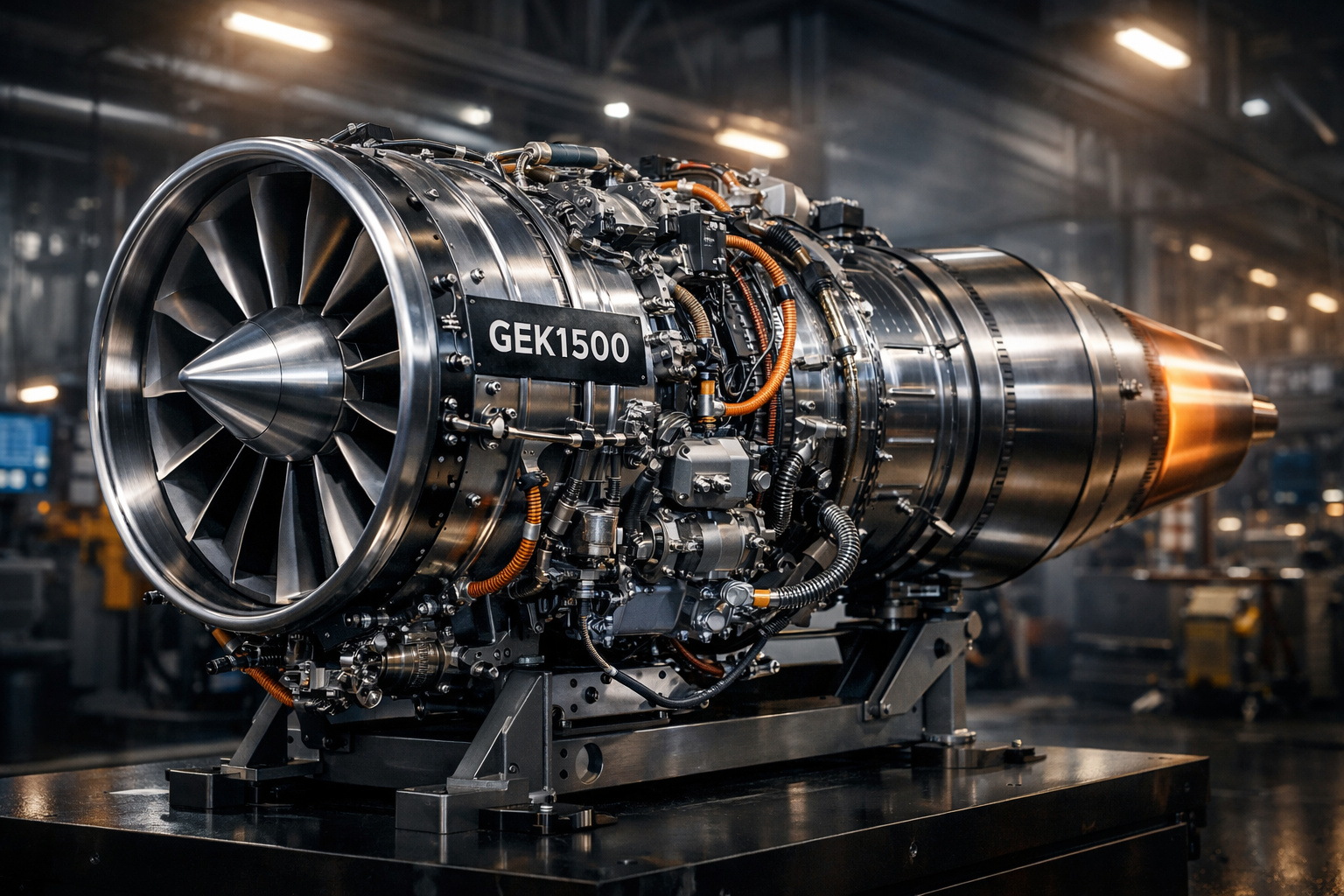
New GEK1500 Engine Boosts Collaborative Aircraft and Reinforces American Low-Cost High-Scale Military Strategy
GE Aerospace and Kratos Defense & Security Solutions announced a joint contract with the United States Air Force worth US$ 12.4 million. The goal is to develop a next-generation engine for small combat collaborative aircraft (CCA).
This agreement marks a significant advancement in American military strategy. Additionally, it reinforces the investment in stealth and scalable unmanned aerial systems.
The initial phase of the program aims to complete the preliminary design of the GEK1500 engine. The team needs to meet rigorous performance requirements. At the same time, it must meet aggressive cost targets for mass production.
-
The military spaceplane that almost took the Cold War into orbit: Boeing X-20 Dyna-Soar was designed to re-enter above Mach 20, fly for up to 40 hours, land like a plane, and transform Titan rockets into a gateway to a new era of orbital warfare.

-
FAB bets on national drones and increases investments to strengthen the Brazilian aerospace industry

-
Six times, a luminous crescent the size of the Moon startled the Soviet sky at dusk: it seemed like a wave of UFOs, but it was a secret orbital weapon created to attack the United States via the South Pole and evade Cold War radars.

-
The United States government approved a potential sale of 100 portable Stinger anti-aircraft missiles to the Brazilian Army, in a package estimated at around 330 million dollars that still depends on negotiations between the two countries.




According to an official statement from the companies, the project seeks to combine high performance with economic accessibility. Therefore, the focus is not only on power but also on industrial viability.
GEK1500 Delivers 1,500 Pounds of Thrust for Drones and Missiles

The GEK1500 is a jet engine with 1,500 pounds of thrust. It will be able to equip unmanned aerial systems (UAS), combat collaborative aircraft, and missiles.
Furthermore, the project leverages the architecture of the GEK800, originally developed for cruise missiles. Currently, this engine is in an advanced stage of technical maturation.
Stacey Rock, president of the Turbine Technologies Division at Kratos, emphasized that the development strengthens the company’s ability to produce high-performance engines quickly. According to her, the team remains committed to reducing costs.
For his part, Steve “Doogie” Russell, vice president of Edison Works at GE Aerospace, stated that recent altitude tests on the GEK800 yielded valuable insights. This data is now being directly applied to the GEK1500.
Consequently, the new engine is expected to deliver greater thrust, better electrical power generation, and lower life-cycle costs. In addition, the project aims to meet stringent deadlines.
The contract includes an additional option. If activated, it will allow for the assessment of critical risks and the testing of engine performance in real flight and installation conditions.
American Strategy Prioritizes Affordable Engines and Accelerated Production


The United States Air Force prioritizes high-performance engines at low cost. This strategy is central to enabling the disruptive capabilities of small CCA.
Recent altitude tests with the GEK800 demonstrated increased range and thrust. Additionally, they reduced life-cycle costs and enhanced electrical power generation.
These advancements are expected to reduce costs and timelines for the GEK1500. Therefore, the program is likely to accelerate its entry into operation.
In June, GE Aerospace and Kratos formalized a technological cooperation agreement. The objective was to drive propulsion systems for affordable drones and CCA aircraft. This understanding expanded a Memorandum of Understanding signed in 2024.
Kratos has over 25 years of experience in developing compact engines for UAS, drones, and missiles. Meanwhile, GE Aerospace boasts a century of experience in propulsion technology.
Furthermore, GE has the capability to scale projects for high-cadence production. This facilitates the transition from prototypes to large-scale operation.
Thus, the partnership combines established industrial experience with military innovation. The ultimate goal is clear: to create stealthy collaborative drones that operate alongside manned fighters.
In this way, the GEK1500 could become a key component in the next generation of combat air systems for the United States.
Do you believe that stealth collaborative drones could completely change the way air wars will be fought in the coming decades?







-

1 person reacted to this.