






 Portuguese
  Spanish


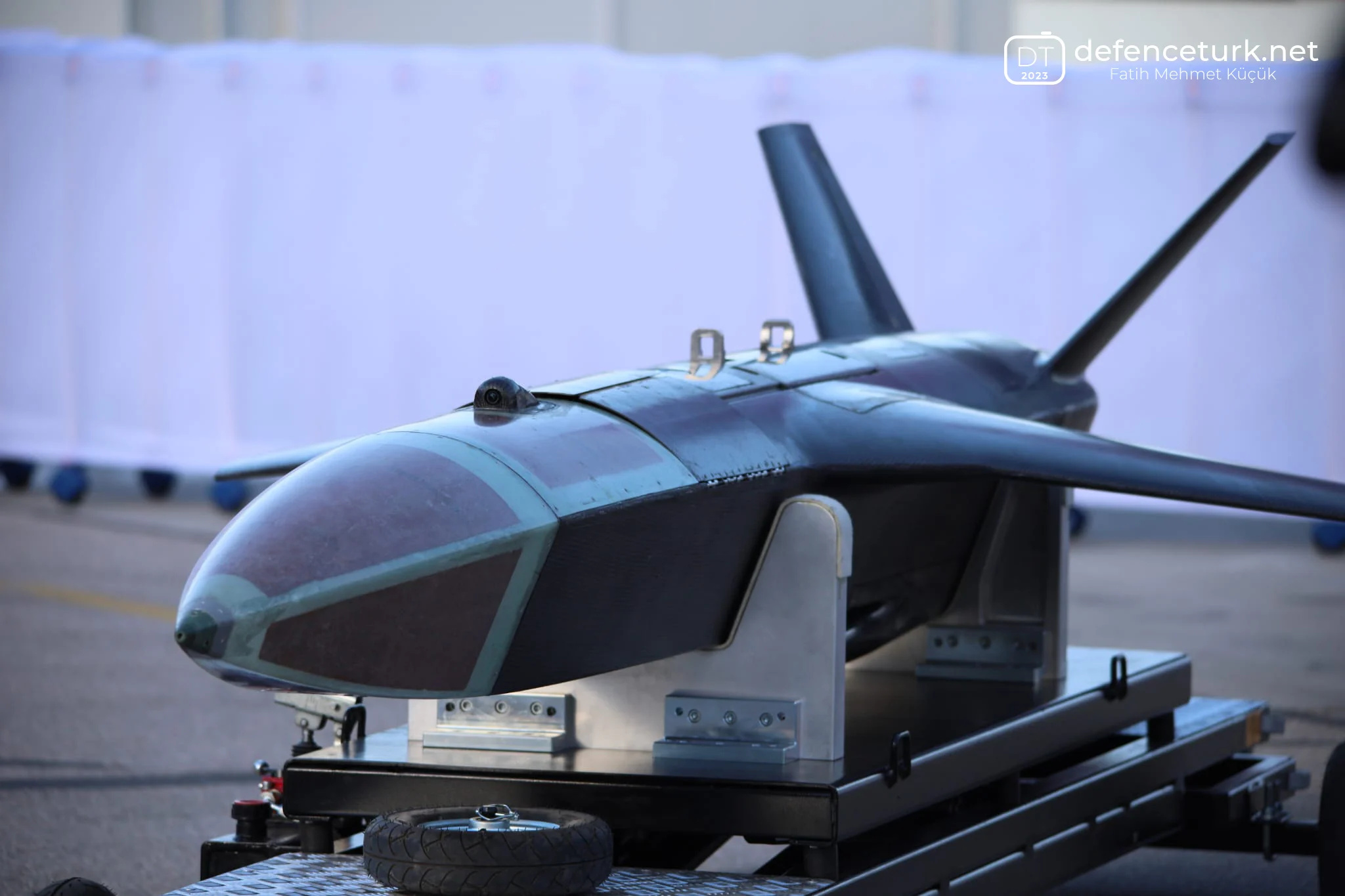


Aksungur from Turkish Aerospace appears carrying two Süper Şimşek drones and shows how Turkey is creating an unmanned aerial warfare ecosystem.
According to Army Recognition, on March 10, 2026, Turkish Aerospace Industries published a flight test video on its official account showing the Aksungur drone carrying two Süper Şimşek jet drones under its wings. The demonstration confirms that Turkey is building not just an unmanned aircraft, but a combat ecosystem with drones, where a long-endurance platform carries and launches smaller platforms near the target.
The Aksungur itself already boasts impressive numbers: a wingspan of 24.2 meters, two TEI-PD170 turbodiesel engines, 49 hours of autonomy in signals intelligence missions, a ceiling of 40,000 feet, and a payload of 750 kg on six hardpoints.
Turkey’s Aksungur Drone Becomes Mother Platform for Süper Şimşek Jet Drones
The Aksungur transitions from being just a long-endurance military drone to operating as a mother platform for other drones. This change alters the traditional logic of unmanned missions.
-
China Unveils Laser Weapon Capable of Instantly Neutralizing Military Drones, Marking a Significant Advancement in Air Defense Technology

-
U.S. Navy’s Ticonderoga-class Cruiser Becomes a 9,800-Ton Missile Fortress with Advanced Aegis System Capable of Tracking Hundreds of Targets

-
France’s Charles de Gaulle: The Sole Nuclear-Powered Aircraft Carrier Outside the US, Weighing 42,500 Tons and Equipped with Two Atomic Reactors

-
The military spaceplane that almost took the Cold War into orbit: Boeing X-20 Dyna-Soar was designed to re-enter above Mach 20, fly for up to 40 hours, land like a plane, and transform Titan rockets into a gateway to a new era of orbital warfare.




With two Süper Şimşek installed under the wings, the larger drone can carry disposable vectors for decoy missions, electronic warfare, and precision strikes. It is a layered combat architecture.
In practice, Turkey shows that its military drone program is moving from the phase of isolated platforms to a phase of integrated systems, with sensors, munitions, engines, radars, and smaller drones working together.
Aksungur has 49 hours of autonomy and changes the logic of maritime surveillance
The 49-hour autonomy is one of the most important data points of the Turkish Aksungur drone. Most medium-sized military drones, including platforms known as the Bayraktar TB2, operate for about 24 to 27 hours.
This time is sufficient for tactical missions but limited for ocean patrol, maritime surveillance, and coverage of vast areas. In naval missions, flight endurance can be more important than speed.
The Pacific Ocean is approximately 165 million km², while the Atlantic Ocean is about 106 million km². Patrolling areas of this size requires aircraft capable of staying airborne for long periods.
Anti-submarine mission places Aksungur in a strategic role at sea
The anti-submarine mission is one of the areas where the autonomy of Aksungur becomes most relevant. Detecting a submerged submarine requires persistence, sensors, and time spent over the suspected area.
In October 2022, the Turkish Navy tested the Aksungur in launching sonobuoys in the Aegean Sea. This type of operation is associated with manned maritime patrol aircraft, but the drone brings the function to an unmanned model.
The search for submarines requires launching sonobuoys in specific patterns, monitoring acoustic signals for hours, repositioning sensors, and tracking the target’s movement. A drone with 49 hours of autonomy can sustain this cycle for longer.
TEI-PD170: the Turkish engine that reduced foreign dependency in Aksungur
The TEI-PD170 is the turbodiesel engine that equips the Aksungur in a twin-engine configuration. Its importance goes beyond the technical specifications, as it reveals Turkey’s industrial strategy in the defense sector.

When the program began, the prototypes used Thielert Centurion engines, manufactured in Germany. They worked, but created external dependency on a critical component for a military aircraft.
TUSAŞ Engine Industries, a subsidiary of Turkish Aerospace, developed the PD170 as a national substitute. The four-cylinder turbodiesel engine delivers 170 hp, operates with standard NATO JP-8 fuel, and entered serial production in 2020.
Turkey’s defense industry advances with its own drone, engine, radar, and munitions
Turkey has not only developed the Aksungur. The country has also advanced in the engine, mission control systems, onboard radars, guided munitions, and now in smaller drones carried by larger drones.
This set creates a chain of technological autonomy in critical defense systems. Instead of relying on foreign suppliers for each component, Ankara now controls essential parts of the ecosystem.
This strategy resembles the path taken by traditional military powers, which consolidated technological independence to export weapon systems without relying on external permissions for each sale.
Aksungur with PD170 engine reached an altitude of 40,000 feet in test
In April 2025, the Aksungur equipped with PD170 engines set an altitude record in tests, demonstrating that the turbodiesel version reached the specified ceiling of 40,000 feet for the platform.
This result was important because it confirmed the maturity of the integration between airframe, engine, and mission systems. For a military drone, high altitude means better sensor coverage and greater operational flexibility.
The integration of the national engine also allowed advancement from the experimental phase to operation with less dependence on licenses and exports of foreign components.
Süper Şimşek transforms the Aksungur into a cascading air warfare system
The demonstration on March 10, 2026, with the Aksungur carrying two Süper Şimşek, represents an evolution in Turkey’s unmanned air warfare architecture.
The Süper Şimşek is a multi-mission jet drone, designed to act as an aerial target, decoy, electronic warfare platform, and attack vector, depending on the onboard configuration.
The logic is simple and strategic: the Aksungur approaches the operation area using its long range, launches the smaller drones when necessary, and remains out of part of the immediate risks of enemy air defense.
Süper Şimşek jet drone can act as decoy, electronic warfare, and attack
The Süper Şimşek was designed for missions where speed, saturation, and controlled risk are more important than prolonged reuse. It can simulate larger aircraft to confuse radars and anti-aircraft systems.
In the decoy role, the drone forces the enemy to reveal radars, expend munitions, or divide its attention among multiple targets. In electronic warfare, it can act in the jamming or interference of sensors and communications.

In precision attack, the Super Lightning can function as a disposable vector against specific targets. This extends the tactical range of the Aksungur without requiring the main platform to enter the most dangerous zone directly.
Aksungur has already been used in real scenarios and shows the limits of drone warfare
The Aksungur is not just a demonstration platform. The base text informs that the drone has already been used in real scenarios in Syria, Iraq, and Libya, with documented losses in air defense environments.
In November 2023, an Aksungur crashed in northern Iraq. In May 2024, another was shot down in the Qandil mountains, and in August 2024 a third was downed by an Iraqi Pantsir system near Kirkuk.
These episodes show that long-endurance MALE drones have operational value, but they are not invulnerable. When entering contested zones, they can be detected and hit by anti-aircraft systems.
Turkish drone ecosystem attracts countries outside the Western axis
The expansion of the Aksungur also has a geopolitical dimension. Countries that cannot buy American or European systems due to political restrictions, price, or export dependency find an alternative in Turkey.
The base text points out that Kyrgyzstan and Chad have already received export deliveries, while Algeria, Angola, and Uzbekistan have orders in the pipeline. This shows the entry of the Aksungur into markets beyond Turkey.
The Turkish package is attractive because it combines a long-endurance drone, sensors, guided munitions, national engines, and now auxiliary drones. It is not just an aircraft, but an integrated military solution.
Aksungur shows how Turkey wants to compete with traditional military powers
The Aksungur represents a larger strategy of Turkey: to transform its defense industry into a global supplier of unmanned systems. The platform combines range, payload, autonomy, and integration with other drones.
The demonstration with Super Lightning increases the military value of the system because it allows for more complex missions, such as air defense saturation, electronic warfare, advanced reconnaissance, and precision attack.

The most important point is that Turkey is not just copying existing models. It is creating its own architecture, aimed at countries seeking modern military capability without being entirely dependent on Western suppliers.
The flight of the Aksungur with two Süper Şimşek under its wings shows that drone warfare has entered a new stage. Now, the advantage is not just in flying longer or carrying more ammunition.
The advantage now lies in the ability to launch other drones, create multiple targets, confuse air defenses, and execute layered missions. This is the logic behind unmanned combat ecosystems.
With 49 hours of autonomy, a wingspan of 24.2 meters, Turkish PD170 engines, a ceiling of 40,000 feet, and integration with Süper Şimşek jet drones, the Aksungur has become a symbol of Turkey’s ambition to compete in the global military drone market.


