





 Portuguese
  English
  Spanish
  5 min of reading
  0 comments


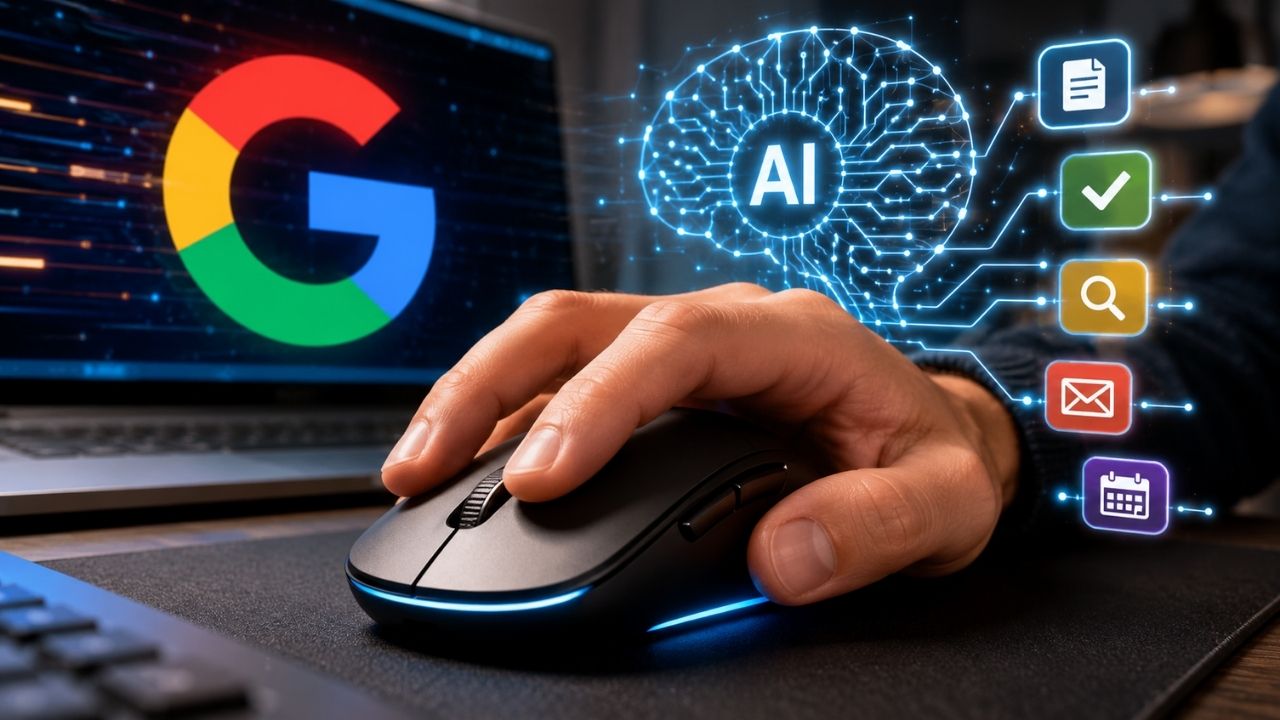
The mouse may gain AI integration if Google advances a proposal to transform the accessory into a tool capable of interpreting tasks, suggesting commands, and reducing steps on the computer, reigniting the debate about productivity, automation, and the future of peripherals used for decades in modern daily digital work.
The mouse may cease to be just the accessory used to click, drag, and select items on the screen. Google is studying an integration with artificial intelligence that could transform one of the most traditional computer peripherals into a more active tool in the digital routine.
According to the portal Olhar Digital, the idea draws attention because it deals with an object that has hardly changed in its main function over the last decades. Even with touch screens, voice commands, and virtual assistants, the mouse remains present in work, studies, and daily navigation.
Google targets an accessory that seemed difficult to reinvent

The mouse has always been seen as a simple extension of the hand on the computer. It moves the cursor, executes clicks, opens menus, selects files, and helps the user navigate programs and internet pages.
-
Processors can become 1,000 times faster with a new device that uses light pulses, operates in 40 picoseconds, and reduces the heat that stalls data centers.

-
Noise in the sky frightened residents: NASA confirms that a meteor exploded over New England with a force equivalent to 230 tons of TNT
-
The invisible flaw that protects banks, passwords, and messages may be numbered after a quantum experiment transforms imperfect randomness into numbers impossible to predict.

-
China has ceased to be just a factory for cheap products and now challenges health giants: Chinese laboratories are advancing in medicines, while other countries recalculate their medical dependence.



Now, the proposal to integrate AI into this accessory suggests a change of role. Instead of just obeying the user’s movement, the mouse could start participating in the task, understanding context, speeding up commands, and reducing repetitive steps.
There are not yet enough details to state how this feature would work in practice. The discussion, however, points to a clear path: transforming common peripherals into smarter interfaces, capable of better interacting with software and operating systems.
This movement aligns with the strategy of major technology companies, which have been incorporating AI into browsers, search engines, systems, productivity applications, and everyday devices.
AI can change the way commands are executed
If the integration advances, the mouse could become a bridge between physical gestures and digital automation. A click, a movement, or a selection on the screen could trigger more contextual features, depending on the task at hand.
Imagine selecting a text and receiving intelligent options for summarizing, translating, rewriting, or organizing. Instead of opening multiple menus, copying content, and searching for external tools, the user could have quicker shortcuts within their own workflow.
The great promise lies in reducing friction. On the computer, many tasks are not difficult but require several small steps. AI could help precisely at this point, anticipating actions and offering more useful commands at the right moment.
At the same time, this would require caution. An AI-powered mouse cannot disrupt navigation, suggest excessive actions, or make simple commands more confusing. The usefulness would depend on a balance between automation and user control.
Smart accessories enter the race for productivity
The potential change in the mouse shows that the next phase of AI may not be limited to chatbots or isolated applications. It could reach the accessories that are part of the computer routine.
Keyboards, headphones, cameras, screens, and mice could gain functions more connected to the context of use. The logic is to transform common objects into entry points for intelligent commands, without requiring the user to open a separate tool for each action.
In the case of the mouse, the appeal is strong because it is present in very varied tasks. It appears in office work, image editing, spreadsheet use, navigation, gaming, programming, and educational activities.
Therefore, any change in this peripheral can have a broad impact. Even a small function, if well applied, can save time for millions of users who repeat the same movements every day.
Not every innovation in the mouse will be automatically accepted
Despite the potential, AI integration in the mouse may also face resistance. Many users like the simplicity of the accessory. It is straightforward, predictable, and does not require complex learning.
If the technology adds too many layers, it could have the opposite effect: instead of facilitating, it could make the experience heavier. The challenge will be to make AI seem like a natural help, not a constant interference on the screen.
There are also privacy concerns. To understand tasks, an intelligent system may need to analyze context, open windows, selected texts, or usage patterns. This would require clear rules on data processing and user control.
Another point is compatibility. An AI-powered mouse would need to work well in different programs and systems, without relying solely on a closed environment. Otherwise, the feature could be limited to a few uses and lose part of its appeal.
The click can become just a part of the experience
For decades, the click was the primary language of the mouse. Clicking meant choosing, opening, confirming, or dragging something on the screen. With AI, this gesture could gain new layers of interpretation.
The accessory could cease to be just an input device and become more like a contextual assistant. The difference is that the intelligence would be directly linked to the point where the user is working, making suggestions closer to the actual action.
This type of evolution follows a larger trend: reducing the distance between intention and execution. The user doesn’t just want to move the cursor; they want to complete a task, solve a problem, or speed up a step.
If AI can understand this intention without invading the experience, the mouse may gain new relevance. Otherwise, it could become just another attempt to place artificial intelligence where it doesn’t make a significant difference.
The future of the computer may pass through the most common objects
The possible integration of AI into the mouse shows that innovation doesn’t always start with a completely new device. Sometimes, it arises when a familiar object gains an unexpected function.
Google seems to be targeting precisely this point: an old accessory, used by millions of people, but still central to the relationship with the computer. If the idea works, the mouse may cease to be just a manual control and become a more intelligent piece of the digital routine.
It is still early to know if this proposal will reach the market, in what format, and with what limitations. But the debate already raises an important question about the future of personal computing: do we want smarter accessories or just simple, fast, and reliable tools?
Would you use an AI-powered mouse to speed up tasks on the computer, or do you prefer that this type of accessory continues to do just the basics without interfering with your routine? Leave your opinion in the comments.


Be the first to react!