






 Portuguese
  Spanish


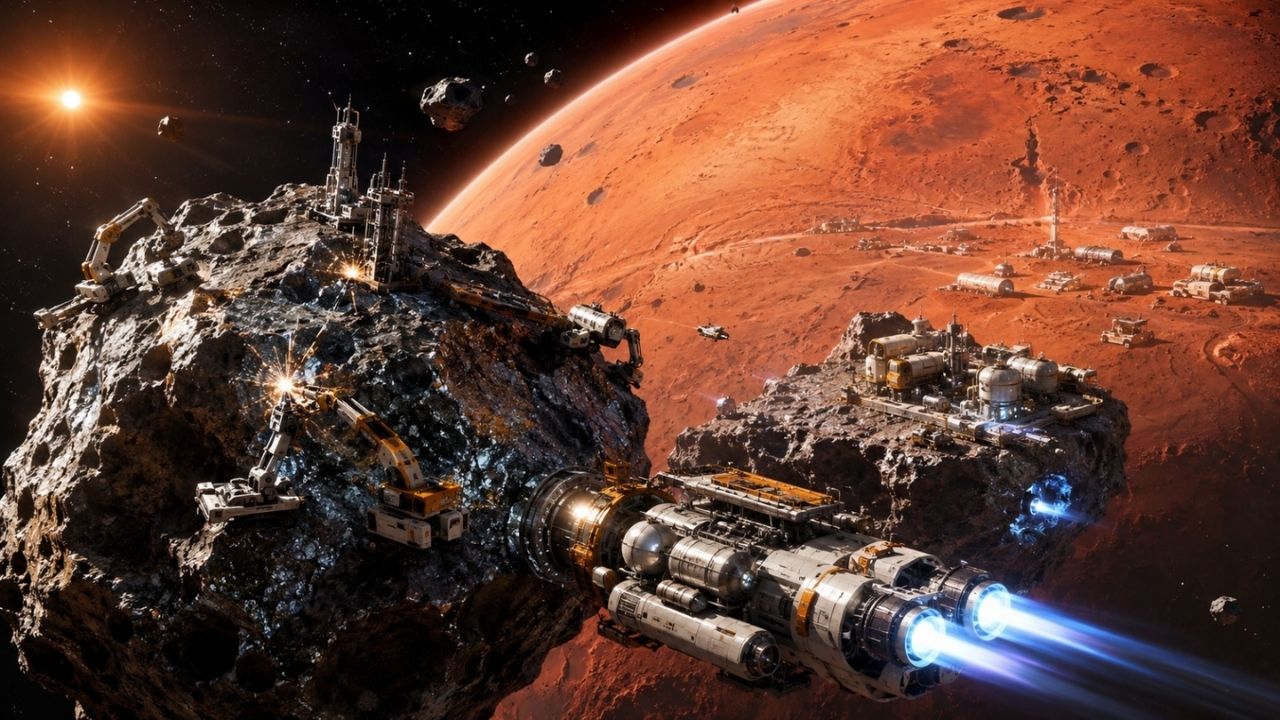
Mars appears as a possible destination, but the construction of a base would require metals from asteroids, refueling on water and hydrocarbon-rich bodies, rare orbital windows, and slow travel, according to a proposal that shows how space colonization would depend on fuel, patience, technology, and entire generations away from Earth in the future.
Mars still seems distant as a human address, but researchers are already discussing a practical obstacle even before the first base is built: where would the materials to construct structures far from Earth come from? A proposal led by aerospace engineer Serena Suriano, published on April 20, 2026, points to a bold possibility: sourcing metals from asteroids near the Red Planet.
The idea is not simply to travel to a space rock, mine material, and return. The challenge involves fuel, orbital maneuvers, rare launch windows, and logistics so slow that building a Martian base could span entire generations before becoming a reality.
Mars depends on materials that may not be on the planet itself
Before imagining cities, laboratories, or permanent shelters on Mars, there is a basic question: how to bring or obtain everything necessary for construction? Transporting large volumes directly from Earth would increase the complexity of missions and make any plan even more difficult.
-
Rotterdam Develops Floodable Square to Absorb Nearly 2 Million Liters of Rainwater, Doubling as Sports, Theater, and Leisure Space When Dry to Combat Urban Flooding

-
U.S. National Park Deploys Robotic Birds Near Wyoming Airport to Protect Endangered Species: Dancing and Sound-Emitting Replicas Aim to Lure Real Birds to a 100-Acre Restored Area Away from Runways After 32 Aircraft-Related Deaths
-
Russia and India Lift 320-Ton Pressure Vessel into Kudankulam Nuclear Plant Reactor, Advancing Project That Has Already Prevented 112 Million Tons of CO2 Emissions

-
Brazilian Student Wins Global Science Fair in the U.S. with Sound Wave Method to Alter Alzheimer’s-Linked Genes


Therefore, the proposal considers an alternative path. Instead of relying solely on cargo sent from our planet, scientists are evaluating the use of metallic asteroids as a source of materials. Among the resources mentioned is molybdenum, a metal relevant for structural and technological applications.
Metallic asteroids enter the plan as a source of construction
The asteroid belt contains bodies rich in metals that could be explored to support future construction on Mars. This possibility transforms small space rocks into strategic pieces of a supply chain beyond Earth.
But the operation would not be simple. Going from Mars to an asteroid, extracting, and returning would require a precise sequence of orbital maneuvers. The central problem is not just the distance, but the amount of energy needed to change trajectory, reach the target, and return with useful cargo.
Fuel is the greatest limit of the mission

To test the feasibility of the idea, researchers worked with simulations based on a hypothetical spacecraft similar, but not identical, to SpaceX’s Starship. The considered model would weigh 120 tons, have the capacity to carry 115 tons of cargo, and space for up to 1,100 tons of fuel.
Even with these numbers, the limit appears quickly. The spacecraft would have a delta-v of 6.4 km/s, a measure used to represent the capacity for velocity change in space maneuvers. To reach certain metallic asteroids and return to Mars, between 10 and 12.8 km/s would be needed, beyond what the vehicle could deliver with chemical propulsion in this scenario.
Scientists propose using asteroids as fuel stations

The proposed solution involves a route with two stops. First, the spacecraft would go to a metallic asteroid to obtain materials. Then, on the way back, it would make a second stop at a type C asteroid, known for containing volatiles like water and hydrocarbons.
These resources could be used in the production of propellant on-site, a process called in situ propellant production. In practice, the type C asteroid would function as a space fuel station, allowing the spacecraft to complete the return trip to Mars within the 6.4 km/s limit.
Window from 2040 would have 22 possible combinations
According to the calculations presented, there are 22 pairs of metallic and type C asteroids within a 20-year window starting from 2040. This means that when the construction of bases on Mars is considered more viable, there would be more than twenty possible combinations between mining and refueling.
Even so, the scale remains modest. The estimate is that about 200 tons of metal could be obtained in this interval. For an entire base, this volume would not solve everything, but it would help reduce the dependence on materials transported directly from Earth.
Building a Martian base would be an extremely slow process
The biggest shock of the proposal is the pace. On-site fuel production would occur at a rate of only 2 kg per day. Completely filling the tank would take approximately 1,500 years, an impossible timeframe for any practical space exploration operation.
Therefore, the plan considers working with a partially filled tank and adjusting the transported load. The logic makes it clear that colonizing Mars does not only depend on getting there, but on setting up a logistical chain outside Earth, respecting physical, orbital, and technological limits.
Orbits need to align for each trip
Another obstacle is orbital alignment. The positions of Mars and the asteroids need to be favorable for the trips to happen. This reduces the number of opportunities and makes each mission dependent on specific windows over the years.
In practice, it would not be possible to make trips when convenient. The construction of a Martian base would have to follow the pace imposed by the movement of bodies in space, which helps explain why a permanent installation could take so long to grow.
Solar or nuclear propulsion could shorten the path
The researchers also recognize that other forms of propulsion could facilitate the process. Solar or nuclear systems, for example, could make metal extraction on asteroids more efficient and perhaps reduce mission times.
Even so, the calculations were made based on technology considered viable today: chemical propulsion. This makes the proposal more conservative and shows that, with current means, building on Mars would still be a very long, expensive, and full of limitations process.
The idea of using asteroids to build on Mars shows that space colonization will not just be a matter of powerful rockets or prepared astronauts. It will depend on mining outside Earth, refueling in space, precise orbital calculations, and a lot of patience.
The plan seems distant, but raises an important discussion: is it worth investing in a Martian base that might take generations to build, or should humanity focus its efforts first on closer missions, such as the Moon? Leave your opinion in the comments.




Be the first to react!