






 Portuguese
  Spanish


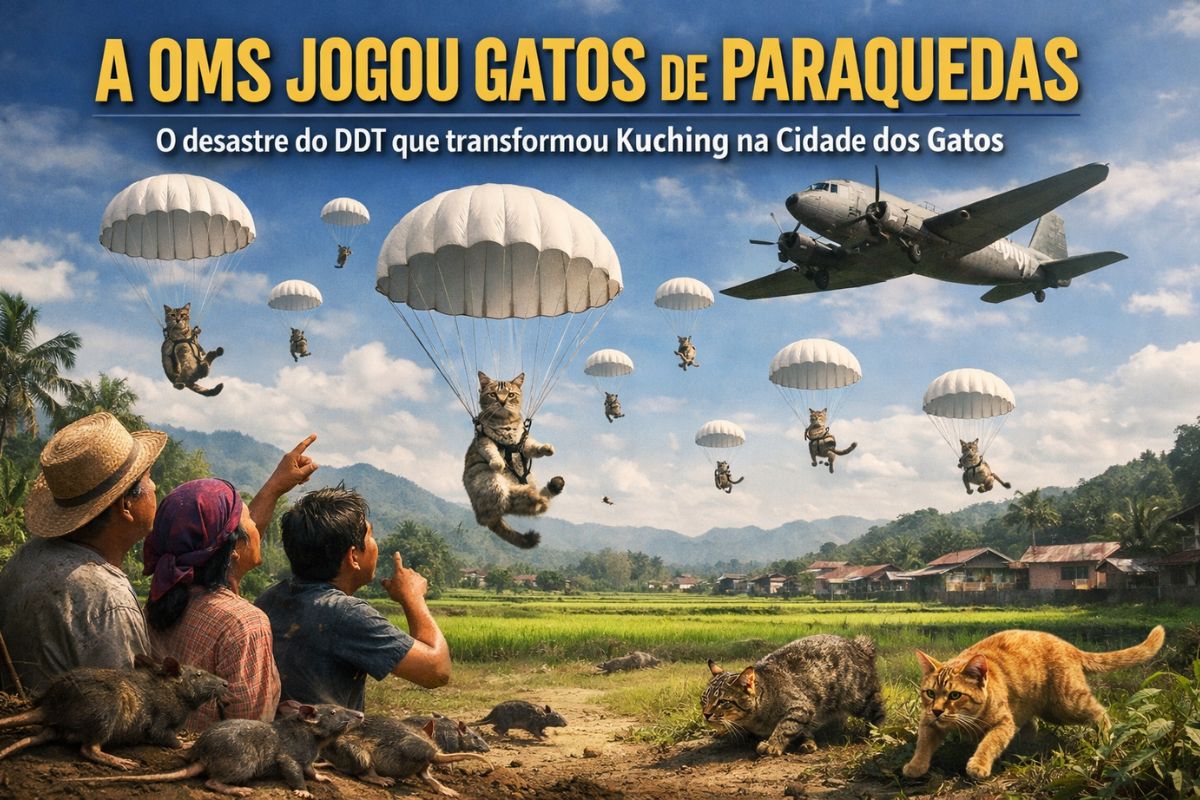


In The City of Cats in Malaysia, The WHO Used DDT Against Malaria, Created an Ecological Disaster and Needed Parachute Cats to Control Rats.
In the heart of the Malaysian jungle, the city of Kuching became known as the City of Cats, a place where felines appear in statues, museums, coins, and even festivals. For many residents, cats are not just pets, but symbols of protection that deserve absolute respect. Few people imagine that this devotion also carries the mark of one of the strangest episodes in public health history.
It was there, around the famous city of cats and the neighboring regions of Borneo, that a World Health Organization campaign against malaria ended in an ecological disaster. In trying to kill mosquitoes with DDT, humanity killed cats, gave way to a rat explosion, and needed to drop cats from parachutes to fix the problem it had created.
The City of Cats Turned Stage of a War Against Malaria
Kuching, the so-called city of cats, is today one of the most modern urban centers in Malaysia, by the Sarawak River. Tourists arrive expecting to see cats everywhere, and it’s no exaggeration: there’s a cat museum, cat festival, giant cat statues, themed cafes, and even coins with felines printed on them. In local culture, mistreating a cat is seen almost as a sacred offense.
-
China Surpasses U.S. and Russia Combined in Submarine Production

-
Xiaomi Unveils Smart Glasses in Brazil with 12MP Camera, 4K Video, and AI Features, Challenging Ray-Ban Meta

-
Volkswagen Unveils Bold Strategy to Compete with Chinese Automakers in Brazil, Featuring 5,000 Parts, 76% Localization, and a Surprising Turnaround
-
Three Teens Win Global Prize for Low-Cost AI Microscope Diagnosing Malaria Species in Seconds for Remote Villages


Behind this devotion is a curious hypothesis: it would be linked to a public health campaign that forever changed the relationship between the people and the felines. In the mid-20th century, malaria infected hundreds of millions of people and killed millions of lives each year, more than many wars.
The WHO decided it was time to eradicate the disease globally and chose areas of the then British colony in Malaysia, near the city of cats, as a laboratory for an audacious experiment.
When DDT Seemed a Scientific Miracle


Before the era of DDT, mosquito control was done with primitive methods, like arsenic-based compounds or kerosene dumped into ponds and swamps.
The results were fragile and dangerous. Everything changed when Swiss chemist Paul Müller discovered DDT, an insecticide capable of killing mosquitoes at very low concentrations, earning him the Nobel Prize.
After World War II, DDT became a symbol of scientific progress. It was cheap, easy to produce, and seemed harmless to humans.
In 1955, the WHO launched a global malaria eradication campaign. Soldiers and health teams began to spray DDT everywhere: walls, thatched roofs, beds, and longhouses that housed dozens of families.
Initially, the results seemed spectacular. In less than two years, the rate of infected mosquitoes plummeted, and the city of cats and other nearby communities breathed a sigh of relief. However, the apparent success hid an ecological cost that would soon come to light.
The Domino Effect: Destroyed Roofs, Dead Cats, and Rats Everywhere
Over time, mosquitoes began to develop resistance to DDT. Control teams increased the dosage, and in some places, started using even more toxic products. Gradually, side effects appeared in unexpected places.
First, moths and their eggs took over the grass fields, destroying thatched roofs that used to last for years. The wasps that controlled these pests had been decimated by DDT. Residents began to complain: not only were there still mosquitoes, but now the roofs also rotted.
Soon after came a much more worrying sign: cats began to die en masse in Borneo and other countries where DDT was excessively sprayed.
The poison permeated walls, floors, and also the fur of animals. And cats, as we know, spend a lot of time grooming themselves.
By ingesting small doses of DDT accumulated in their bodies, many exhibited convulsions, paralysis, and death. With fewer cats, what seemed like a mere domestic detail turned into a public health crisis.
Rats, the natural enemies of felines, took over the villages. Bags of rice were torn apart, stocks were destroyed, and diseases like typhus and plague returned to scare the population.
In a few months, communities that feared malaria began to dread rodents. Not surprisingly, the teams spraying DDT gained the ironic nickname of “cat killers.”
The Bizarre Operation That Dropped Cats From Parachutes

When outbreaks of typhus and bubonic plague began to explode in Borneo, the WHO realized it had gone too far. It was necessary to quickly restore the ecological balance destroyed by the pesticides. And the solution found seems straight out of a movie: drop cats from parachutes over the villages.
In the early 1960s, the WHO, in partnership with the British Air Force, organized the so-called “Operation Cat Drop.” About 23 pregnant cats were collected from coastal towns in Sarawak, many of which were connected to the city of cats. They were native felines, adapted to the humid climate, agile in hunting rats, and considered perfect “biological warriors.”
The cats were placed in bamboo baskets, lined with straw, attached to small white parachutes. On one of the flights, a large transport plane took off carrying tons of humanitarian aid and about two dozen paratrooper cats.
During the journey, the aircraft faced a storm, made an emergency landing, and the crew themselves had to calm the animals before the drop.
When the sky cleared, the plane flew over the plateau of Bario, an isolated area without roads. At 11:15 AM, the parachutes opened.
Residents watched in astonishment as cats literally fell from the sky, softly landing on rice fields and open areas. Official reports record that all landed without injury, and the villagers rushed to welcome them as if they were a gift from fate.
On the same day, local newspapers featured headlines calling for “flying cats” to expel rats. In Kuching, the city of cats, the population felt proud to know that their animals had been sent as air reinforcements to save other communities.
When Flying Cats Defeat Rats

The most surprising thing is that the idea worked. About a month after the operation, the density of rats plummeted in the villages. The felines began to hunt intensively, rice stocks stopped being destroyed, and cases of typhus virtually disappeared.
The “paratrooper cats” became local legend. Within a year, the feline population of the region had multiplied and established itself as a permanent part of the ecosystem. Reports indicate that the presence of cats reduced rodent numbers by over 90% in some critical areas.
Not coincidentally, this story helped further solidify the imagery surrounding the city of cats. For many people, felines ceased to be mere symbols of luck and became practical heroes, capable of saving crops and human lives.
Experiments, Failures, and Improbable Four-Legged Heroes
The operation to drop cats in Bario did not remain isolated. Other smaller experiments were tested in Malaysia during the 1950s and 1960s.
In some military bases, a single cat dropped from low altitude began to control rats that were destroying rations and electrical wires, earning affectionate nicknames among the soldiers.
Not all attempts had a happy ending. In one case, cats brought in to face giant rats in rice warehouses ended up being killed by the very rodents within a few days.
In other regions, there was even consideration of using pythons as biological control, which brought another problem: the snakes also attacked chickens and domestic animals.
Despite these setbacks, some stories stand out, like that of a cat taken by helicopter with kittens to another village, which in a few weeks eliminated hundreds of rats and saved the local supplies.
These episodes reinforced the idea that, in many cases, nature offers more efficient solutions than any heavy chemistry.
The Ecological Lessons of the City of Cats for the 21st Century
By the end of the 1960s, the white parachutes stopped crossing the skies of Borneo. Roads were opened, new pest control technologies emerged, and DDT began to be banned in various countries after reports of its effects on birds, mammals, and even human health.
However, the story of the operation with cats was not forgotten. It began to be featured in environmental educational materials as a classic case of cascading effect: a pesticide designed to kill mosquitoes ends up destroying natural predators, opening space for even worse pests, and forcing governments to resort to improbable solutions to restore balance.
In practice, what the city of cats helps to show is both simple and profound. Every abrupt intervention in complex ecosystems has a later cost. When we underestimate the relationships between species and ignore natural cycles, we end up creating problems we don’t know how to solve.
Today, the world is once again investing in high-impact technologies, such as modified insects, radical biological controls, and new chemistries.
The memory of the city of cats and the operation of launching cats from parachutes serves as a silent warning: what seems like a quick solution can often become a new trap.
And you, after learning the story of the city of cats and the felines dropped from parachutes, do you think we are really learning from these mistakes or just preparing the next ecological disaster in another part of the world?


