Portuguese
  Spanish


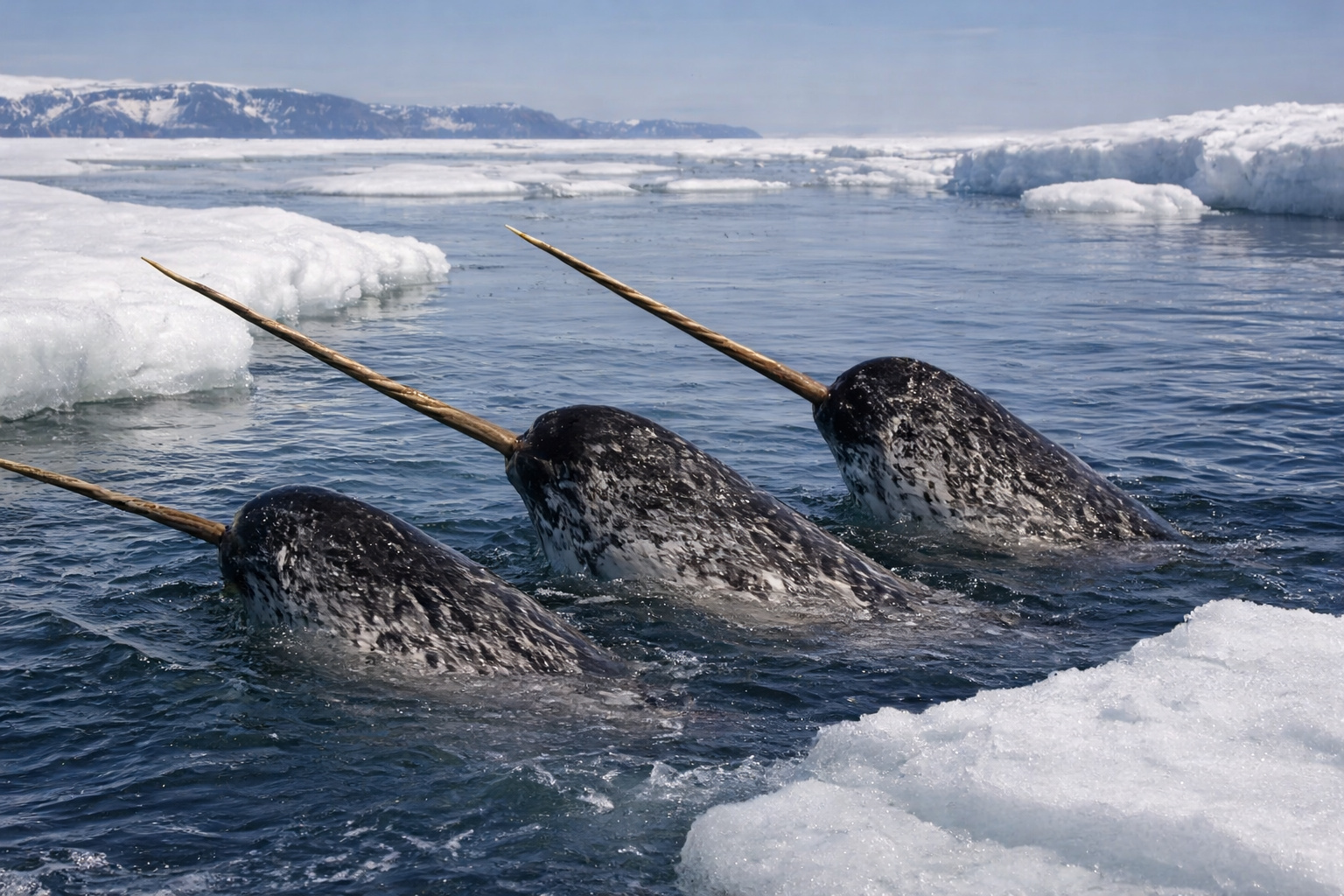


With a Canine of Up to 3 Meters Filled with Nerves, the Narwhal Uses Its “Tooth” as a Sensory Organ to Map the Arctic Ocean.
The narwhal (Monodon monoceros) has always seemed like a nearly mythical creature: a cetacean that looks like a gray dolphin, but with a spiral “horn” protruding from its head — a feature that has fueled legends of “sea unicorns” for centuries and fueled the trade of rare artifacts in medieval Europe. Modern science, however, has dismantled the mystery and revealed something even more fascinating: the “horn” is not a horn, but rather a canine tooth that grows spirally out of the maxilla, can exceed 2.7–3.0 meters in length, and functions as a hyperspecialized sensory organ.
What the Narwhal Has Is Not a Common Tooth, But a Sophisticated Biological Sensor
Research led by Dr. Martin Nweeia (Harvard School of Dental Medicine) has shown that the spiral canine has millions of nerve endings exposed through micropores, allowing the narwhal to detect salinity, temperature, pressure, and even chemical composition of the water. In other words, the animal uses the tooth as a sensory interface with the environment, something that does not exist in any other known mammal.


The canine is not covered by external enamel — like our teeth — and therefore has sensitive surfaces that function as a detector, sending signals to the brain. This arrangement is essential in icy and variable seas, where identifying microgradients can mean finding migration routes, schools of fish, and gaps between ice plates.
-
Farewell to Toilet Paper? New Technology Sparks Debate on Bathroom Habits

-
Young Entrepreneur Who Started Recycling Bottles at Age 3 Becomes Environmental Icon in the U.S.

-
Nivea Blue Tin Cream: Popular Post-Beach and Pool, But Pharmacist Warns About Missing Ingredients and Common Summer Mistakes Regarding UVA and UVB Protection.
-
Archaeologists Recover Colossal Structure Lost for Over 1,600 Years Under the Sea, Including 22 Monumental Blocks Weighing Up to 80 Tons, Intriguing Experts.




A Sensor to Navigate Under the Ice, Hunt, and Survive
The narwhal primarily lives in Arctic areas such as Greenland, Canada, and Russia, where environmental conditions change rapidly. There, cetaceans need to navigate under ice fields, seek openings to breathe, and track fish stocks like Arctic cod.
The researchers’ hypothesis is that the canine functions as a “chemical radar,” allowing the animal to:
- Register sharp changes in salinity (indicating melted ice or entry of fresh water)
- Detect cold fronts that move fish and krill
- Identify regions of water mixing (which concentrate food)
Nweeia’s study and colleagues showed that the tooth responds to changes in salinity, producing measurable nerve pulse variations, confirming its sensory function.
Why Do Only Males Have This “Sensor”?
The sensory canine appears in about 85% of males and more rarely in females, which raises an ancient scientific debate: whether the tooth evolved for sensory or sexual functions (display, competition, or mate selection). Some researchers argue that it may serve a dual purpose: communication, demonstration of biological fitness, and environmental sensitivity.
There are rare records of “bident” individuals, with two canines, which reinforces the idea that they are teeth and not external cranial structures.
How the Narwhal Became an Arctic Enigma
Unlike other cold-water cetaceans, the narwhal is very difficult to study:
- Lives in remote and frozen regions
- Spends long periods submerged
- Dives to depths of 800–1,500 meters
- Avoids contact with vessels
Therefore, much of what we know is recent — the result of scientific expeditions with drones, satellite sensors, and magnetic resonance applied to the study of the tooth.
The Impact of Climate Change on the “Sea Unicorn”
The accelerated melting of Arctic ice affects migratory routes and prey availability. Since the narwhal is a highly specialized animal in polar ecosystems, scientists consider the species a sensitive biological indicator for ocean changes.
Organizations like WWF and Fisheries and Oceans Canada monitor narwhal populations and warn of the advance of vessels, underwater noise, and temperature changes.
A Mystery That Has Not Ended
The narwhal remains one of the most enigmatic mammals in the Arctic. Despite significant advances, there are still unanswered questions:
- How does the brain integrate signals from the canine with navigation?
- Does the sensor help in direct hunting or merely in locating ideal habitats?
- What is the exact function in social interactions among males?
The truth is that, contrary to the medieval myth, the “sea unicorn” is not magical — it is scientific, evolutionary, and technically extraordinary. And precisely because of this, it is even more fascinating.