






 Portuguese
  Spanish


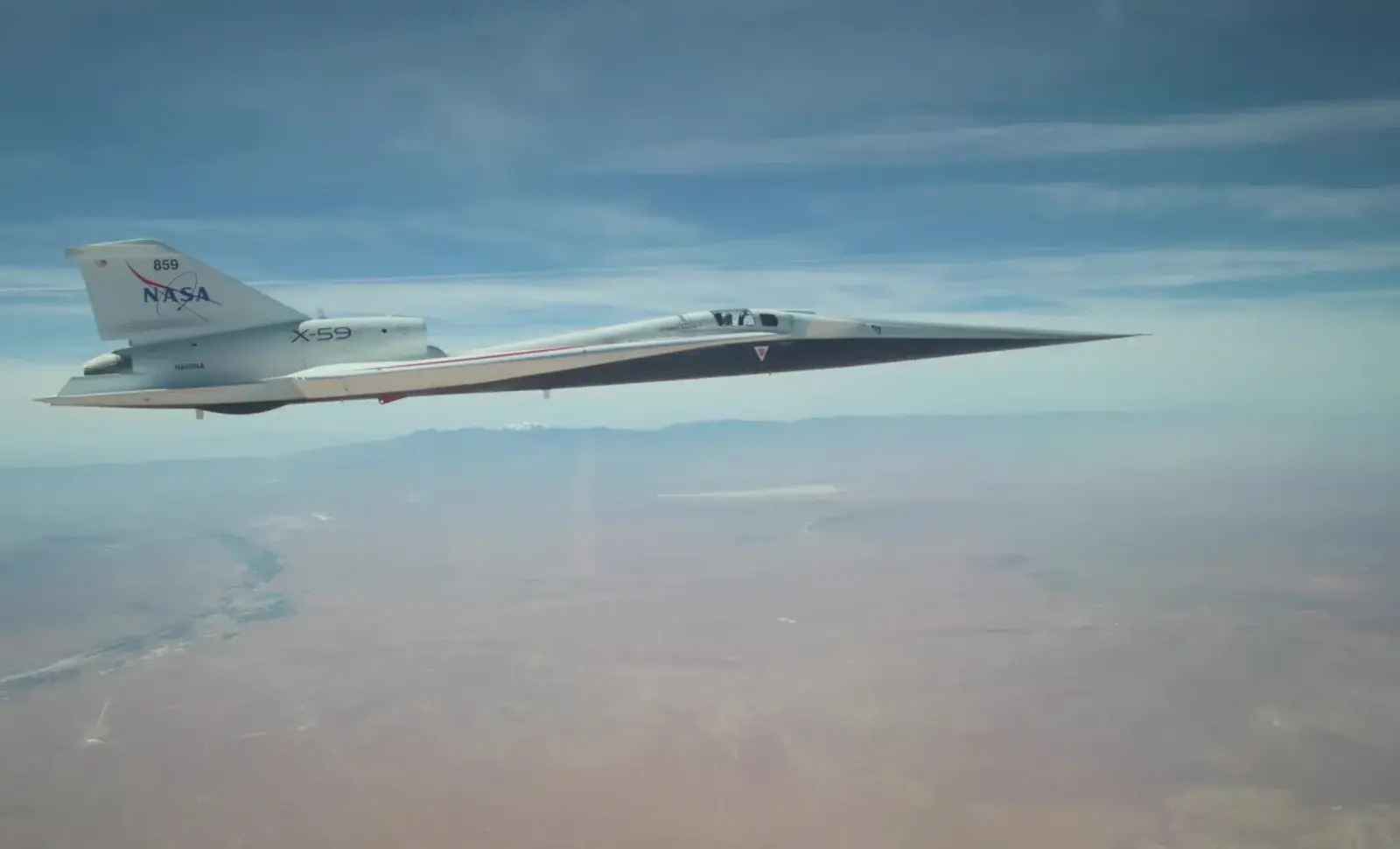
In testing in the Mojave Desert, NASA’s X-59 reached 6,096 meters and 740 km/h, reinforcing the bet on silent supersonic flights over land
NASA’s X-59 completed a test flight on April 3, 2026, without taking off in the Mojave Desert, California, reaching 6,096 meters and 740 km/h, marking a step forward in making silent supersonic flight viable over land.
X-59 advances in decisive testing
The flight of the X-59 marked a central step in the Quest mission, a NASA initiative focused on developing a supersonic jet capable of reducing the impact of sonic booms in populated areas.
During the test, the aircraft flew over the Mojave Desert with its landing gear retracted. The operation was conducted by NASA test pilot Jim “Clue” Less.
-
Chile’s Plan for a 20,000 km Undersea Cable to Hong Kong Halted by U.S. Pressure, Highlighting the Silent Data Control Battle in Latin America

-
In Somaliland’s Desert, Greenhouse Uses Sun and Seawater to Grow Lettuce, Cucumbers, and Tomatoes Without Rain: 1-Hectare Project Cools Crops, Desalinates Water, and Converts Brine into Commercial Salt
-
Trump Unveils $400 Million Boeing 747 Donated by Qatar as Temporary Air Force One Amid Boeing Delays, Sparking Debate on National Security, Costs, and Foreign Influence
-
Chinese Company Unveils Robotic Toilet That Comes to You, Featuring Lidar Sensors, Voice Command, Bidet, Hot Air Drying, UV Light, and Self-Cleaning Waste Disposal



The completion of this flight reinforced the X-59’s preparation for new phases of testing and public demonstrations, as part of a campaign aimed at validating its aerodynamic performance.
How the supersonic jet was designed
The X-59 was developed to reduce the noise generated by traditional supersonic aircraft. Instead of a loud boom, the goal is to produce only a soft thump.
To achieve this, the supersonic jet features a long fuselage and a pointed nose. These elements help reduce the shock waves associated with sonic booms.
The shape of the aircraft was designed to minimize drag and improve flight performance. The aerodynamic structure aims to combine high speed with silent operation.
This set of solutions makes the X-59 a demonstration of how aerospace engineering is evolving to tackle the longstanding limits of supersonic air travel over land.
Quest mission aims to change current rules
The Quest mission aims to prove that commercial supersonic flights can occur without disturbing people on the ground. The X-59 is the centerpiece of this project.
Today, conventional supersonic jets face restrictions on flying over land due to noise impact. As a result, this type of travel has been limited to intercontinental routes or over oceans.
With the X-59, NASA intends to gather data on human reactions to silent sonic impacts. This information will be shared with regulatory bodies in the United States and other countries.
This data could support a review of current rules that prohibit supersonic flights over land. The proposal is to pave the way for faster operations without the noise of traditional models.
Expected impact on commercial aviation
The reduction of noise can change the way air transport operates. By allowing for a more discreet supersonic flight, the X-59 approaches the idea of faster travel in populated areas.
This could significantly reduce passenger travel time. The expectation presented is to make coast-to-coast trips possible in a few hours.
In addition to speed, the mission was presented as an attempt to build a more sustainable future for aviation, with less noise pollution and reduced need for long detours.
In this scenario, the supersonic jet would no longer depend solely on ocean routes or restricted areas, expanding the possibilities for regional commercial operations.
Upcoming Tests of the X-59
By April 10, 2026, the X-59 had completed eight test flights. The campaign will continue with new evaluations to expand the aircraft’s flight envelope.
These tests will measure the performance of the supersonic jet at different altitudes and speeds, as well as analyze its handling and stability during supersonic flight.
The next step will be the first flight over populated areas. At this stage, the aircraft should demonstrate to the public its ability to operate quietly.
This moment will be important for gathering feedback, validating the project’s potential, and strengthening NASA’s proposal to transform air transport with a faster and quieter model.
With information from Daily Galaxy.


-

1 person reacted to this.