Portuguese
  Spanish


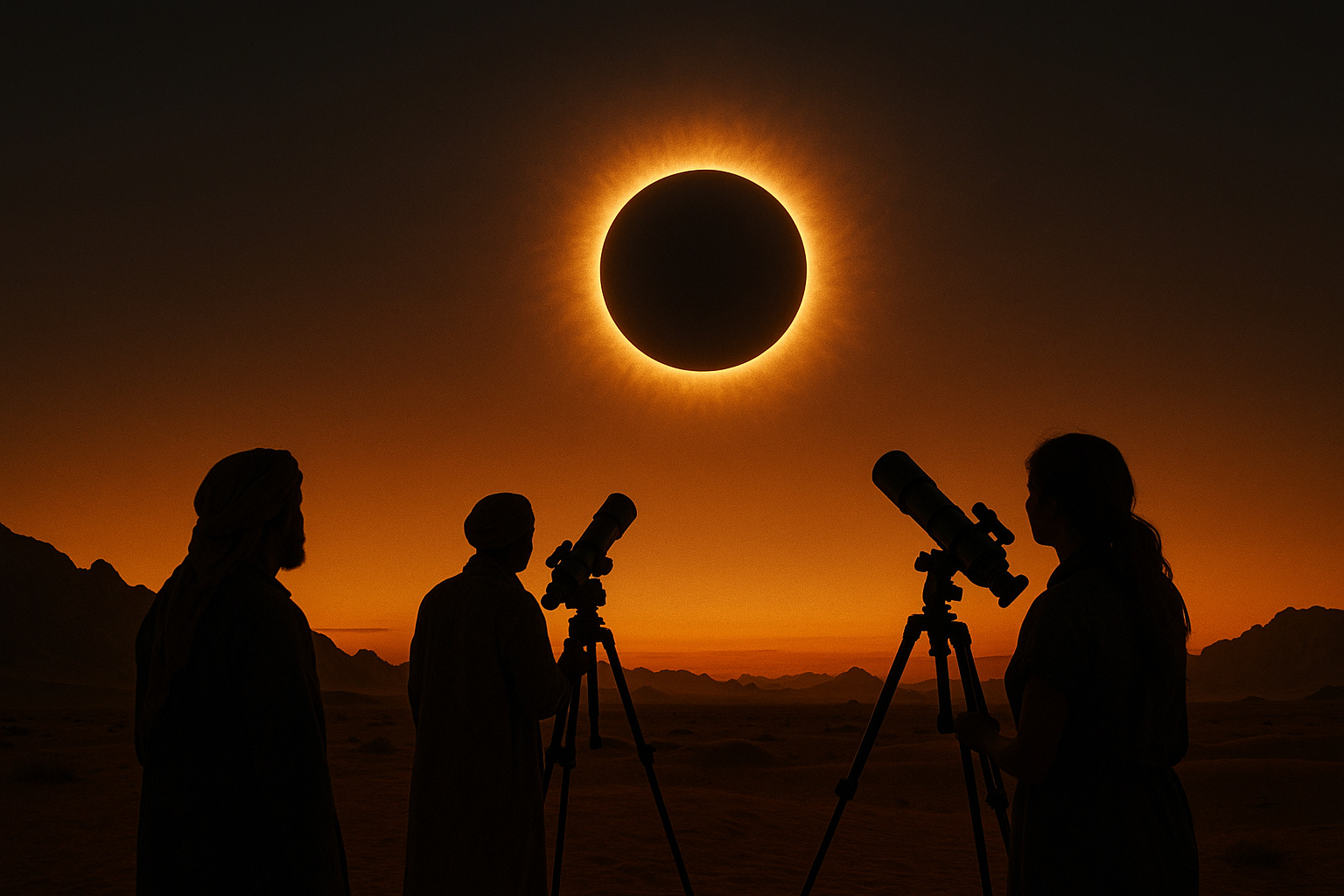


Unprecedented Astronomical Phenomenon Will Bring Minutes of Total Darkness and Can Be Observed in a Band of Ten Countries, According to NASA and Space Portal
The whole world is about to witness a rare and impressive celestial spectacle that promises to mark an entire generation. The NASA has confirmed that a unprecedented total solar eclipse will turn day into night for over six minutes, covering part of the planet in a deep and fascinating twilight.
Astronomers are already classifying it as the greatest solar eclipse of the 21st century, an event that exceeds all recent records and promises to mobilize researchers, tourists, and curious onlookers in search of the best view of this historical phenomenon. But what makes this eclipse so special — and where will it be possible to observe it with total clarity?
Where the Solar Eclipse Can Be Seen in Its Totality
Although several countries in Europe, Africa, and the South Asia can see the phenomenon partially, the totality phase, when the Moon completely covers the Sun, will only be visible within a narrow shadow band of about 258 kilometers wide, which will cross ten nations: Spain, Morocco, Algeria, Tunisia, Libya, Egypt, Sudan, Saudi Arabia, Yemen, and Somalia, according to the specialized site Eclipse Wise.
-
Rare Diamond Found in Brazil’s Mato Grosso Formed 800 Kilometers Deep, Holds Clues to Earth’s Water Transport

-
Smart Connectivity Transforms Daily Life: High-Speed Internet, 5G Mobility, and Seamless Service Control

-
World’s First Fully Robot-Operated Hotel to Begin Trials with Real Guests in 2026, Full Opening in China Set for 2027

-
Estonia Constructs Bunkers and Trenches on Russian Border to Strengthen NATO Defense and Signal Baltic Readiness


This band of darkness will extend over 15,227 kilometers across the Earth’s surface, covering an area of approximately 2.5 million square kilometers — equivalent to five times the territory of France. Still, it is a minimal fraction compared to the 510 million km² of the planet.
During these minutes of darkness, the sky will take on twilight hues, the temperature may drop, and the environment will take on a golden color, creating an almost mystical atmosphere. NASA emphasizes that for those observers within the totality zone, it will be possible to see the spectacular diamond ring and the delicate solar corona, phenomena that are impossible to see with the naked eye at other times.
The Longest Darkness of the 21st Century
According to the Space portal, this will be the “eclipse of the century” due to its unusual duration. The Moon will completely cover the Sun for 6 minutes and 22 seconds, making it the longest total solar eclipse over land in the 21st century.
For comparison, the eclipse on April 8, 2024, which crossed Mexico, the United States, and Canada, had a maximum duration of 4 minutes and 28 seconds, already considered remarkable. However, the new phenomenon will greatly surpass that mark, offering a unique opportunity for scientific observation of the solar corona, the outer layers of the Sun, and its magnetic fields.
The reason for this record duration is related to the Moon’s orbital position. During the event, the satellite will be at its perigee — the closest point to Earth — which will make it appear larger in the sky and increase the time that sunlight will remain blocked.

How a Total Solar Eclipse Occurs
According to NASA, a solar eclipse occurs when the Sun, the Moon, and the Earth align perfectly, causing the Moon’s shadow to block some or all of the sunlight in certain regions of the planet. This alignment occurs only during specific periods known as eclipse seasons, which happen twice a year.
During the phenomenon, the Earth’s atmosphere reacts impressively: the sky darkens, stars become visible, and even the behavior of birds and animals changes in response to the sudden absence of light. For astronomers, it is a crucial moment to study the outer layers of the Sun and the effects of solar radiation on Earth.
As highlighted by the newspaper O Globo, the event will include international scientific expeditions, high-precision equipment, and live broadcasts worldwide, allowing millions of people to witness the spectacle even from a distance.
A Natural Spectacle With a Set Time
Phenomena like this happen only a few times in a century and evoke the same fascination since ancient civilizations. Egyptian, Mayan, and Greek peoples viewed the eclipse as a message from the gods — today, it is seen as a masterpiece of celestial mechanics and one of the most beautiful coincidences of the cosmos.
But after all, when will this spectacle occur? The answer is near: the greatest solar eclipse of the century will happen on August 2, 2027, a date when dozens of countries will be plunged into a temporary night lasting over six minutes.
The totality band, especially over regions of Egypt and Saudi Arabia, promises to offer the best visibility conditions. Thousands of tourists and scientists are already planning their trips to witness the moment when the Sun completely disappears behind the Moon — an event that will not happen again on a similar scale until the 22nd century.