Portuguese
  Spanish


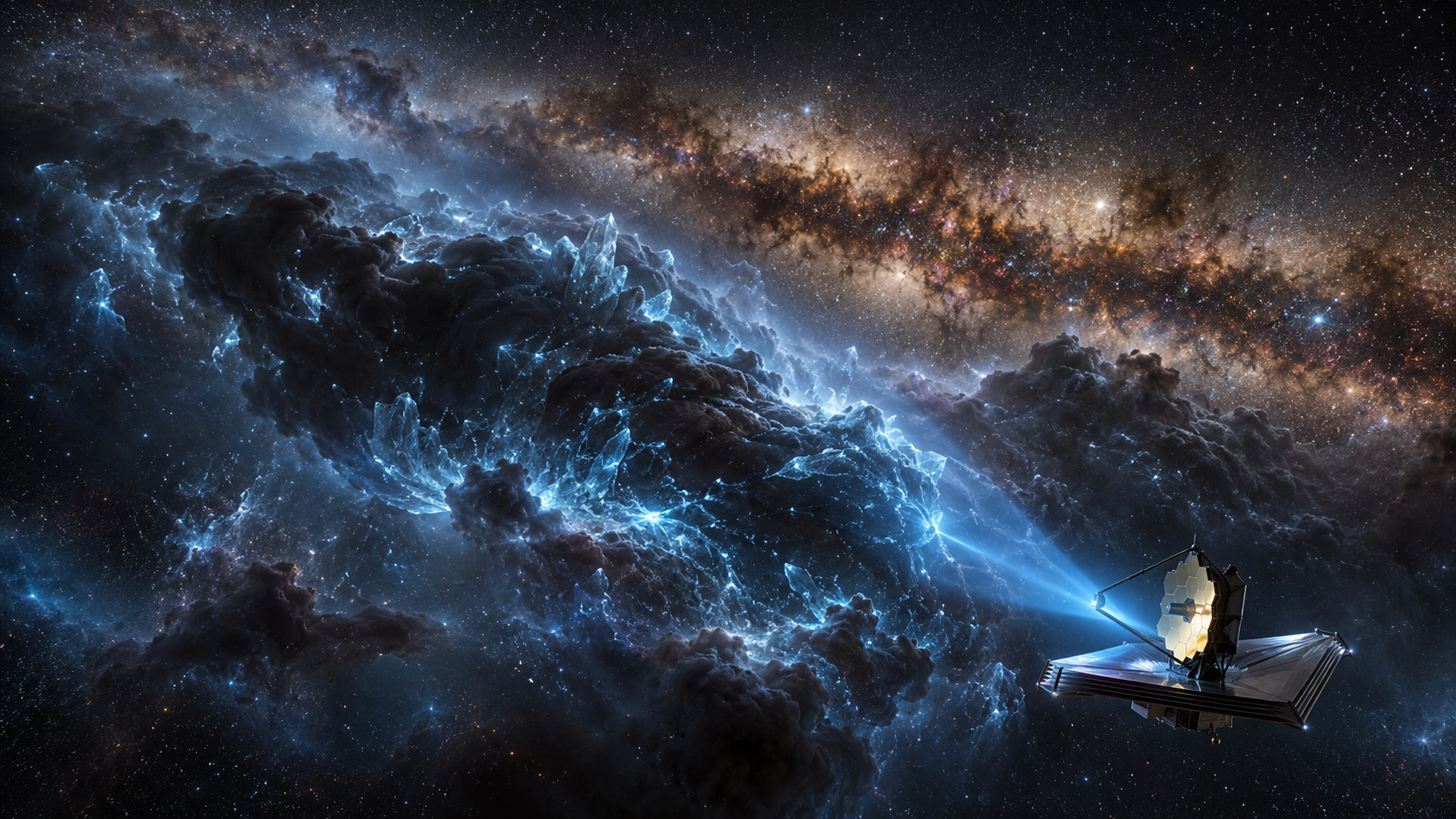


NASA identifies enormous frozen regions in the Milky Way with water and gases trapped in clouds that can give rise to stars and planets.
On April 15, 2026, NASA scientists released images and analyses of gigantic frozen structures scattered throughout the Milky Way that began to be informally called “interstellar glaciers.” The data was obtained by the SPHEREx space telescope, created to map the sky in infrared and identify chemical compounds invisible to traditional optical telescopes.
Observations revealed enormous concentrations of water ice, carbon dioxide, and carbon monoxide trapped in microscopic cosmic dust particles within the Cygnus X star-forming region, a gigantic structure located about 4,500 light-years from Earth. According to NASA’s Jet Propulsion Laboratory, these frozen clouds spread for hundreds of light-years and may represent one of the largest known reserves of raw material for the formation of stars and planets.
SPHEREx can see invisible ice hidden in Milky Way clouds
Unlike traditional optical telescopes, SPHEREx was designed to observe the Universe in infrared wavelengths, allowing it to detect chemical signatures invisible to human eyes.
-
16-Year-Old from Brazil’s Sertão Wins Young Scientist Award for AI Predicting Rainfall with 94.5% Accuracy to Aid Farmers

-
Netherlands Reports First Child Euthanasia Case Since Rule Expansion for Minors

-
Brazilian Innovator Survives Homemade Submarine Dive in Paraty Despite Hatch Leak and False Oxygen Alarm
-
China Develops Custom 140-Ton Electric Mining Truck with 770 kWh Swappable Battery, Deploys 290 Units in Xinjiang’s Largest Zinc Mine



This is essential because many regions of the galaxy are covered by dense dust that blocks visible light.


By analyzing how infrared radiation passes through these clouds, scientists can identify frozen molecules adhering to microscopic interstellar dust particles.
It was precisely this capability that allowed SPHEREx to map large quantities of frozen water, carbon dioxide, and carbon monoxide scattered throughout the interior of the Milky Way.
“Interstellar glaciers” extend for hundreds of light-years within the galaxy
Although the term “glacier” is merely a visual and conceptual comparison, the structures found truly involve enormous concentrations of frozen material.
The clouds observed in the Cygnus X region span hundreds of light-years, a scale so gigantic that it vastly exceeds the size of the Solar System.
For comparison, a single light-year is equivalent to about 9.46 trillion kilometers. This means that these frozen regions occupy distances practically impossible to imagine on a human scale, functioning as enormous chemical reservoirs within the galaxy.
Frozen water and gases trapped in dust can form stars and planets
The compounds found by SPHEREx are not frozen as solid blocks floating in space. They appear adhered to microscopic particles of extremely cold cosmic dust.

Over time, these clouds can gravitationally collapse, forming young stars surrounded by disks of gas and dust. It is precisely within these disks that planets begin to emerge.
This transforms these “interstellar glaciers” into true cosmic nurseries, containing fundamental ingredients for future planetary systems.
The presence of frozen water also draws attention because this compound is considered essential for many chemical processes linked to planetary formation.
Cygnus X region is among the most active star-forming areas in the Milky Way
The area analyzed by SPHEREx is in Cygnus X, one of the most intense star-forming regions in the galaxy.
The site harbors giant stars, massive molecular clouds, and intense gravitational activity. This environment produces radiation, shocks, and turbulence capable of constantly altering the chemical composition of interstellar clouds.
Even so, extremely cold parts manage to survive protected from the most intense radiation, allowing the formation of ice on a gigantic scale.
These cold regions function as chemical reservoirs preserved within an extremely energetic environment.
Frozen carbon monoxide and carbon dioxide help scientists understand deep space chemistry
In addition to water, SPHEREx identified large quantities of frozen carbon monoxide and carbon dioxide.
These molecules are important because they help astronomers track the temperature, density, and chemical evolution of interstellar clouds.

At extremely low temperatures, gases can adhere to the surface of cosmic dust and remain frozen for millions of years.
The study of these molecules helps scientists reconstruct chemical processes that occurred even before the birth of stars and planets.
Telescope was created to produce a gigantic chemical map of the sky
SPHEREx was not developed just to observe specific regions of the Milky Way. The mission aims to create a huge spectral map of the sky, recording chemical signatures from hundreds of millions of galaxies and cosmic objects.
This will allow the study of everything from star formation to the large-scale evolution of the Universe. In the case of interstellar glaciers, the telescope shows how materials essential for life can exist scattered throughout the galaxy long before the formation of planets.
The mission expands the idea that water and complex chemical compounds may be much more common in the Universe than imagined decades ago.
Cosmic dust functions as a “chemical surface” in space
One of the most interesting points of the discovery is the role of interstellar dust. These microscopic particles function as surfaces where molecules can form, freeze, and chemically interact.
Without this dust, many complex compounds would likely not easily arise in deep space. This means that an important part of the Universe’s chemistry literally happens on microscopic grains floating between the stars.
Discovery reinforces that the Milky Way is much more dynamic than it seems
To observers on Earth, the Milky Way may seem like just a static luminous band in the night sky. In practice, however, the galaxy is an extremely dynamic environment, full of giant clouds, frozen regions, stellar explosions, and the continuous formation of new systems.
The interstellar glaciers revealed by SPHEREx reinforce this complexity, showing that enormous quantities of chemical material continue to circulate and evolve within the galaxy.
Part of the water present in future planets may have spent millions of years frozen in clouds like these before the birth of a star.
Mission can help scientists understand the chemical origin of the Solar System
Researchers believe that similar structures may have existed before the formation of the Solar System about 4.6 billion years ago.
This means that part of Earth’s water and other chemical compounds in our planetary system may have originated in frozen interstellar clouds similar to those observed now.
SPHEREx can help reconstruct this primordial chemical history, bringing scientists closer to answers about how fundamental ingredients for habitable planets emerged in the cosmos.
Given discoveries like this, do you believe the Milky Way still hides gigantic chemical regions completely unknown to science, or have modern telescopes already begun to reveal most of these invisible structures?