






 Portuguese
  Spanish


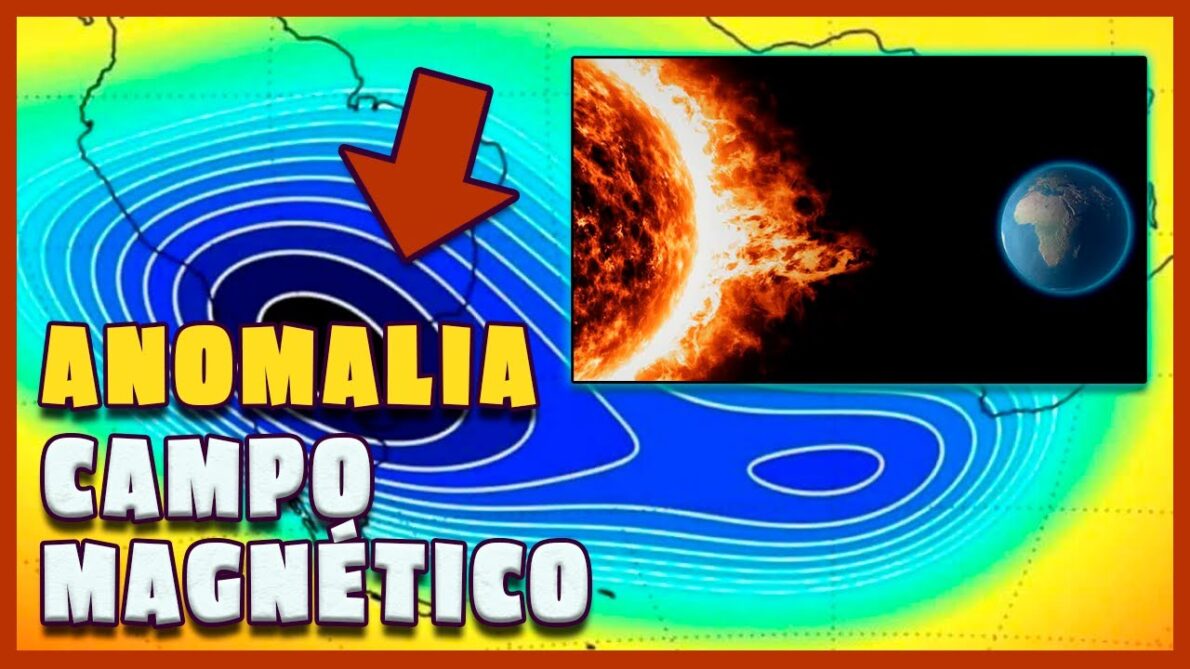


NASA Reveals Anomaly Weakening Earth’s Magnetic Field. Discover The Associated Dangers And Main Concerns Of Scientists.
A magnetic anomaly is causing great concern in the South Atlantic region, where Earth’s magnetic field is abnormally weakened. This phenomenon is interfering with the operation of artificial satellites and impacting intercontinental flights crossing the area. Originating from Africa and now extending into South America, this anomaly has caught the attention of NASA scientists, who are closely monitoring potential risks and long-term effects. In this article, we will explore the details of this magnetic disturbance and what it means for the future of technology and aviation.
What Is Earth’s Magnetic Field?
NASA scientists have discovered that the anomaly, which leaves the magnetic field weakened, is recurrent, possibly originating from Africa, and caused by variations in thermal flow within the Earth. The results of the work are presented in an article in the journal Proceedings of the National Academy of Sciences (PNAS), published in the United States on December 10.
The Earth’s magnetic field is similar to that of a bar magnet, centered within the planet.
-
China Develops Custom 140-Ton Electric Mining Truck with 770 kWh Swappable Battery, Deploys 290 Units in Xinjiang’s Largest Zinc Mine

-
Meta to Launch Arena, a New Prediction App Targeting 3.56 Billion Users, Competing with Polymarket and Kalshi

-
Scientist Challenges Famous Human Evolution Theory, Argues Homo Sapiens Evolved Gradually Over Thousands of Years
-
15-Year-Old American Builds Ocean Generator with PVC Pipe and 3D-Printed Propeller for $12, Wins National Prize, Presents at White House, and Makes Forbes 30 Under 30 List






It is generated in the outer core, from the slow movement of an iron-rich metallic alloy in a liquid state. According to Professor Ricardo Trindade from IAG (Institute of Astronomy, Geophysics, and Atmospheric Sciences at USP), the anomaly of the weakened magnetic field occupies a significant part of the southern Atlantic and South America, being the most important currently recorded. This was stated by the researcher who coordinated the study, along with doctoral student Plinio Jaqueto.
Trindade also emphasized that the anomaly discovered by NASA is the main cause of space risks. According to him, the weakened magnetic field facilitates the entry of charged particles from solar wind into Earth, increasing the risk of accidents involving artificial satellites in orbit, as well as space and intercontinental flights.
The Objective Of NASA Scientists’ Work
According to the specialist, the work aimed to answer three major questions: when the anomaly emerged, what its cause is, and whether it occurs recurrently over thousands of years.
In 2015, American researcher John Tarduno hypothesized that the phenomenon might have arisen due to a thermal anomaly at the interface between Earth’s mantle and core, which caused a greater magnetic flow.
According to the professor, studies with burnt soils in Africa showed that during certain periods, very rapid variations of the magnetic field occurred. He stated that to study the phenomenon affecting Earth’s magnetic field in South America, there was a challenge due to the lack of data, as there are no records on the continent prior to the arrival of Europeans in the 16th century.
In search of a deeper understanding of the topic, researchers from IAG analyzed the magnetism of a rock collected in Pau D’Alho Cave, located in the state of Mato Grosso in the Central-West region.
How The Researchers Conducted Their Work
In their work, the specialists used a material that is seldom analyzed in other studies focusing on the evolution of Earth’s magnetic field: stalagmites. This type of rock forms in caves, growing from the bottom up.
The research utilized a stalagmite from the collection of the Institute of Geosciences (IGC) at USP, in collaboration with Professor Francisco Cruz’s group. It formed 1,500 years ago in Pau D’Alho Cave, which is located in the municipality of Rosário Oeste, Mato Grosso, where it was collected.
At IGC, stalagmites are used in studies of paleoclimatic variations, from which chemical measurements can reveal climate oscillations in South America over the last 500,000 years. In this work, the variation of the magnetic field was measured using a highly sensitive magnetometer, as the samples contain little magnetic material, according to the IAG professor.







Curioso como essa anomalia só afeta o país no que se refere a raios nocivos do Sol, e não no clima. O clima, só é afetado por “ação do homem”, nunca por razões naturais.