






 Portuguese
  Spanish


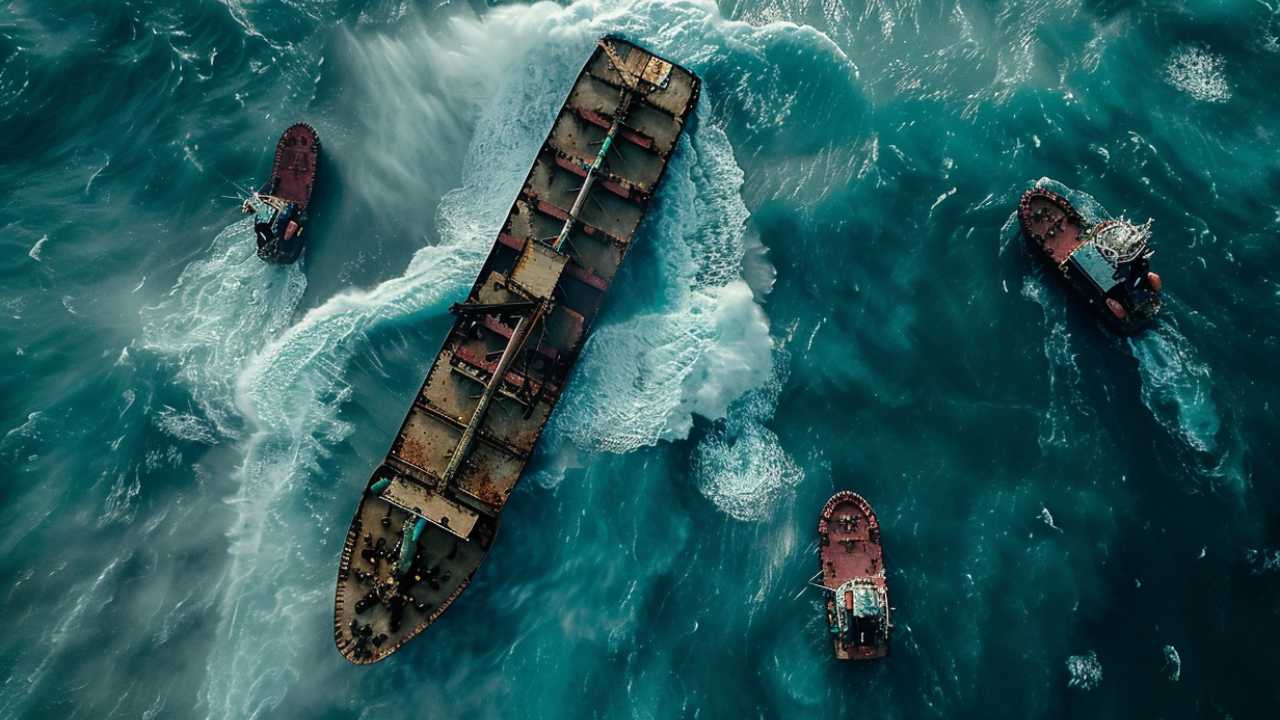


The Transportation of Rice and Other Grains by Ships Presents Unique Stability Challenges Due to the Reserve Angle Phenomenon, Where Load Shift Can Drastically Alter the Vessel’s Center of Gravity, Increasing the Risk of Capsizing or Sinking If Adequate Preventive Measures Are Not Taken.
The transportation of rice by ships may seem simple, but it hides a complexity that has already led to the loss of large vessels. When loaded in large quantities, grains, including rice, exhibit behavior that can compromise stability of the ships, especially in rough sea conditions. This risk arises from a concept known as the reserve angle.
The reserve angle is essentially the maximum angle at which a pile of grains can remain stable without sliding. In the context of a ship, when the vessel tilts beyond this critical angle during navigation, the rice can begin to slide inside the hold, altering the ship’s center of gravity and potentially leading to a dangerous tilt or even capsizing of the ship.
The Problem of Large Ships Is Not Exclusive to Rice; It Applies to All Types of Grains and Even to Iron Ore, Which Has Its Own Safety Angle
This problem is not exclusive to rice; it applies to all types of grains and even to iron ore, which has its own safety angle. The shifting of any solid load that behaves similarly can cause changes in the ship’s balance, making it susceptible to sinking or capsizing.
-
They exchanged the idea of a large house for a 35 m² warehouse, spent US$ 12,000 on the structure, and created a tiny house in Colorado with space to live and work.

-
While modern cities rely on pumps and electricity, in Iran, ancient tunnels carried water through the desert using only slope and gravity.
-
Instead of sending families far from the city, a project in Chile intentionally created incomplete houses on expensive urban land and left technical space for each to grow.
-
General Motors Replaces Over a Thousand Workers with 50 Cobots at Electric Vehicle Plant, UAW Union Criticizes Move Amid Industry’s Automation Push


To mitigate these risks, strict measures are adopted in the loading of ships. The cargo must be distributed in a way that maximizes stability, and it is crucial not to leave empty spaces that allow the shifting of grains. Despite these precautions, the nature of grains causes them to settle and compact during the voyage, creating voids at the top of the load that can lead to dangerous shifts under adverse conditions.
Ships Carrying Grains Are Required to Have a Higher Stability Coefficient Than Other Vessels
Ships carrying grains are required to have a higher stability coefficient than other vessels. For example, while most ships must maintain a minimum GM (a metric indicating stability) of 15 cm, bulk carriers need at least 30 cm. This requirement aims to provide an additional safety margin, as a higher GM decreases the likelihood of capsizing in the event of load shifting.
Entering Holds That Contain Grains Can Also Be Fatal for the Crew
The shifting of the load is not the only danger on bulk carriers. Entering holds that contain grains can also be fatal for the crew, due to the possible presence of toxic gases or lack of oxygen, a risk that is often underestimated.
The transportation of rice and other grains on a large scale by ships is an operation that requires careful planning and strict safety measures. These procedures are essential to ensure that both the cargo and the crew arrive at their destination safely. This phenomenon illustrates the complexity of maritime operations and the importance of adhering to the laws of physics and nature in maritime transport.







A bordo conhecemos como: ângulo de repouso. Sou oficial da Maringá Mercante e comandei navios graneleitos por 20 anos.