






 Portuguese
  Spanish
  3 min of reading
  0 comments


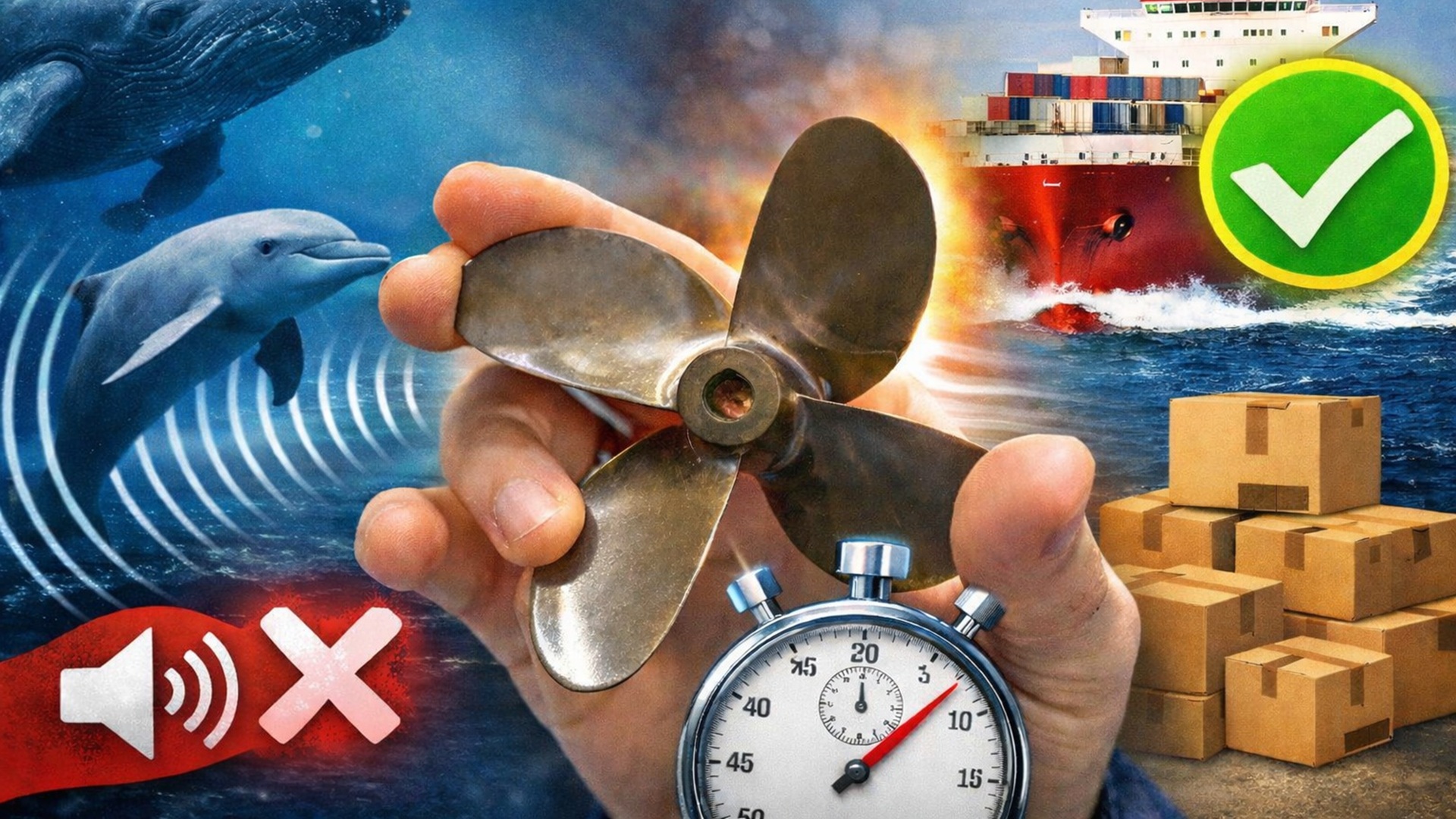
MinKav Project Started on January 1, 2026 Receives € 390,000 from Schleswig-Holstein to Develop Silent Propellers Capable of Reducing Underwater Noise Without Compromising Speed, Energy Efficiency and Global Commercial Fleet Operation
Researchers from HAW Kiel started the MinKav project on January 1, 2026, funded with € 390,000 by the state of Schleswig-Holstein, to develop silent propellers that reduce underwater noise without compromising the speed and efficiency of commercial vessels.
Silent Propellers Seek to Reduce Noise Impact on Marine Life
German engineers have launched a new project to address the intense noise generated by ship propellers, which disrupts marine life. This interference interrupts communication, feeding, and mating patterns of marine mammals.
The HAW Kiel team is developing new projects for silent propellers to quiet the sea. The central goal is to reduce underwater noise without compromising the efficiency or speed of vessels, which is a crucial balance for global maritime transport.
-
They wanted artificial intelligence, but they drained the water from a village in Mexico: the water consumption of data centers caused a hepatitis outbreak, and big tech companies Amazon, Microsoft, and Google were forced to halt billion-dollar projects.

-
System created to save lives in disasters turned ‘against’ Brazilians overnight: a hacker attack sent out a false alert from Civil Defense with the word “misantropia” that went off on the phones of half the country, even in silent mode, and took down the Cell Broadcast.
-
In the cold desert of Ladakh, where it hardly rains, engineer Sonam Wangchuk created the ice stupa, a tower that freezes winter water and stores it for irrigating crops in the spring, a simple engineering feat that mimics nature.
-
For the first time in history, solar and wind energy generated more electricity than natural gas worldwide in a single month, April 2026, a milestone in the energy transition that shows renewable sources taking the lead in the global electric system.




Currently, existing solutions require ships to slow down to remain quiet. This compromise leads to longer travel times and higher costs for shipping companies.
Cavitation Science Guides Development of New Silent Propellers
The noise from a propeller begins with cavitation. Pressure drops sharply on the suction side of a spinning blade, causing the water to vaporize and form small bubbles.
When the pressure rises again, the bubbles collapse violently. This process creates loud and sudden sounds that propagate for miles in the oceans.
Leonie Föhring leads the doctoral research at the Shipbuilding and Maritime Technology Institute at HAW Kiel. She uses a cavitation tunnel, high-speed cameras, and underwater microphones to study the phenomenon.
“The strong impulse occurs at the moment the bubble collapses. Its volume depends on how quickly the process happens,” explains Föhring.
She states that the team wants to find out if it is possible to slow down this collapse and how the silent propellers would need to be designed to achieve this goal.
Integration of Noise Reduction in Naval Design
Modern commercial ships use custom-designed propellers. However, underwater noise has rarely been a priority for engineers.
Prof. Jörn Kröger, the project leader, advocates for changes to meet upcoming environmental limits. According to him, practical methods are needed to routinely integrate noise reduction into propeller design.
Kröger also seeks to ensure that changes do not lead to significant losses in efficiency or speed. The goal is to prevent the industry from facing new operational restrictions.
Föhring and Kröger use computational flow simulations to find solutions. They aim to protect marine species while maintaining energy efficiency and contributing to climate protection.
Global Application and Duration Until December 31, 2028
The project benefits from the expertise of JASCO-ShipConsult, a specialist in naval acoustics. Naval engineer Dr. Dietrich Wittekind identifies a gap in current maritime research.
He notes that international teams have been studying low-frequency noise for 20 years. Despite many measurements, according to him, the fundamental mechanism responsible for high noise levels is still not understood.
Wittekind states that MinKav is the first project to systematically analyze the main causes and develop concrete solutions for significant noise reduction through measures related to silent propellers.
The conclusions could be applied to both new constructions and existing vessels. This presents a real opportunity to reduce noise pollution in the oceans.
The MinKav project will last until December 31, 2028. Its success could redefine how the global fleet moves through water, with a direct impact on marine life and the efficiency of maritime transport.








-

1 person reacted to this.