Portuguese
  Spanish


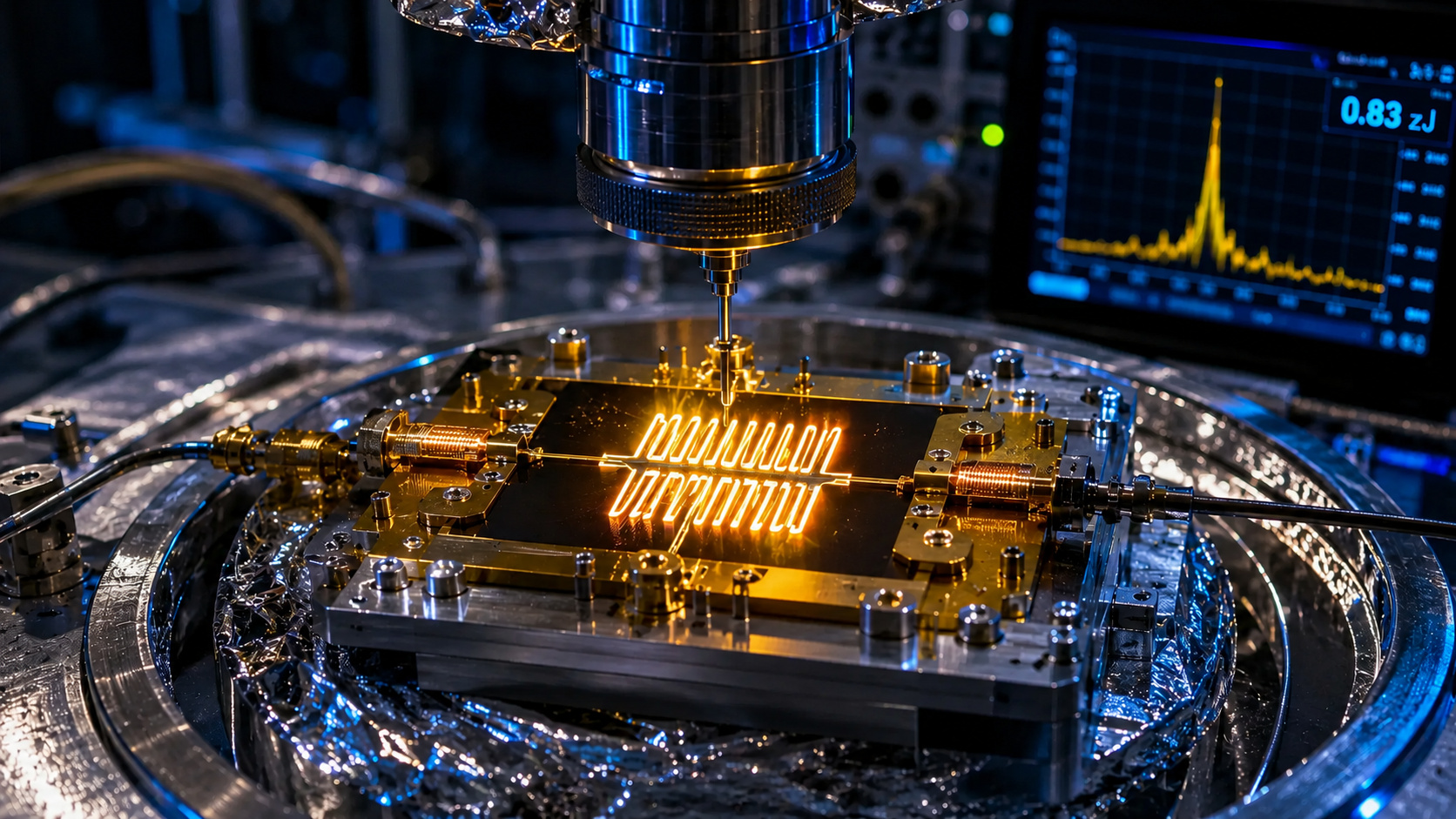


Scientists from Finland develop ultra-sensitive quantum sensor that could revolutionize astrophysics and accelerate studies on dark matter.
A group of scientists from Finland has developed an ultra-sensitive quantum sensor capable of detecting energy amounts lower than a zeptojoule, something considered extremely difficult even by modern physics standards. The breakthrough could boost research in astrophysics, quantum computing, and especially in the search for dark matter, one of the universe’s greatest enigmas.
The study was published in the journal Nature Electronics and republished in Science Daily on May 20 and utilized the OtaNano infrastructure, a Finnish center focused on nano, micro, and quantum technologies. In addition to measuring nearly imperceptible signals, the new technology could eventually help scientists detect invisible particles associated with dark matter.
Scientists from Finland achieve nearly impossible energy precision
The scientists from Finland have created an extremely sensitive calorimeter to measure minimal changes in thermal energy. The equipment combines superconducting materials with normal conductors, allowing the detection of nearly imperceptible changes in temperature.
-
Brazilian Polilaminin Reaches 100 Spinal Cord Injury Patients Through Compassionate Use, Shows Progress After 6 Months, Highlighting UFRJ’s Role in Experimental Regeneration Research

-
Electrolux Unveils New Stove with Integrated Airfryer, PerfectCook360, VaporBake, Grill, Glass Top, and Oil-Free Large Portion Cooking

-
Brazil Approves Non-Hormonal Drug to Alleviate Menopausal Hot Flashes, Potentially Transforming Treatment
-
Giant Phantom Halo Appears Around Remote Pacific Islands, NASA Reveals It’s Created by Tiny Marine Organisms





During the experiments, the researchers recorded an electromagnetic pulse of only 0.83 zeptojoule. This value is so small that it is typically used only in advanced studies of quantum physics and astrophysics.
To illustrate the scale of this energy, the scientists explained that it is approximately equivalent to the effort needed to move a red blood cell by just one nanometer under Earth’s gravity.


What makes the quantum sensor so different from current devices
The major differentiator of the quantum sensor is its ability to operate at extremely low temperatures, near the millikelvin scale. Under these conditions, superconducting materials become extremely sensitive to any thermal change.
According to the study, this allows the detection of energy signals much smaller than those observed in conventional sensors. The new technology also reduces interference during measurements, something essential for applications in quantum physics.
Among the main advances presented by the device are:
- Detection of energy below 1 zeptojoule
- Operation at ultracold temperatures
- High sensitivity to electromagnetic signals
- Compatibility with advanced quantum systems
- Potential use in space research

How dark matter challenges astrophysics researchers
Dark matter remains one of the greatest mysteries of science. Although it cannot be seen directly, researchers believe it accounts for about 27% of the known universe, according to estimates used by institutions like NASA and the European Space Agency.
The gravitational effects observed in galaxies indicate that there is a huge amount of invisible mass spread throughout the cosmos. Without it, many stellar movements simply could not be explained.
In astrophysics, detecting particles linked to dark matter is considered one of the main objectives of modern physics. The new quantum sensor developed by scientists in Finland emerges precisely as a possible tool to increase the precision of these experiments.

New technology may help in the detection of invisible axions
Researchers believe that the new technology could eventually identify hypothetical particles called axions, often associated with dark matter.
Researcher Mikko Möttönen, one of the names linked to the study, explained that the goal is to adapt the system to measure signals with variable arrival times. This capability is considered essential for detecting extremely difficult-to-observe particles.
In practice, this means that the quantum sensor will be able to capture very weak energetic events coming from space, expanding the possibilities of discovery in astrophysics.
Currently, one of the greatest scientific challenges is precisely differentiating real signals from external interferences. The greater the sensitivity of the equipment, the higher the chances of recording rare phenomena.
Quantum sensor can also transform quantum computers
In addition to space applications, the quantum sensor can also contribute to the advancement of quantum computing. This is because the calorimeter operates at the same ultra-low temperatures required by qubits.
According to researchers, this compatibility reduces disturbances in the system, eliminating the need to heat the device or excessively amplify signals.
Among the possible impacts of the new technology on quantum computing are:
- Reduction of noise in measurements
- Greater stability for qubits
- More precise sensors
- Better energy efficiency
- Advancement in quantum processing systems
These factors can accelerate the development of more stable and efficient quantum computers in the coming years.
OtaNano structure was decisive for scientific advancement
The project was carried out at the OtaNano facilities, Finland’s national research infrastructure focused on nanotechnology, microelectronics, and quantum technologies.
The laboratory houses advanced equipment used in high-precision research. The structure is considered one of the most important in Europe for experiments involving quantum physics and ultrasensitive sensors.
The work also received funding from the Future Makers initiative, a program dedicated to encouraging innovative scientific research.
For specialists, this type of investment is crucial to accelerate discoveries in strategic areas of modern science.
Astrophysics gains a new tool to investigate the invisible universe
In practice, the new quantum sensor can open important paths for future research in astrophysics. Extremely sensitive equipment helps scientists analyze almost imperceptible signals coming from deep space.
This includes cosmic radiation, subatomic particles, and possible interactions related to dark matter. The greater the precision of the sensors, the higher the chances of detecting rare events that go unnoticed by current instruments.
Experts also believe that the new technology could eventually be integrated into telescopes, satellites, and space observatories.
The breakthrough that could expand the limits of modern physics
The development of the quantum sensor by scientists in Finland represents an important step for modern physics. Detecting a signal of just 0.83 zeptojoule shows how much science has advanced in creating ultra-sensitive instruments.
More than a technical breakthrough, the discovery reinforces how research in astrophysics and quantum computing can transform different areas of science in the coming decades.
Although dark matter remains a mystery, technologies of this kind significantly increase the possibilities of understanding invisible phenomena that shape the universe.
With information from Science Daily.