Portuguese
  Spanish


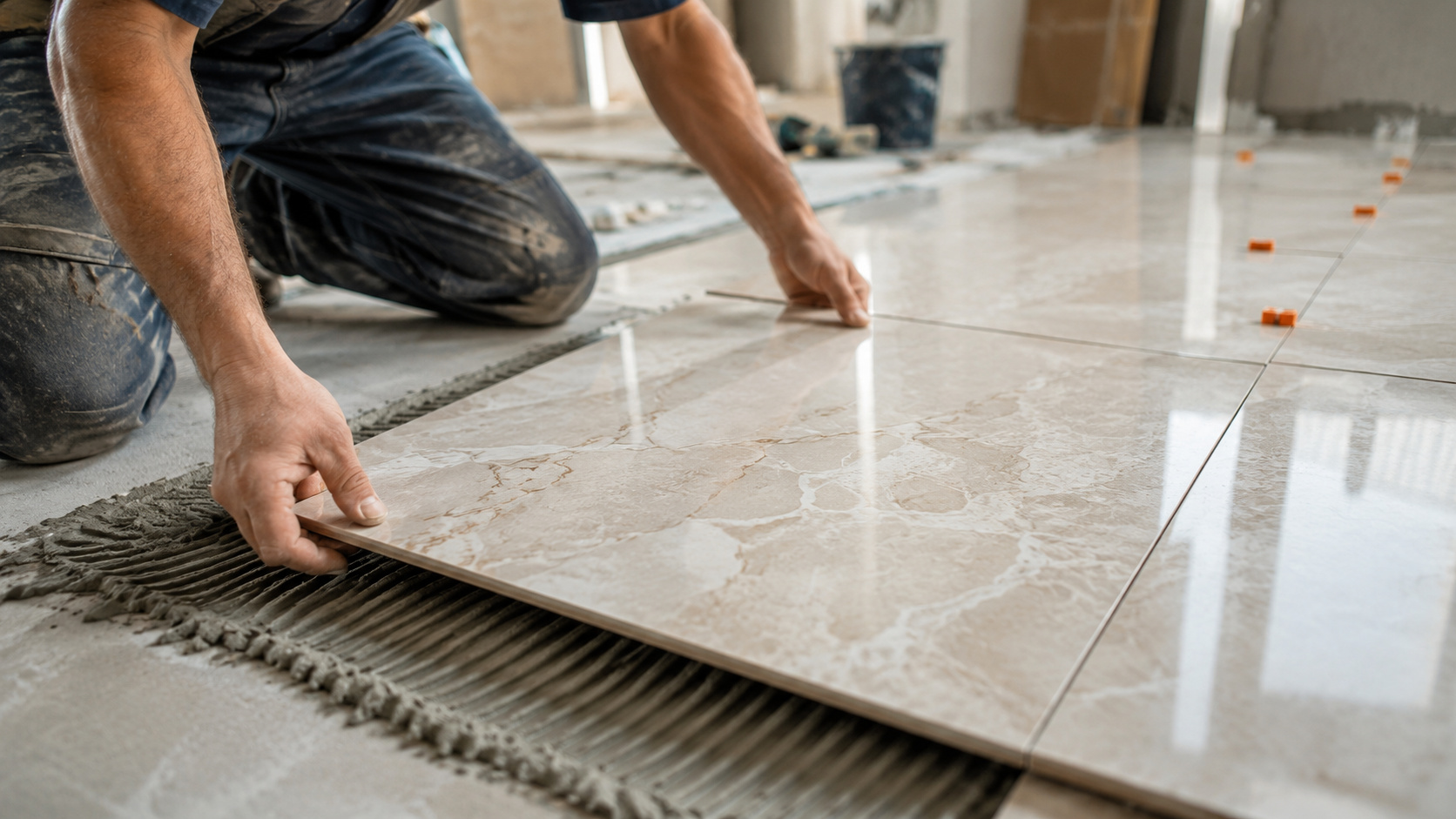

Learn the best mortar mix for porcelain tiles to install them securely, avoid tiles coming loose, and prevent tiles from bulging.
The correct installation of ceramic coverings requires detailed planning to avoid future headaches. When it comes to renovating spaces, understanding the dynamics of materials ensures a durable and visually flawless result in any room of your current residence.
In the interior engineering scenario, the perfect millimetric adjustment in the dosage — widely known as mortar mix — has assumed a key role in preventing pathologies in floors. Engineers and designers agree that preparing a correct mortar mix ensures that the adhesion properties reach their maximum potential.
How choosing the right mortar for porcelain tiles prevents the pieces from coming loose
Porcelain tiles have an extremely low porosity, which makes it difficult for common mixtures to adhere. For this reason, the use of a mortar for porcelain tiles developed with special chemical additives is indispensable to ensure that the pieces are firmly fixed to the floor.
-
Giant Robots Build Entire Neighborhood of 100 3D-Printed Homes in the U.S., Showcasing Technology’s Impact on Construction Industry

-
Helsinki Residents Receive Water That Travels 120 Kilometers Through a Hidden Rock Tunnel from a Lake Before Treatment

-
Brazil’s Sertão Region Nears Completion of Latin America’s Longest Artificial River, Transforming Water Access in Drought-Prone Ceará
-
Pre-mixed stabilized mortar set to revolutionize construction in 2026: extends usability to 36 or 72 hours, boosts productivity, and minimizes waste in building projects.



Inadequate product choice often results in the premature detachment of ceramic tiles. Using a generic option compromises the entire floor structure, leading to significant financial losses and the urgent need to redo the renovation work.
- Understanding the technical requirements of porcelain tiles prevents serious failures in piece fixation.
- The low porosity of the material requires compounds with high chemical adhesion.
- ACII and ACIII models cater to different sizes and application locations of the floor.
- Errors in water proportion drastically reduce the final strength of the mixture.


Technical diagnosis behind bulging porcelain tiles
The appearance of a swollen porcelain tile is one of the most complex problems in modern residential civil engineering. This destructive phenomenon occurs when shear stresses exceed the adhesion capacity of the interface between the back of the tile and the subfloor.
To avoid the inconvenience of a swollen porcelain tile, the proper dosage of the polymers present in the preparation must be rigorously monitored by the project managers. When analyzing a real case of swollen porcelain tile in the laboratory, it is often found that there is a lack of chemical anchorage caused by the improper use of generic bonding compounds.
The material requires additives that promote chemical bonding, as purely mechanical fixation is unfeasible due to the high density of the porcelain tile. Without the correct additives, the tiles expand with heat and contract with cold. This results in the detachment and sequential lifting of the pieces, which break under minimal traffic, creating the undesirable swollen porcelain tile that damages the property.

Criteria to keep porcelain tile from detaching
The classification of compounds determines where they can be applied with maximum safety. The ACII version is recommended for internal projects, while the ACIII typology offers the high resistance needed to withstand intense thermal variations in exposed outdoor areas.
To keep your porcelain tile from detaching for decades, the specifier needs to map the dynamic load of the environment and local climatic conditions. Ensuring porcelain tile from detaching requires a high-performance compound in pieces that exceed large formats or are directly exposed to sunlight.
The dimensions of the piece also directly influence this crucial technical decision during the project. Large formats demand the superior performance of the ACIII standard to support the weight and structural movement, avoiding the terrible floor swelling that ruins residential aesthetics. Therefore, obtaining a porcelain tile from detaching requires respecting the elastomeric traction limits established by current technical standards.
Water adjustments to save the mortar mix
Preparing the material requires strictly following the manufacturer’s instructions regarding the volume of water used. An incorrect proportion modifies the chemical properties of the mix, reducing the open time available for the professional to make the necessary adjustments to the pieces.
Gross errors in the mix modify the mortar mix, creating latent flaws. Consequently, calibrating the mortar mix prevents excess water from causing internal porosity after full curing, which would weaken the system. A perfect mortar mix results in a homogeneous and highly adhesive paste.
The use of a mechanical mixer ensures that all additives are evenly distributed throughout the bucket. Respecting the maturation period is vital for the complete activation of the chemical components of the adhesive mixture. Letting the mixture rest after the first mixing fully activates the essential adhesive polymers. Ignoring this step weakens the bond, compromising proper setting and severely reducing the coating’s lifespan in its internal environment.
Steps to lay porcelain tiles with double gluing
The technique used to lay porcelain tiles has evolved drastically with the increase in the average size of tiles in the architectural market. Today, to lay porcelain tiles with complete safety, the use of a notched trowel with the appropriate tooth size is mandatory in any project.
Common mistakes made when laying porcelain tiles include neglecting the open time of the binder, which leads to the formation of a dry surface film that prevents adhesive transfer. Double gluing is mandatory for tiles that exceed 30 centimeters on each side.
Spreading the product both on the subfloor and on the back of the coating eliminates internal voids, creating a solid base capable of withstanding severe daily impacts. When laying porcelain tiles using the double gluing technique, the qualified installer must apply the beads always in the same directional way, facilitating perfect air release. To complement this practical learning, video guidelines distributed by the Quartzolit brand help visually detail the main points of this application.

Load distribution and the use of mortar for porcelain tiles
Using the correct mortar for porcelain tiles and ensuring proper application techniques always go hand in hand on the construction site. The uniform application of mortar for porcelain tiles ensures that there are no bubbles or voids beneath the large-format tiles.
In high-traffic commercial areas, the thickness of the mortar for porcelain tiles must be continuously monitored to avoid severe unevenness. Every high-specification mortar for porcelain tiles requires a flat, clean, and properly cured subfloor.
The ridges created with the notched trowel should always be spread in the same directional sense. This guidance facilitates the release of air during the mass compression, ensuring complete filling and preventing moisture from accumulating at the bottom.
The correct execution of the bonding requires attention to essential handling factors:
- Use of appropriate trowels for the selected format.
- Uniform pressure when pressing the ceramic onto the base.
- Constant verification of the back to assess full coverage.
Control of movement and curing of the base
The focus on keeping your porcelain tile from detaching also requires strict control of movement and isolation joints. It’s not enough to just choose a good adhesive; to keep the porcelain tile from detaching under drastic thermal variations, the joint width prescribed by the manufacturer must be strictly adhered to. Success in keeping the porcelain tile from detaching protects the final customer’s investment and significantly reduces post-construction technical assistance costs.
Additionally, controlling the phenomenon of swollen porcelain tile requires extra attention to the curing of the subfloor. Applying the mixture on a concrete base that is still undergoing hydraulic shrinkage will inevitably cause a swollen porcelain tile in the medium term. If the base moisture is excessive, the polymers undergo hydrolysis and lose their mechanical properties, causing severe damage associated with detachment.
Deep cleaning before laying porcelain tile
The surface that will receive the coating must be completely clean, cured, and free of loose particles. Dust or oil residues prevent direct contact of the mass with the subfloor, breaking the mechanical adhesion necessary to efficiently hold the heavy structure.
When we start to lay porcelain tile on poorly prepared surfaces, the entire system is put at risk, invalidating contractual guarantees. Mastering the art of laying porcelain tile requires patience in the leveling stage and deep cleaning of the base.
Excessive moisture in the base also compromises the uniform drying of the applied chemical product. Ensuring that the level of squareness is correct saves material and ensures that the finish remains perfectly aligned, adding extreme value to your complete residential project. The ridges created with the notched trowel should always be spread in the same directional sense.
Molecular advances and pull-off tests
The high-tech formulations of contemporary porcelain tile adhesive contain cutting-edge polymers that create stable molecular adhesion bridges. The intrinsic quality of the adhesive compound marketed by leading brands undergoes rigorous laboratory mechanical pull-off tests. Therefore, investing in an excellent adhesive mix means safeguarding the project against future mishaps.
Finally, the precision in the mass dosage determines the fine balance between rheology and workability. By obtaining a perfectly balanced compound, the installer reduces the physical effort required for crushing the ridges, accelerating daily productivity and generating a perfectly stable surface. Every detail of the mix directly influences the visual result perceived by the client.
The path to indestructible ceramic surfaces
The stability and mechanical resistance of a floor depend directly on the synergy between technical knowledge and executive precision on the job. From the correct sizing of the adhesive mix to the careful cleaning of the subfloor, each step acts as a protective barrier against severe pathologies. Understanding the material’s rheology and the need for chemical bonding ensures that surfaces withstand intense use without presenting structural defects.
Investing in high-grade materials (such as ACII and ACIII) and applying established techniques, such as double bonding, are the fundamental pillars for delivering durable, safe residential projects with unquestionable excellence in finish.