






 Portuguese
  Spanish


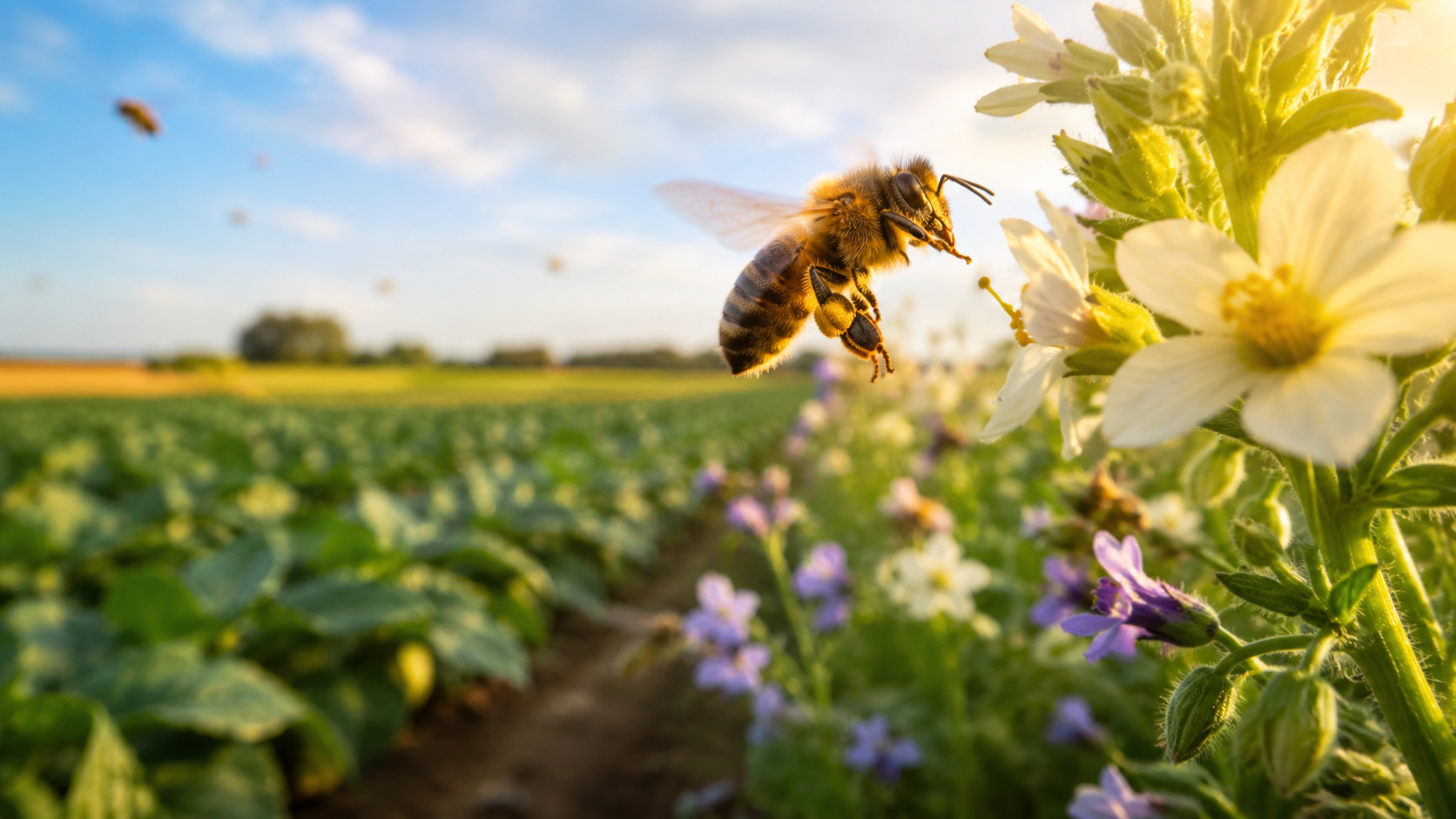

New study shows how bees and flowers can increase agricultural productivity and help in the sustainable production of food worldwide.
A new study conducted by researchers from the Institute of Biosciences at USP provided an unprecedented explanation for one of the most important debates in modern agriculture. After all, do flowers planted near crops help or hinder agricultural productivity? The answer found by the scientists indicates that bees can be decisive in increasing food production in a more sustainable way.
The research, published by Luana Mendes in the USP Journal on May 11, shows that flowering areas within or around plantations can strengthen biodiversity, improve pollination, and also contribute to the ecological balance of crops. More than decorative elements, these flowers serve as support for pollinators and help in the natural control of pests.
The work was conducted by researcher Cristina Akemi Kita, under the guidance of Professor Marco Mello, at the Laboratory of Ecological Synthesis at USP. The group developed a theory called the “Integrative Hypothesis,” considered a new attempt to explain how bees interact with flowers and agricultural crops over time.
-
China Develops Custom 140-Ton Electric Mining Truck with 770 kWh Swappable Battery, Deploys 290 Units in Xinjiang’s Largest Zinc Mine

-
Meta to Launch Arena, a New Prediction App Targeting 3.56 Billion Users, Competing with Polymarket and Kalshi

-
Scientist Challenges Famous Human Evolution Theory, Argues Homo Sapiens Evolved Gradually Over Thousands of Years
-
15-Year-Old American Builds Ocean Generator with PVC Pipe and 3D-Printed Propeller for $12, Wins National Prize, Presents at White House, and Makes Forbes 30 Under 30 List




Modern agriculture faces increasing pressure to produce more without destroying ecosystems
The challenge of current agriculture goes far beyond increasing productivity. With the world population growing and the demand for food increasing, producers face pressure to expand crops without further compromising natural resources.
In recent years, the intensive use of pesticides, the advance of deforestation, and the reduction of biodiversity have started to threaten species fundamental to the functioning of crops. Among them, bees have gained prominence for their importance in the pollination of different agricultural crops.
Many foods consumed daily depend directly on the action of these pollinators. Among the most well-known examples are:
- Coffee;
- Apple;
- Melon;
- Passion fruit;
- Tomato;
- Various fruits and vegetables.
Without bees, a significant part of global food production could suffer a considerable reduction. Therefore, researchers have been trying to find ways to make agriculture more productive without eliminating the natural mechanisms of the ecosystem.
Flowers in plantations have long raised questions among researchers
For many years, scientists have been divided on the role of flowers near crops. One group believed that flowers attracted bees and strengthened the pollination of agricultural crops. Another argued that they could “distract” pollinators and reduce their presence in commercial plantations.
The new study aimed to understand this contradiction. According to Cristina Akemi Kita, part of the problem was in the way previous studies analyzed bee behavior only at isolated moments, without considering the complete dynamics of the agricultural system.
The so-called “Integrative Hypothesis” proposes that the two phenomena occur in sequence, rather than in opposition.
New study explains how bees migrate from flowers to crops
According to the research, bees initially remain concentrated in flower beds when the main crop does not yet offer sufficient attractions. However, as the crop blooms and starts to provide competitive energy resources, a natural “overflow” of pollinators to the agricultural crop occurs.
In practice, flowers function as a kind of temporary ecological support area. They help maintain bee populations close to the plantation until the agricultural crop is ready to receive the pollinators.
This discovery could change management strategies in the field and open up opportunities for agricultural models less dependent on chemical products.
Marco Mello compared the difficulty of the research to assembling a 5,000-piece puzzle with only 500 pieces available. According to him, many international studies still fail to record important information about floral species, climate, and environmental conditions, making more comprehensive analyses difficult.
Sustainable agriculture could gain strength with planned use of flowers
The research reinforces a concept called ecological intensification. The model seeks to increase agricultural production using nature-based solutions, reducing environmental impacts and strengthening biodiversity.
In this context, flowers cease to have only an aesthetic function and take on a strategic role within rural properties.
Among the benefits observed by researchers are:
- Greater presence of bees in agricultural areas;
- Partial soil recovery;
- Strengthening of biodiversity;
- Biological control of some pests;
- Reduction in pesticide dependence.
Scientists emphasize that the results depend on different environmental factors. The type of crop, the species of flowers used, and even the group of bees present in the region directly influence the success of pollination.
Native bees may be fundamental for the future of Brazilian agriculture
Brazil is home to one of the largest diversities of bees on the planet. Many of these species are native and play important roles in national agricultural production.
However, the expansion of urban areas, deforestation, and the intensive use of agricultural pesticides are reducing pollinator populations in different regions of the country.
The new study also highlighted the need to separate the effects of wild bees from those caused by Apis mellifera, commonly known as the European bee. This species is often commercially used in rented hives for agricultural pollination, which can alter natural results observed in research.
According to the researchers, better understanding the behavior of native species will be essential for developing more efficient agricultural systems adapted to the Brazilian reality.
Methodology analyzed global research on flowers, agriculture, and pollinators
To develop the work, the researchers used a methodology called “research weaving,” which combines systematic review of scientific literature with bibliometric analyses.
The goal was to identify patterns, gaps, and contradictions in the studies already published on flowers, bees, and agriculture.
The entire process followed the Prisma protocol, considered one of the most rigorous standards for international scientific reviews. The methodology ensures greater transparency and organization of the analyzed data.
The team also identified a significant geographical imbalance in global research. A large portion of studies is concentrated in Europe and North America, while tropical regions, like Brazil, still have few in-depth analyses on the subject.
This scenario concerns researchers because tropical environments have biodiversity very different from temperate regions, especially regarding bees and flowers present in agricultural areas.


New study may influence public policies aimed at sustainable agriculture
The results obtained by the USP team can also serve as a basis for future public policies aimed at strengthening sustainable agriculture.
The researchers believe that governments could create tax incentives and support programs for rural producers who adopt ecological practices on their properties.
Among the measures that may gain traction are:
- Implementation of living fences;
- Creation of flower beds;
- Preservation of native vegetation;
- Reduction of excessive pesticide use;
- Protection of natural habitats for bees.
Additionally, Cristina Akemi Kita continues working on computational models capable of simulating thousands of different agricultural scenarios. The goal is to discover which combinations of flowers offer the best results for each region and type of agricultural crop.
The researcher also studies specific characteristics of bees, such as body size, a factor that directly influences flight distance and pollination capacity.

Preserving bees may be the way to ensure food in the future
The new study developed by USP reinforces an idea that is gaining strength among scientists from different countries: protecting bees may be one of the most important strategies to ensure food security in the coming decades.
By showing that flowers can function as ecological support for pollinators and increase the efficiency of agricultural pollination, the research presents a promising alternative to make agriculture more resilient.
Instead of seeing biodiversity and productivity as opposing goals, the study suggests that both can go hand in hand. Environmental preservation ceases to be just an ecological agenda and also becomes an economic and strategic issue for global food production.
With the advancement of climate change and pressure on natural resources, better understanding the relationship between bees, flowers, and agriculture could be decisive for the future of crops in different parts of the world.
With information from Jornal da USP






