Portuguese
  Spanish


Pattern of Holes in the Atlantic Intrigued the Team Due to Regularity
NOAA scientists found rows of nearly straight holes in the sediment at the bottom of the Atlantic Ocean at a depth of 2,540 meters during the Voyage to the Ridge 2022 expedition. The marks drew attention because they appeared in linear series, with small mounds of sediment around them, as if something had excavated the seabed. The origin, however, remains undefined.
The case attracted interest again because the 2022 record was not the first. A study published in the journal Frontiers in Marine Science showed that very similar formations had already been observed in 2004, north of the Azores, also on the Mid-Atlantic Ridge. Even with images, morphological analysis, and discussion of hypotheses, researchers could not definitively identify which organism or process produced the holes.
Holes on the Sea Floor Were Seen in a Remote Area of the Mid-Atlantic Ridge
The most well-known discovery occurred during Dive 04 of the second leg of the Voyage to the Ridge 2022 expedition by NOAA Ocean Exploration. In this dive, the team recorded several sublinear sets of holes in the sediment at about 2,540 meters, in a deep area of the Atlantic associated with the Mid-Atlantic Ridge.
-
NASA Issues Warning: 20-Year-Old Telescope That Detected Over 2,000 Explosions More Energetic Than the Sun Is Rapidly Losing Altitude; Unprecedented Mission Aims to Prevent Its Fall and Extend Operation by 5 Years.

-
Interstellar Comet 3I/Atlas, Potentially 12 Billion Years Old, Baffles NASA Scientists with Unprecedented Features
-
Microwave Stone-Melting Machine Aims to Drill Deeper Than Steel and Unlock Near-Infinite Energy Source

-
Longest Solar Eclipse of the Century Will Turn Day to Night for Over 6 Minutes, Allowing Star Gazing; Won’t Recur for 156 Years


NOAA itself reported that the holes were seen again during Dive 09, in four occurrences at depths between approximately 1,440 and 1,500 meters. This reappearance reinforced the perception that it was not an isolated mark or a casual detail of the underwater relief.
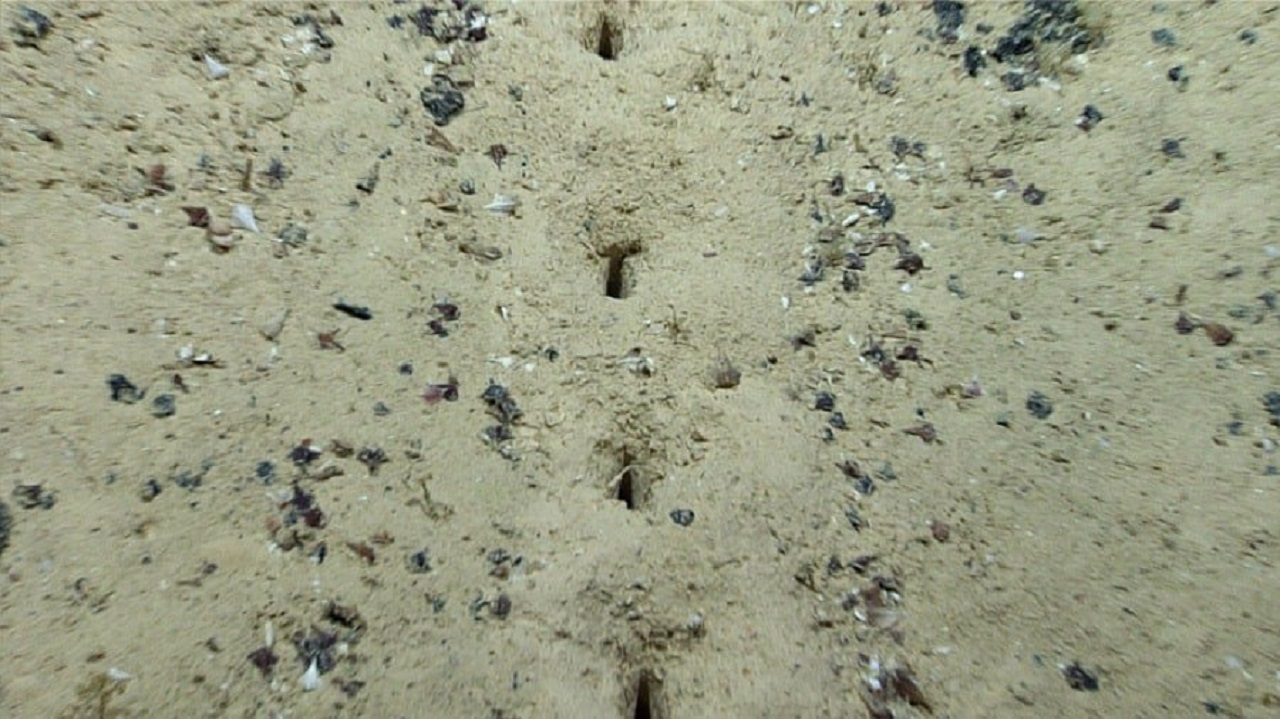
The scientific study by Michael Vecchione and Odd Aksel Bergstad helps to broaden the context. The authors reported similar observations in 2004, north of the Azores, at depths between 2,074 and 2,097 meters, showing that the phenomenon had been recorded in the region long before the 2022 expedition.
Pattern of Holes in the Atlantic Intrigued the Team Due to Regularity
What caught the researchers’ attention the most was the design of the marks in the sediment. Instead of appearing scattered randomly, the holes emerged in sublinear series, with strong visual alignment and relatively repeated spacing, making them unusual for a seabed with a homogeneous appearance.
In the scientific article, the authors describe these holes as elongated structures, about 6 by 1.5 centimeters, and note that the distance between one hole and another was similar to the length of each mark.
The apparently more recent specimens had elevated sediment around them, while the older ones seemed partially filled.
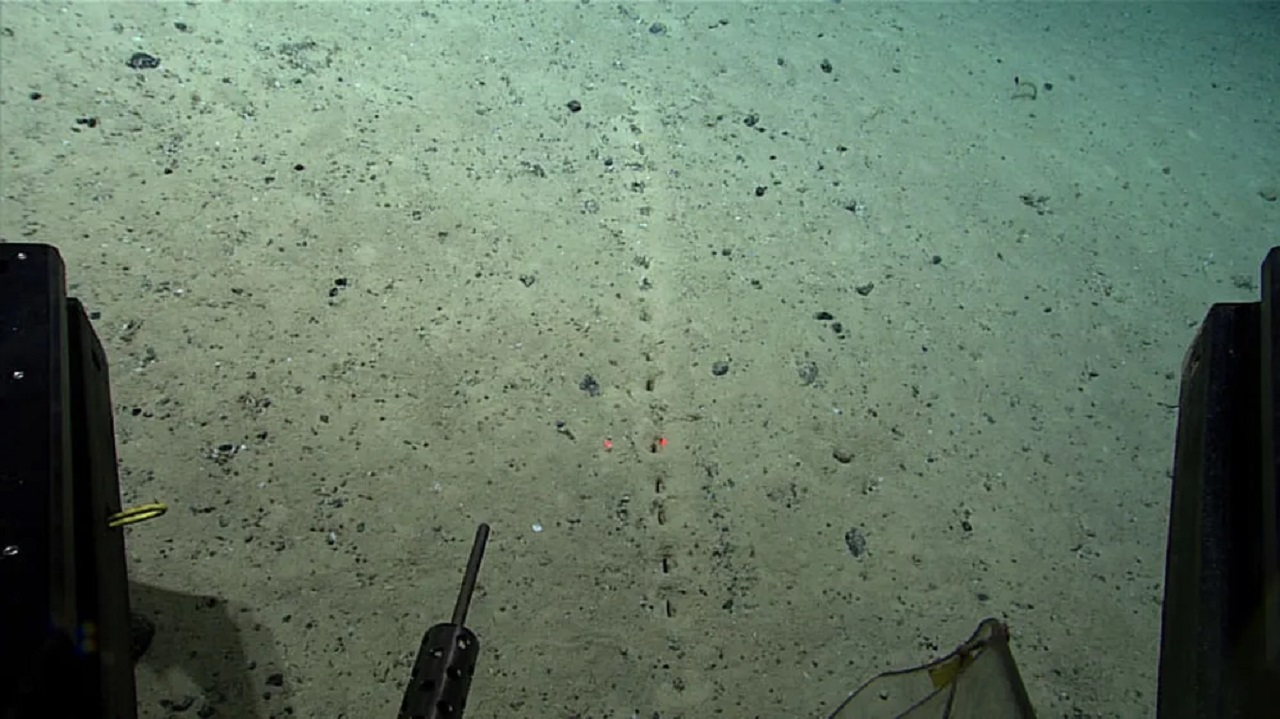
The images released by NOAA also show two laser points separated by 10 centimeters, used as a scale on the seabed. This detail helped the team estimate the size and repetition of the pattern more accurately.
NOAA Submarine Robots Tried to Investigate the Holes Up Close
The analysis was conducted with remotely operated vehicles, known as ROVs, which allow observation and sampling of deep areas without direct human diving.
According to NOAA, the operators tried to examine the cavities with the robot’s instruments but could not see if the holes were connected beneath the sediment surface.
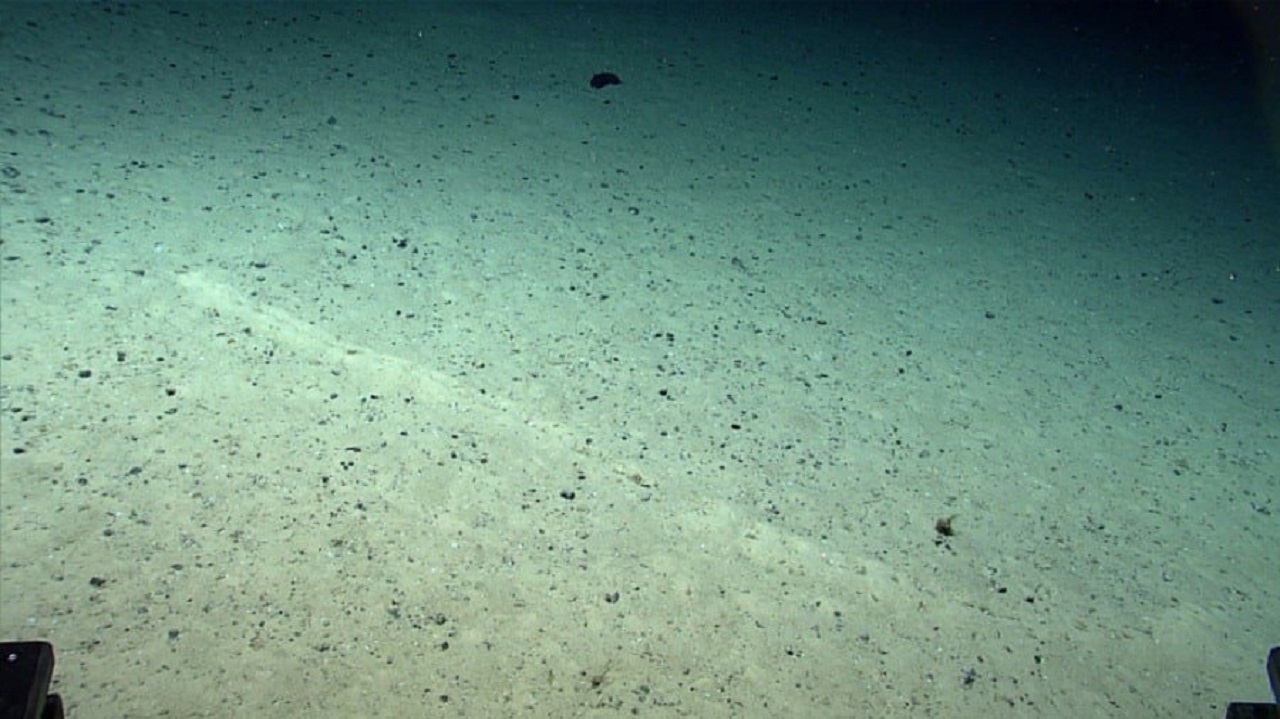
In the second observation of the phenomenon, during Dive 09, the ROV pilots used a suction system to collect sediment from marks considered fresher.
The team also collected a water sample for later analysis of environmental DNA, in an attempt to discover which organisms might be living inside or around the perforations.
Even so, the recovery of the material did not provide a conclusive answer. NOAA recorded that the inspection of the collected sediment did not reveal clear clues about what formed the holes, keeping the case open.
Scientific hypotheses point to biological activity, but nothing has been confirmed
NOAA and the article by Vecchione and Bergstad treat the origin of the holes as unknown. Among the considered hypotheses, the most cited is excavation by some organism associated with the sediment, either living within it or removing material with some body structure used for feeding.
The authors use the term lebensspuren, an expression applied to “traces of life” produced on the sediment surface by biological activity.
In this context, the holes could represent marks of bioturbation, that is, physical alterations of the seabed caused by living beings that dig, stir, or move particles in search of food or shelter.
At the same time, the study emphasizes that no close-up obtained clearly showed an animal inside the holes, and the connection between the cavities under the sediment could not be observed either. Therefore, the scientists did not reach a diagnosis and kept the origin of the marks as a scientific mystery.
Mysterious holes had already been seen before north of the Azores
One of the most relevant points of the story is that the 2022 episode did not emerge from nowhere. The article published in 2022 in Frontiers in Marine Science describes records obtained on July 13, 2004, when an ROV filmed several sublinear series of holes in sediments of the Mid-Atlantic Ridge, north of the Azores.
In that survey, the authors observed that some series were less than a meter, while others extended for many meters. There were straight, gently curved sets and even intersecting rows, showing that the pattern was not restricted to a single simple trail on the seabed.
This history makes the case even more important. Instead of a one-time event, the evidence suggests a type of recurring mark in a part of the deep Atlantic, still poorly understood by science.
The ocean floor remains little known even with modern technology
The episode also helps explain why the deep ocean still produces unexpected discoveries. NOAA reports that, in April 2026, only 28.7% of the global seabed had been mapped with modern high-resolution technology.
This means that most of the ocean floor has not yet been recorded in sufficient detail to regularly reveal smaller features.


The same page highlights that maps made with satellite data offer only an overview of the submarine relief. They are useful for guiding expeditions but do not replace direct observations with robots, high-resolution sonar, and on-site sample collection.
NOAA also states that explorers have seen less than 0.001% of the deep ocean floor, a tiny fraction compared to the real scale of this environment. It is precisely in this little-observed frontier that anomalies like these rows of holes continue to appear.
NOAA asked for public help after releasing images of the phenomenon
Faced with the lack of immediate response, NOAA decided to share the case on social media and ask for hypotheses from the public. The agency reported receiving suggestions of all kinds, from unidentified organisms to natural processes within the sediment.
This open consultation movement did not mean abandoning the scientific method. In practice, it was a way to broaden the debate around an unusual record, especially because researchers from different areas might recognize patterns that the original team had not yet associated with a specific process.
So far, however, no hypothesis presented has been definitively confirmed. The case remains a clear example of how much the deep ocean still challenges observation, classification, and scientific interpretation.
Mystery in the deep Atlantic remains without a definitive explanation
The discovery of the rows of holes on the Atlantic floor gained attention because it combines three rare elements at the same time: extreme depth, unusual visual pattern, and absence of conclusive explanation. This turns the case into one of those occurrences that seem simple at first glance but expose large gaps in knowledge about deep-sea ecosystems.
The most important thing is that the phenomenon was not treated by NOAA as an empty curiosity. The images were contextualized by sampling, attempts at direct inspection, and comparison with previous scientific records, which shows that the mystery has already entered the formal radar of oceanographic research.
New missions, more precise collections, and future analyses may clarify whether these marks are produced by an animal not yet associated with the pattern, by some rare feeding behavior, or by another deep sediment process. For now, the most honest answer remains the same: there is no confirmation about what created the holes.