






 Portuguese
  Spanish
 5 min of reading
  5 comments


Northeast Wins Billion-Dollar Megaproject That Will Connect the Atlantic to the Pacific: 1,527 km Railroad Has New Section of 35.7 km Confirmed in Bahia, with Works in 2026 and 2,400 Direct Jobs
Federal Government Launches Bid for New Section of Fiol II in Bahia, Part of the Bioceanic Railroad That Will Connect the Atlantic to the Pacific. Project Provides for 35.7 km, R$ 507 Million in Investments and Thousands of Direct Jobs.
The federal government launched on Thursday (04) the bid for the construction of a new section of the West-East Integration Railway (Fiol II), in Bahia.
The segment will have 35.7 kilometers in length, between the municipalities of Guanambi and Caetité, in the Bahian hinterland.
Construction is expected to begin at the end of the first half of 2026, with an expectation of generating 2,400 direct jobs.
-
Brazilian Joins Homeownership Consortium, Faces Decade of Dual Payments Totaling $141,000, Surpassing Traditional Mortgage

-
Land Rover to Halt Production in July, Putting 371 Jobs at Risk, as Chinese Automaker Negotiates to Convert Factory to 100,000 Vehicles Annually by 2027

-
Mexican Pest Threatens U.S. Cattle Herds at Historic Lows, Potentially Boosting Brazilian Beef Exports as Burger Prices Soar

-
Brazilian Freight Bill Progresses in Congress with $5,000 Minimum Wage, 70% Advance Payment, and Fines Up to $1 Million, as Agriculture and Industry Warn of Rising Costs and Legal Uncertainty


The expected investment is R$ 507.1 million, a value that covers both the project design and the execution of the section. The estimated completion time is 43 months.
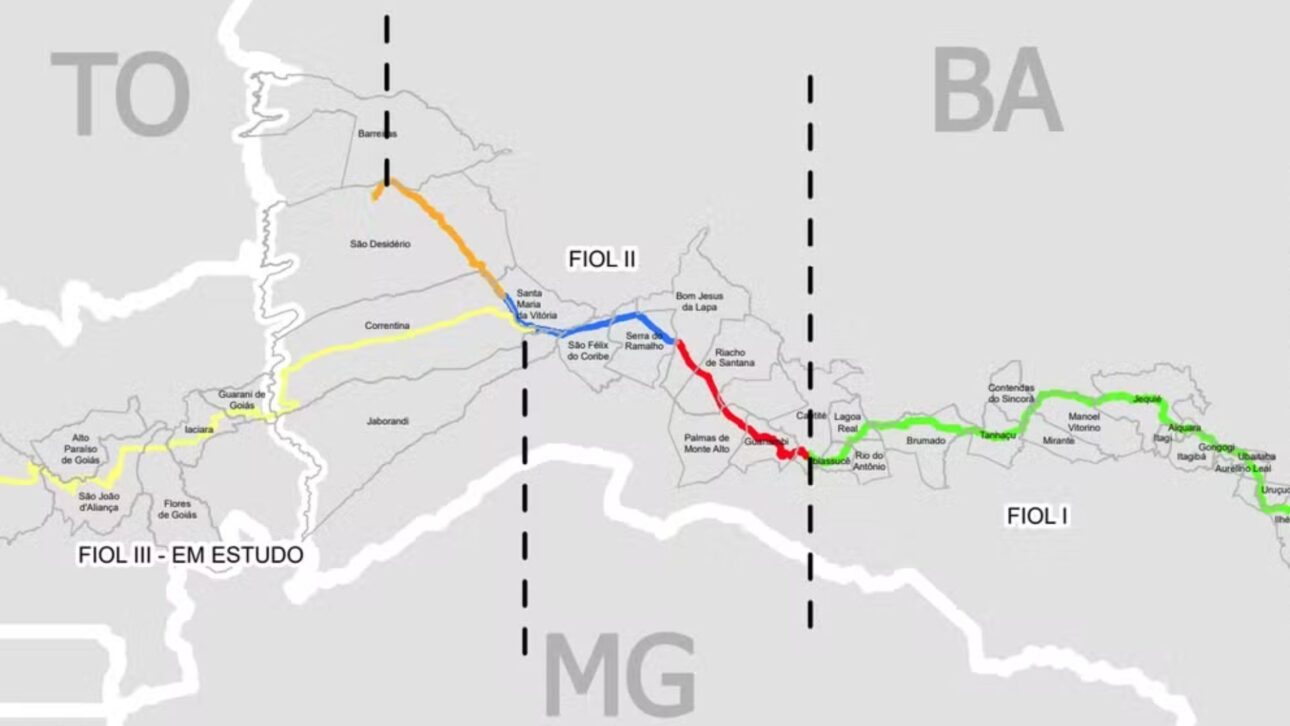
Bioceanic Railroad and Continental Integration
The Fiol II is part of a project of continental scope.
The route is part of the future bioceanic railway corridor, planned to connect the Atlantic, on the coast of Bahia, to the Pacific, in Peru.
The route will start at the Port of Ilhéus and will continue to the Port of Chancay, crossing the interior of Brazil and the Andes, opening a new commercial alternative with the countries on the west coast of South America and Asia.
With 1,527 kilometers planned, the Integration Railway will connect Ilhéus to Figueirópolis, in Tocantins.
At this point, it will meet the Northern-Southern Railway, expanding the country’s railway network and strengthening the flow of grains, minerals, and other Brazilian products.
Adjustments in the Fiol II Route
According to the Director of Projects at Infra S.A, André Luís Ludolfo, the recently bid section needed technical adjustments before the publication of the bid.
The modification took into account the proximity to a dam in the region, which could suffer structural risks if the railway were constructed next to the reservoir.
“There was a possibility that the work could impact the dam, with risk of cracks or ruptures. The new route was planned to move away from the reservoir, offering greater environmental and structural safety,” explained Ludolfo.
Flow of Agricultural and Mineral Production
The Fiol II, which will have a total of 485 kilometers between Caetité and Barreiras, was conceived as a strategic axis for cargo transportation in the interior of Bahia.
Currently, around 245 kilometers already have installed tracks. The remaining portion is under construction or awaiting bidding.
According to Ludolfo, the railway will facilitate the flow of agricultural and mineral production from Bahia, especially grains and agricultural bulk from the western part of the state.
The future connection with the Northern-Southern Railway will also expand the transportation reach to other regions of Brazil.
“Our expectation is that the Fiol II will consolidate as a new logistical corridor and a driver of regional socioeconomic development,” he stated.
When completed, the line will also integrate with Fiol I, which is already under construction, linking Caetité to the Port of Ilhéus.
This interconnection will form a complete corridor to the coast, ensuring competitiveness for Brazilian exports, especially of commodities and fertilizers.
Economic and Regional Impact in Bahia
The announcement of the new section reinforces the government’s strategy to use the expansion of the railway network as a driver of economic growth.
In addition to the creation of thousands of direct jobs during the construction phase, the expectation is that the railway will reduce logistical costs, increase the competitiveness of national production, and stimulate investments in areas near the route.
In Bahia, the railway is expected to directly benefit producers of soybeans, corn, and cotton from the western part of the state. It will also facilitate the transport of iron ore extracted from the region of Caetité.
The Port of Ilhéus will be the outlet for these goods, establishing itself as a strategic terminal for agribusiness and mining.
Progress and Challenges of the Project
Despite its potential, the implementation of Fiol has faced delays since its conception, back in the 2010s. Several sections only advanced after concessions to the private sector and project re-adjustments.
The launching of this Thursday’s bid is considered an important step to maintain the railway schedule.
The challenge, according to logistics sector experts, will be to ensure execution within the expected deadlines and to ensure that the integration with other lines, such as the Northern-Southern, occurs efficiently.
Without this full connection, part of the railway’s potential may be diminished.
Rail Connection Between Brazil and Peru
In a broader plan, Fiol fits into the project of the bioceanic railway, which aims to connect Brazil to Peru.
Although still in the study and international negotiation phase, the corridor is seen as a strategic alternative to reduce dependence on Brazilian ports in the Atlantic and diversify export routes to Asia.
If the project is completed, the country will be able to shorten distances in international trade, reducing transport time to Asian markets compared to the current route, which passes through the Panama Canal or the maritime route to the Cape of Good Hope, in Africa.
Future Perspectives
The publication of the bid marks a new chapter in railway expansion in the country.
The government relies on the railway as a pillar of a more sustainable logistics system, less dependent on road transport, which still predominates in Brazil.
For the population of the Bahian hinterland, the expectation is that the project will go beyond cargo transport and bring opportunities for jobs, income, and revitalization of the local economy.
With the bidding open and the start of works expected for 2026, Fiol II begins to take shape in yet another section.
The question remains: will Brazil be able to accelerate the execution of the megaproject to make the long-awaited connection between the Atlantic and the Pacific a reality?





Vão tomar no **** bando de **** do Carvalho!
Bolsomerda preso a **** vos espera!
O **** está com dor de cotovelo!
É tetra Lula 2026!
Viva o Brasil, viva soberania!
Os bolos são traidores da Pátria!
Mas um **** do **** **** **** que vai chorar muito quando Bolsonaro voltar antes do esperado kkkkkkkkkkk. Lula vassalo da China, ainda vem falar em soberania
KKKKKKKKkkk o Lula não para já está falando em outro grande projeto para o Brasil kkkkkkkkkk ele gosta de projeto que não acaba como transposição do rio são Francisco a ponte Salvador Itaparica e etc para desviar o dinheiro do contribuinte e chamar a atenção dos eleitores kkkkkkkkkk sabemos que ele Lula não termina obras e só conversa para inglês ver. Fora Lula **** ****
Que vergonha copiar e colar um texto de 03 anos atrás .vou pedir para te bloquear