Portuguese
  Spanish


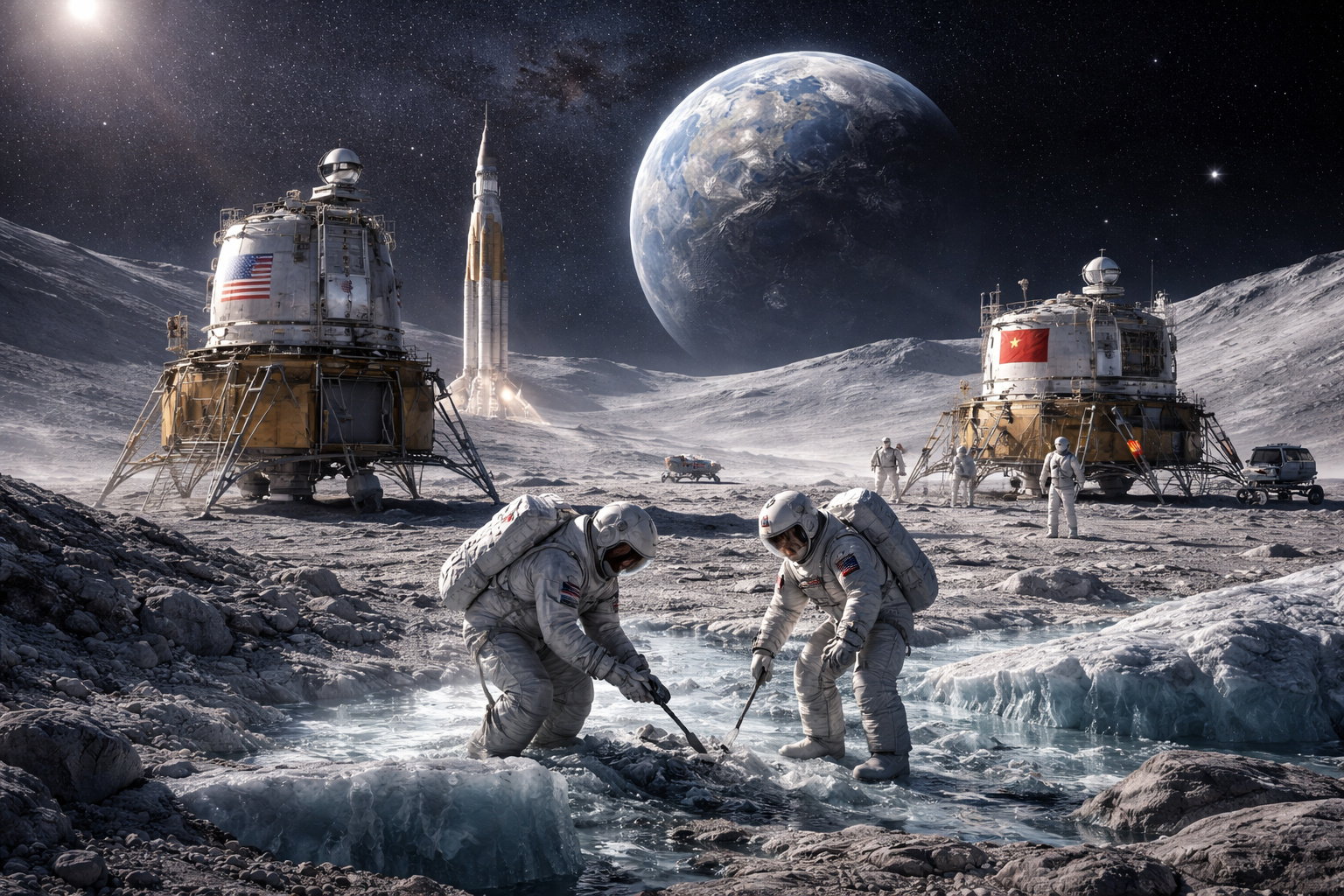


The Dispute Between The United States And China Over The Moon Involves Security, Permanent Bases, And Sustainable Use Of Strategic Resources In The 21st Century
A new phase of the space race has gained momentum after decades of pause in crewed lunar missions.
More than 50 years after Apollo 17, which took place in December 1972, the traces still visible on the lunar surface symbolize the end of the first era.
During that period, according to historical records from Nasa, the dispute between the United States and the Soviet Union reflected a greater geopolitical tension.
The Soviet Union first put an object, an animal, and a human into orbit.
However, in July 1969, the United States landed on the Moon with Apollo 11.
Between 1969 and 1972, 12 astronauts walked on the lunar surface.
-
U.S. Dismisses Brazilian Foreign Ministry’s Military Risk Warning as “Absurd,” Cites Brazilian Criminal Gangs Operating in the U.S. Since May 2026

-
Ukraine War Impacts Brazilian Fuel Supply: Russian Diesel Imports Drop 65% in June, Brazil Turns to US and India Amid Market Concerns

-
Chinese Nuclear Submarine Launches Simulated Warhead Missile in Pacific, Heightening Regional Tensions Amid Naval Drills with Russia Near Qingdao; New Zealand and Papua New Guinea Warn of Persistent Chinese Military Presence
-
Ayatollah Ali Khamenei’s Funeral Draws 15 to 20 Million in Tehran, Calls for Revenge Against Trump After Joint Israel-U.S. Attack



After that, the program was suspended.
According to statements from then-President Richard Nixon, high costs and the symbolic victory ended the lunar priority.
Strategic Return To The Moon Alters Global Priorities
Over the following decades, although the return was mentioned, the focus shifted to satellites and the International Space Station.
However, in parallel, China structured its own lunar program.
In 2006, the chief Chinese scientist declared that lunar exploration represents a nation’s power.
Subsequently, in 2013, China conducted the first unmanned landing on the Moon since the 1970s.
Consequently, the movement drew international attention.
Then, the United States announced the reorientation of the space program to resume human missions.
Artemis Program And A New Phase Of Exploration
Currently, the United States is conducting the Artemis program, structured in three phases.
First, in 2022, an unmanned mission orbited the Moon for technical tests.
Next, a crewed flyby is scheduled.
Only in the third phase, expected in 2027, will there be an attempt at human landing.
However, unlike the 1960s, safety has become a central priority.
Today, acceptable risk is lower, and protocols are more stringent.
Nasa has developed the Space Launch System rocket for this mission.
Meanwhile, private companies like SpaceX and Blue Origin collaborate on the development of landing technologies.
Although this partnership aims to reduce costs, analysts point out that it also contributes to delays.


China, Goals For 2030, And International Alliances
Meanwhile, China announced a goal to send humans to the Moon by 2030.
Although Beijing denies direct competition, President Xi Jinping stated the objective of consolidating the country as a space power.
In this context, two international blocs have consolidated.
On one side are the Artemis Accords, led by the United States and signed by about 60 countries, including India.
On the other side, China leads the Lunar International Research Station, with support from Russia and about 10 participants.
Both projects aim to build permanent bases on the Moon.
Lunar South Pole, Water, And Helium-3 As Strategic Assets
The strategic focus is on the lunar south pole.
There, according to widely circulated scientific studies, there are craters with frozen water.
Water is essential for sustaining human life.
Additionally, it can generate oxygen for breathing and hydrogen as fuel.
Consequently, controlling infrastructure in these regions may influence future space operations.
Moreover, lunar dust contains helium-3, a rare element on Earth associated with nuclear fusion.
However, its extraction would require the transport of equipment, local processing, and safe transportation.
Thus, costs would be high, and results remain uncertain.
Unlike the first race, centered on one-off missions, the current dispute involves continuous presence.
Now, the priority is to establish sustainable capacity for space use over time.
Do You Believe The New Space Race Represents Global Scientific Advancement Or Deepening Strategic Geopolitical Disputes?