






 Portuguese
  Spanish


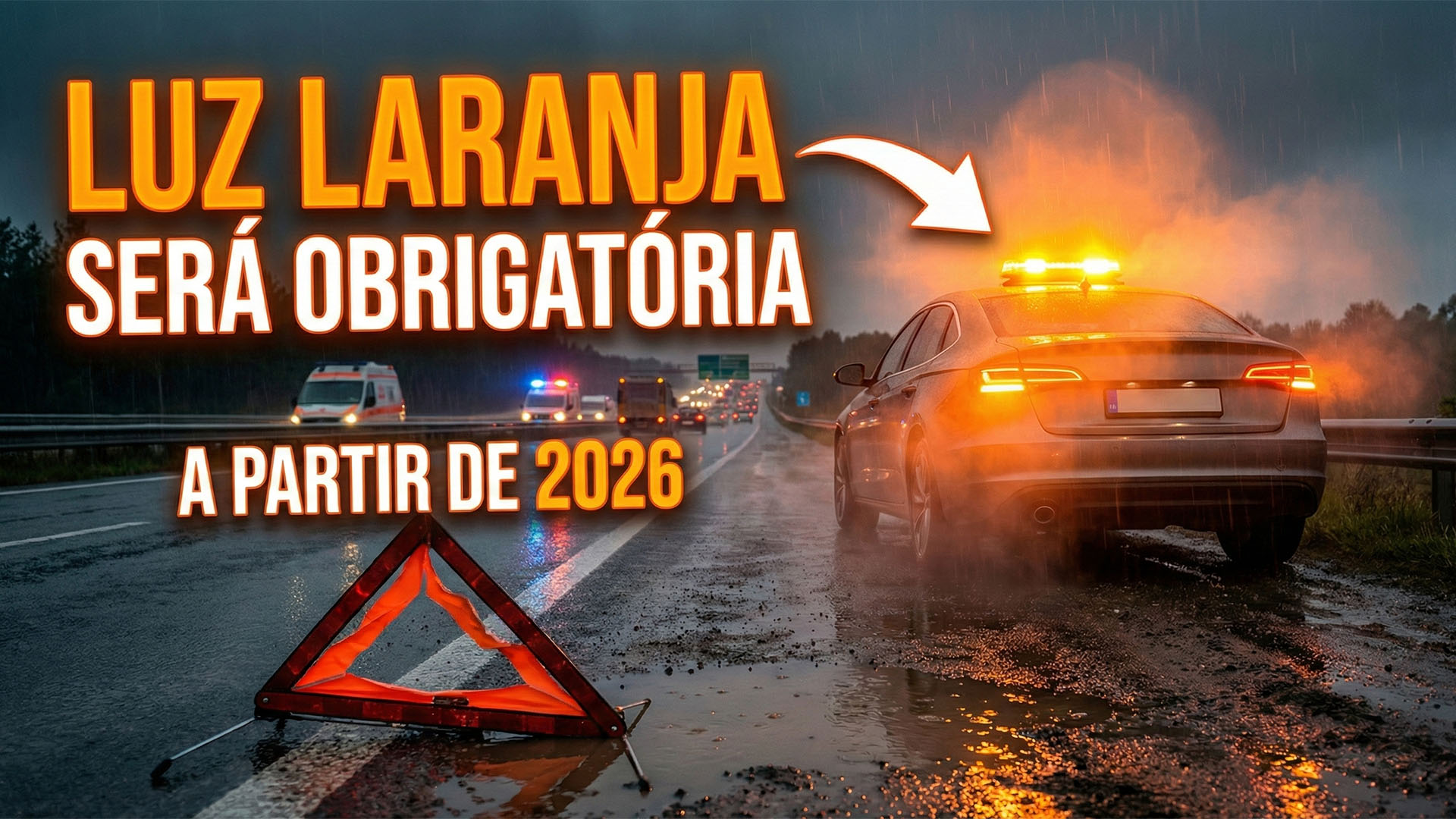


Spain Will Replace the Triangle with the Connected V16 Light in 2026 Aiming to Reduce Pedestrian Accidents on Roads. Understand How the Technology Works, Its Costs, and What the Brazilian Traffic Code Currently Determines About Emergency Signaling.
Starting January 1, 2026, Spanish roads will undergo a significant transformation in road safety regulations. The traditional signaling triangle, a companion for decades for drivers in breakdown situations, will be retired from expressways and highways. In its place, the V16 warning light will come into play, a technological light device that promises to save lives.
This measure is not just an aesthetic upgrade, but an urgent response to fatal accident statistics. Traffic authorities in Spain identified that the act of leaving the vehicle to position the triangle exposes the driver to a very high risk of being hit. The new regulation seeks to eliminate this need, keeping occupants protected inside the vehicle.
The transition will be gradual, allowing drivers to adapt to the new technology over the coming years before full mandatory compliance. However, the discussion has already crossed borders and drawn the attention of drivers in other countries. The main focus is the modernization of the fleet and integration with real-time traffic management systems.
-
Coffee Grounds Find New Purpose Beyond Waste in Innovative Uses

-
Brazilian Entrepreneur Revives Used Cookware, Now Earning $10,000 Monthly at 41

-
Bottle Caps in the Garden: A Creative Solution You Won’t See the Same Way Again
-
Brazilian Producer Adopts Hydroponic Strawberry Farming in Western Paraná, Achieving Year-Round Harvests and Becoming a Model for Continuous Production




Although the law is specific to Spanish territory, it raises discussions about the obsolescence of current safety equipment worldwide. Traffic experts observe that yellow light signaling is much more effective in low visibility conditions, such as fog or heavy rain, than the passive retroreflective materials of triangles.
What is the V16 Light and How Does It Work
The V16 warning light is an emergency signaling device that emits a flashing yellow-orange light beam. Unlike common flashlights, it has been designed to be seen in 360 degrees, ensuring that drivers coming from any direction notice the stopped vehicle. Its magnetic base allows it to be instantly attached to the roof of the car.
One of the major innovations of this device is connectivity. The regulation requires that the V16 has an integrated geolocation system, connected to the cloud of the General Directorate of Traffic (DGT 3.0) of Spain. As soon as the device is activated, it automatically sends the vehicle’s coordinates to emergency services and highway message boards, alerting other drivers.
The cost of the device varies, but it is estimated to range between 30 and 60 euros (approximately R$ 187 to R$ 374 at the current exchange rate). Preliminary studies indicate that the investment pays off quickly by preventing secondary collisions. The device’s battery is expected to have a long lifespan, ensuring autonomous operation for hours, without relying on the car’s power, which could be compromised in the event of an electrical failure.
Advantages of the New Technology for Road Safety
The main advantage of the V16 light is the elimination of the “pedestrian factor” on the roadway. To correctly position a signaling triangle, the driver must walk at least 30 meters behind the vehicle, often in narrow or non-existent shoulders. With the V16, the driver just needs to lower the window and place the device on the roof, without ever unfastening the seatbelt.
Besides the physical protection of the driver, visibility is drastically increased. The light beam generated by the device can be seen up to 1 km away, providing a much longer reaction time for those approaching from behind. This is crucial on high-speed roads, where every second counts to avoid a pile-up or a serious rear-end collision.
Real-time data transmission also revolutionizes emergency response. By receiving the exact location via cell signal (integrated SIM card), ambulances and tow trucks can chart faster routes. This reduces response time in critical situations, where quick medical assistance can make the difference between life and death.
Other European countries, such as Germany, are closely monitoring the results of this implementation in Spain. Field tests have shown that active signaling (light) is superior to passive (reflection) in almost all scenarios. The trend is for the technology to become a gold standard in global automotive safety over the next decade.
Although triangles may continue to be used on rural or urban roads with lower speed limits in Spain, the message is clear: on high-speed roads, technology is the new ally. Reducing the number of accidents involving drivers who left the car to signal a breakdown is the zero goal of Spanish authorities with this legislative change.
Does the Mandate Apply to Brazilian Tourists?
For Brazilians planning to travel to Spain and rent a car, the new rule should not be an immediate headache. Car rental companies will be responsible for updating their fleets with the mandatory equipment. Tourists will only need to know how to operate the device in case of need.
According to Spanish traffic authorities, the rule applies to all vehicles registered in the country. Cars with foreign plates, which are only passing through or on vacation, are exempt from the requirement to have the V16, and can use the signaling systems from their countries of origin, provided they are internationally recognized, such as the triangle itself.
What Does the Brazilian Traffic Code Say About Emergency Lights
In Brazil, the legislative reality is still different from the European one. The Brazilian Traffic Code (CTB) makes no mention of the obligation of light devices like the V16 for passenger vehicles. Here, the signaling triangle remains a mandatory safety item, essential in any vehicle, according to current regulations.
Article 46 of the CTB establishes the general conduct rule in emergency situations. It states that whenever temporary immobilization of a vehicle on the roadway is required, the driver must provide immediate warning signaling. This signaling must follow the standards established by the National Traffic Council (CONTRAN), ensuring that other road users are alerted.
Currently, CONTRAN Resolution No. 36/98 outlines the technical rules. It dictates that the driver must activate the hazard lights and place the triangle at a minimum distance of 30 meters from the rear of the vehicle. The equipment must be installed perpendicular to the roadway’s axis to ensure good visibility and allow other drivers to avoid safely.
Although the V16 is not mandatory, there is no explicit legal impediment for a Brazilian driver to use an additional emergency light as a complement to the triangle and hazard lights. However, it does not replace the triangle under Brazilian law. During an inspection, the absence of the triangle will result in a fine, even if the driver has an LED light on the roof.
Infractions and Cautions When Signaling in Brazil
Failing to signal the roadway in case of breakdown is considered a traffic infraction. Article 225 of the CTB penalizes drivers who do not prevent other road users when needing to remove a vehicle from the roadway or remain on the shoulder. Collective safety depends on this immediate visual communication, especially on poorly lit highways.
In addition to mechanical breakdowns, cargo spills are another situation that requires heightened attention. According to the CTB, if a load falls onto the roadway and cannot be removed immediately, signaling is mandatory. In these cases, auxiliary devices such as cones, cylinders, or markers (in orange and white colors) are recommended by CONTRAN Resolution 973/22.
The Brazilian driver must pay attention to the maintenance of their safety kit. Often, the triangle is forgotten in the trunk and may be broken or have damaged support legs. Driving without the mandatory equipment or with it in an inefficient state is subject to a fine and retention of the vehicle for regularization.
Do you think Brazil should follow Spain’s example and retire the signaling triangle in favor of technological lights, even if it costs more to the driver? Or is the triangle still sufficient for our reality? Leave your opinion in the comments below and participate in this debate on road safety!





Sim sou a favor da sinalização no teto
Brasil como todo sempre ATRASADO em tudo no diz respeito a TRANSITO, nunca o Brasil será país de 1o. mundo, aqui o grande negócio é MULTAR!
Especialmente em vias rápidas, seria excelente, também aqui no Brasil e no mundo!