






 Portuguese
  Spanish


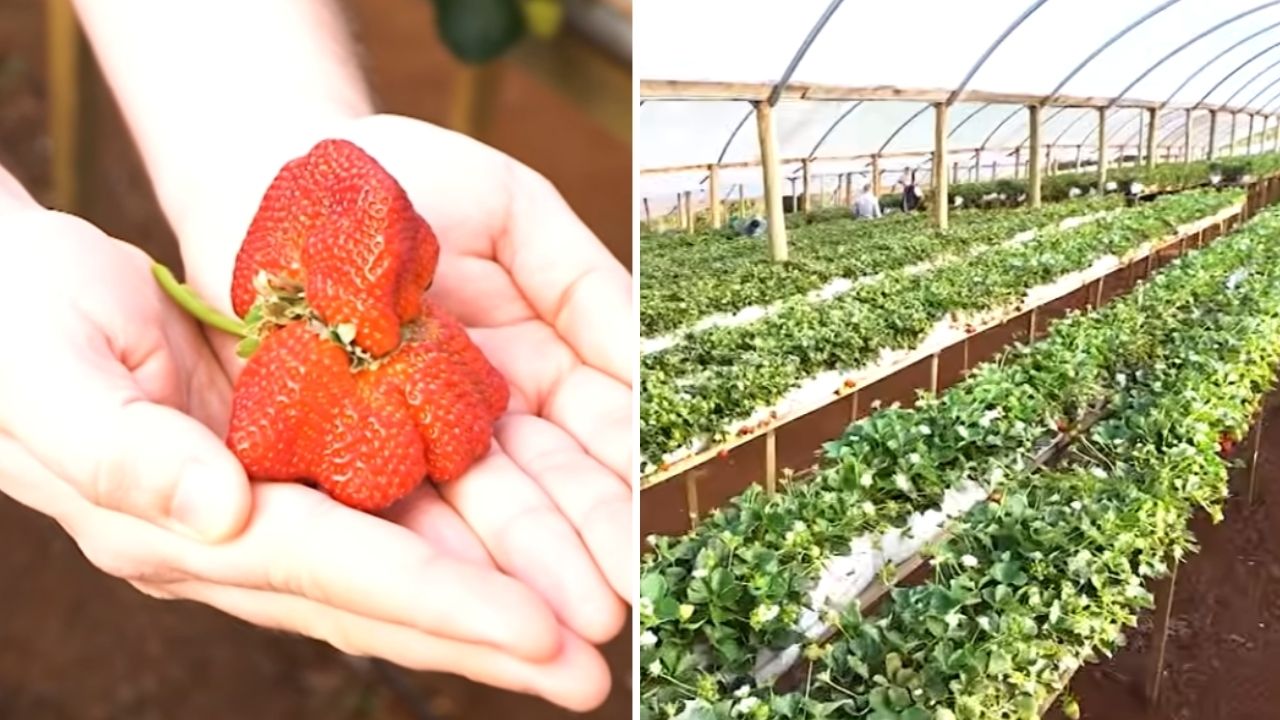

In Xaxim, district of Toledo, producer Paulo uses hydroponic strawberries with different photoperiod varieties, sector irrigation, and balanced nutrition. In a report by RIC TV Oeste, he explained that flowers, green fruits, and ripe fruits allow constant production, as long as water, substrate, fertilization, and sun are well controlled daily
The hydroponic strawberries cultivated in Xaxim, district of Toledo, in western Paraná, show how the choice of variety, daily irrigation, and full sun management can change the logic of a fruit generally associated with a specific season. On producer Paulo’s property, the system allows harvesting at different times of the year.
The production was shown in a report by Mauro Picini, from RIC TV Oeste, on the program Ver Mais. The provided material does not inform the broadcast date but identifies the location, the producer, and the technique used: hydroponic cultivation with different varieties, controlled irrigation, and daily attention to plant development.
Idea was born from an experience outside Brazil
According to Paulo, the idea of working with strawberries began about two or three years ago when he was still outside Brazil. The family was looking for their own production, with the possibility of delivering a product directly to the final consumer.
-
Vale Achieves 45% Female Hiring in Mining by 2025, Surpassing Target a Year Early with 109% Increase in Six Years

-
Over 400 Gold Coins Found in Shipwreck Linked to 17th-Century Dutch Vessel, Unveiling Historic Trade Between Morocco, the Netherlands, and England

-
Why Many People Choose to Keep Silica Gel Packets Instead of Discarding Them

-
São Paulo Unveils $19 Billion Metro Project: 15 Stations, 15.3 km, Cutting Commute from 90 to 23 Minutes with Trains for 2,044 Passengers After Record-Breaking Tunnel Excavation.


The producer, who presents himself in the report as an agronomist, evaluated alternatives until he turned his attention to western Paraná. The choice for hydroponic strawberries arose from the combination of technical knowledge, market reading, and adaptation to the local conditions of Toledo.
Toledo entered the map for constant production
The property is located in Xaxim, district of the municipality of Toledo, a region known for its agricultural strength in Paraná. In the case of strawberries, the differential presented in the report is the possibility of maintaining production for a longer time, instead of relying only on a short harvest period.
Paulo explained that part of the plants can produce all year round, depending on management conditions. Another variety has a cycle concentrated in about six months but delivers larger fruits. This combination allows for staggered production and maintaining the presence of flowers, green fruits, and ripe fruits at the same time.
Hydroponic system requires daily control


The cultivation described by the producer is hydroponic, with water and nutrition supply in a more controlled manner than conventional soil planting. This allows for better adjustment to the plant’s needs, but also increases the requirement for monitoring.
In practice, the work is daily. The routine includes harvesting, removing old leaves, thinning, and monitoring irrigation. Hydroponic strawberries do not function as a production left to the climate: they depend on frequent management to maintain quality and consistency.
Different varieties change the harvest calendar
One of the most important points of the report is the use of varieties with different behaviors. Paulo mentioned plants with different photoperiods, meaning they have different responses to day length and light conditions.
This choice directly affects the property’s calendar. One variety can produce throughout the year when it finds suitable conditions; another concentrates production for six months and presents large fruits. The strategy is not just about planting strawberries, but choosing genetic materials that help distribute the harvest.
Irrigation needs to be done at various times
Water appears as a central element of the system. Paulo explained that instead of just a simple irrigation, the property provides water at various times throughout the day, because strawberries need constant availability.
According to the producer, the pump is turned on for about 22 minutes per sector, a time considered sufficient within that management. The technical point is balance: lack of water harms the plant, but excess can affect flavor, texture, and root oxygenation.
Too much water can also harm the fruit
The producer highlighted an important detail: if there is an irrigation error and the plant receives too much water, the strawberry can become more watery and less sweet. This shows that productivity does not depend solely on the amount of water, but on the correct dose.
He also highlighted that the root is a living being and needs oxygen. Therefore, soaking the substrate or the planting site can hinder development. In hydroponic strawberry production, available water does not mean uncontrolled water.
Full sun is a condition for good development
In addition to irrigation, Paulo emphasized that strawberries need full sun throughout the entire day. This guidance applies both to those working on a production scale and to those maintaining small plants at home, in soil or substrate.
The sun participates in the plant’s development, fruit formation, and the overall balance of the cultivation. When combined with adequate fertilization and correct water management, it helps maintain more stable production throughout the cycle.
Flowers indicate new stages of production
During the report, the white flowers caught attention because they indicate that new fruits are forming. Paulo explained that, on the property, it was possible to see emerging flowers, open flowers, green fruits, and red fruits at the same time.
This visual set helps to understand constant production. When there are different stages in the same area, the property does not rely on a single concentrated harvest: it starts working with successive waves of maturation.
Year-round production depends on conditions
Although the report shows strawberries in different phases, Paulo makes it clear that year-round production depends on the conditions provided to the plant. The variety, irrigation, nutrition, substrate, and regional climate influence the result.
This avoids a simplistic reading. It’s not enough to install a hydroponic system to ensure continuous harvest. Regularity comes from the combination of technique, correct variety, daily management, and adaptation to the environment of Toledo.
Tip for small producers involves water, sun, and fertilization
When commenting on care for those cultivating strawberries at home or on a small scale, Paulo mentioned three basic points: do not let water run out, avoid waterlogging, and ensure full sun. He also recommended attention to strawberry-specific fertilization.
These guidelines show that hydroponic management can have high technology, but still depends on simple agronomic principles. The plant needs to receive the right amount of water, oxygen at the roots, sufficient light, and balanced nutrients.
Hydroponic strawberries show a new path in the field
A production in Toledo shows how hydroponic strawberries can extend the harvest calendar when the producer combines different varieties, sector irrigation, and daily monitoring. The result is a property with flowers and fruits at various stages, even outside the traditional idea of “strawberry season.”
Do you think systems like this can grow in other regions of Brazil, or does strawberry production still heavily depend on local climate and daily management? Leave your opinion in the comments and tell us if you would buy strawberries grown in a hydroponic system.


