






 Portuguese
  Spanish
  3 min of reading
  9 comments


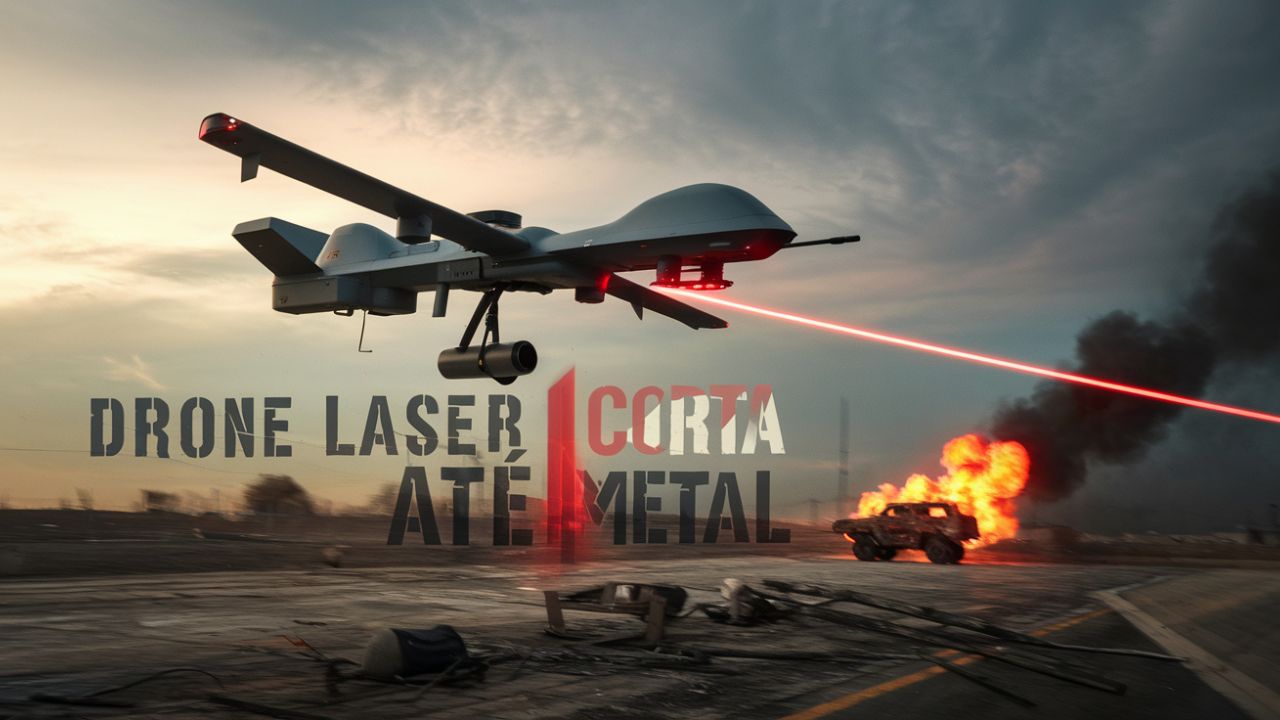


Chinese Weapon Uses 1,080 Nanometer Laser to Carbonize Fabrics in 1 Millisecond and Melt Steel Plates of 2.5 Cm in Just 17 Seconds
China has just added an impressive innovation to its military arsenal: a new military drone equipped with a laser so powerful that it can vaporize human tissue in milliseconds. This advancement, which seems to have come straight out of a science fiction movie, puts the country in the limelight when it comes to directed energy weaponry. But how does this technology work? And what are its implications? Let’s find out together.
What Is the New Chinese Military Drone Equipped with Laser?
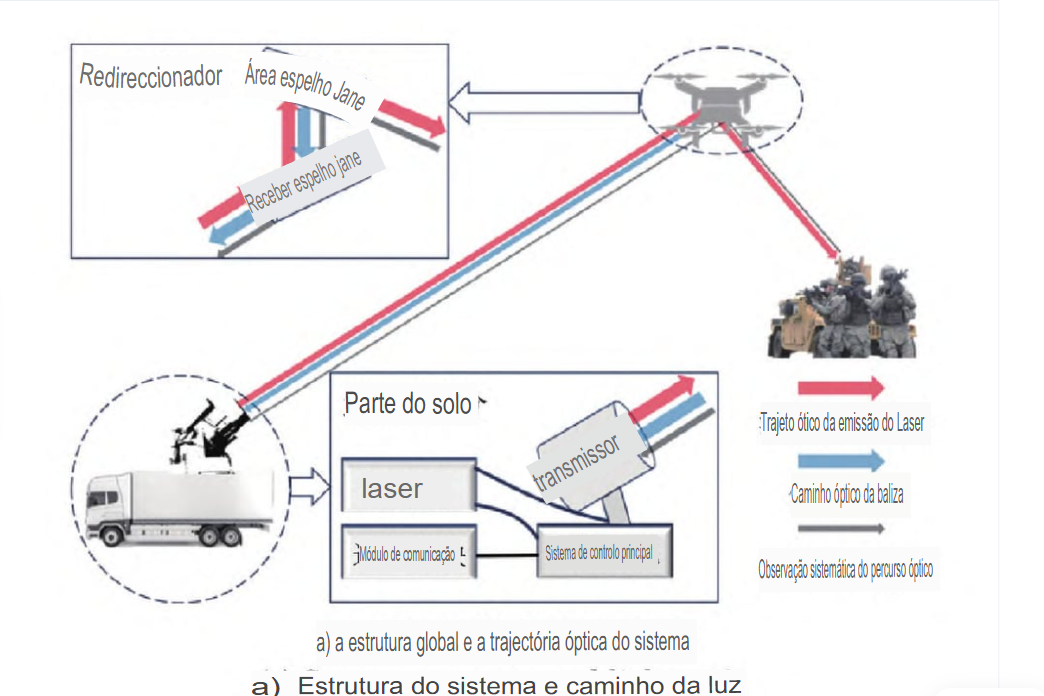
The new Chinese military drone uses a directed energy weapon capable of emitting a concentrated laser beam. This type of technology is specifically developed to neutralize threats, including enemy drones or high-resistance obstacles. Imagine an invisible sword capable of cutting through metal – that’s what we are seeing here.
The laser used in the drone has a power of 1 kilowatt, with a wavelength of 1,080 nanometers. To give you an idea, lasers of this class (Class 4) are normally used in industrial processes, such as welding and cutting metals. A single millisecond of contact is enough to cause instant vaporization of fabric, while materials like plastic, wood, and even metal plates cannot withstand the devastating power of this weapon.
-
Space technology used to search for water on Mars is now hunting for invisible leaks under the streets of São Paulo, using satellites, AI, and chlorine signals to help Sabesp recover up to 6.7 billion liters of water.

-
Japan sends ship to extract mud rich in rare earths at nearly 6,000 meters deep in the Pacific, attempts to lift 350 tons per day from the seabed, and transforms sediments near Minamitori Island into a strategic weapon to reduce dependence on China.
-
Venus Aerospace promises a rotating detonation hypersonic engine that takes the Stargazer to Mach 9 and crosses oceans in 1 hour, but the flight that made history barely surpassed the speed of sound.

-
Brazilian student creates a cheap formula that makes plants grow up to 90% faster and wins an award in a global scientific competition.




How Does the Military Drone Equipped with Laser Work?
The powerful laser is not housed directly in the drone, as it is still too heavy for a compact model to carry. Instead, the drone is equipped with two tubes that act as transmitters. The first tube collects the laser light emitted by a ground station, while the second reflects and directs the beam. The result? Enough energy to vaporize fabrics and melt metals in fractions of a second.
To give you a practical sense, the laser can melt a metal plate in about a tenth of a second. A steel armor plate of 2.54 cm would take approximately 17 seconds to be completely melted. Now, imagine what it is capable of doing with lighter materials or human tissue: instant vaporization.
The Impact of the Laser on Military Operations
The new military drone promises to revolutionize combat operations. Its ability to destroy enemy drones quickly and accurately reduces the need for traditional ammunition and makes operations more agile. The laser is virtually silent, producing no smoke or debris, which enhances its efficiency in tactical situations.
Compared to conventional weapons, the laser offers significant advantages. It is extremely fast, virtually instantaneous, and there is no need to reload ammunition. The cost per shot is much lower than that of traditional projectiles or missiles. It is a futuristic solution that could completely change the battlefield.
What Does the Future Hold for Military Drones with Powerful Lasers?
Despite the advancement, the technology still faces some challenges. The weight of the laser system is a significant limitation, preventing the drone from carrying the power source on board. Weather factors, such as fog or dust, can interfere with the performance of the laser beam.
However, researchers are optimistic. With the constant advancement in lighter materials and compact power sources, it is expected that soon drones will be fully self-sufficient. This means we will see a new generation of even more powerful and versatile weapons in the global military landscape.
The new Chinese military drone with powerful laser is an impressive milestone in the development of directed energy weapons. Capable of vaporizing human tissue and cutting through robust metals, it shows how technology is redefining military operations. There are still challenges to be overcome, but the potential of this innovation is immense.


Então e só destruir a base com um missel
O laser americano para derrubar drones e aviões necessita de uma mega estação de geração de energia elétrica para acionar o laser, sendo utilizado reatores nucleares em miniatura transportados em um caminhão. Portanto está tecnologia tem um custo muito alto para pouca efetividade. O custo de desenvolvimento e operação são tão altos que serve apenas para dissuadir os adversários. No fim é tudo propaganda.
Sugiro que observem uma máquina de corte a laser contar uma chapa a velocidade e tempo de concentração na chapa. Agora imaginem em blindados com 70mm ou mais de chapa quanto tempo de voo estável e concentração de laser em um ponto será necessário apenas para abrir um buraco no blindado.
Faltou falar do alcance desta fibra óptica para levar o concentrado de laser até o drone.
Tem como usar um espelho refletor e mudar a direção do laser?