Portuguese
  Spanish


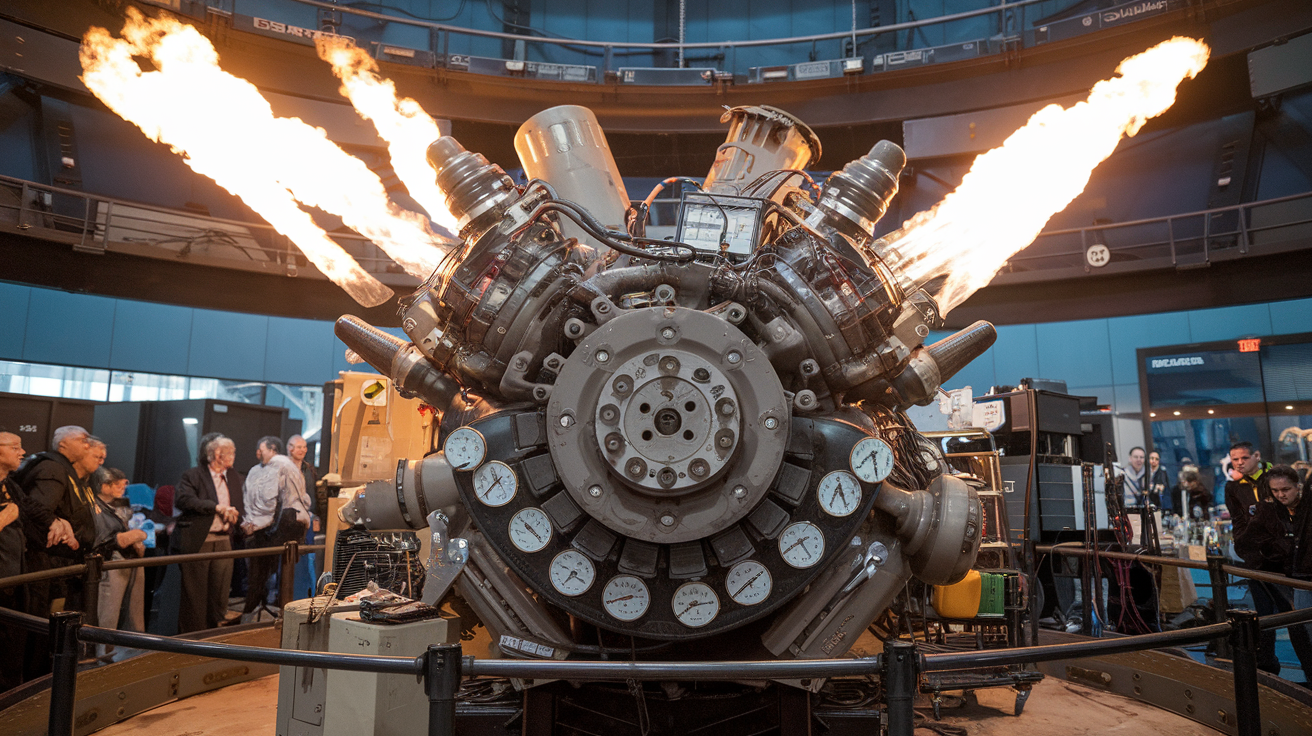


China Develops New Rotating Detonation Engine That Promises to Change Performance in Supersonic Vehicles. Understand the Differentials of the New Propulsor for the Aircraft Market.
A motor capable of transforming a shock wave into stable propulsion is the idea behind a recent technological advance. In China, a team of scientists has developed a new rotating detonation engine that could redefine supersonic vehicles and the related challenges of their engines.
New Rotating Detonation Engine Reaches Mach 4.2
Since the 1950s, detonation engines have attracted increasing interest in aeronautics. These propulsors harness the power of supersonic combustion waves to improve energy efficiency.
However, their adoption is still hindered by thrust instability and technical constraints that remain insurmountable. In this context, Tsinghua University in Beijing announced the Ram-Rotor Detonation Engine (RRDE).
-
China Develops Custom 140-Ton Electric Mining Truck with 770 kWh Swappable Battery, Deploys 290 Units in Xinjiang’s Largest Zinc Mine

-
Meta to Launch Arena, a New Prediction App Targeting 3.56 Billion Users, Competing with Polymarket and Kalshi

-
Scientist Challenges Famous Human Evolution Theory, Argues Homo Sapiens Evolved Gradually Over Thousands of Years
-
15-Year-Old American Builds Ocean Generator with PVC Pipe and 3D-Printed Propeller for $12, Wins National Prize, Presents at White House, and Makes Forbes 30 Under 30 List






By combining a ram-rotor inspired compressor with a rotating detonation, this new rotating detonation engine achieves continuous operation, marking an advancement for this type of propulsion. Its operation is based on a continuous loop, where compressed air mixed with fuel ignites through shock waves, generating constant thrust. This system ensures unique stability, even at speeds reaching Mach 4.2 according to conducted tests.
Scientists from China explain that this new rotating detonation engine stands out for its compact structure and exceptional efficiency. The rotor, equipped with helical blades, optimizes the compression of the air-fuel mixture under ideal conditions for regular detonation, regardless of the inlet airflow.
Numerical simulations confirmed that the detonation remains stationary in the proposed configuration. This allows adaptation in parameters such as airflow rate or fuel richness, ensuring robust performance.
Obstacles of the New Rotating Detonation Engine
Despite these successes of the new rotating detonation engine, obstacles remain. Stabilizing detonation waves and managing heat are among the challenges to be overcome.
However, the team sees these obstacles as fundamental steps towards widespread adoption. If these efforts yield results, the RRDE could become a key solution for supersonic vehicles, opening new horizons in aeronautics and space exploration.
A rotating detonation engine is a type of engine that uses detonation waves to generate thrust. Unlike conventional combustion engines, it exploits supersonic combustion, where a shock wave moves through a mixture of air-fuel, efficiently releasing energy.
In this engine, an annular chamber concentrates the detonation waves, which rotate around a central axis. This rotation maintains continuous combustion, eliminating the cycle interruptions seen in other detonation engines.
Its main advantage lies in the pressure gain, which improves both energy efficiency and thrust. However, its technical complexity, particularly in stabilizing the waves, remains a barrier to widespread adoption. The rotating detonation engine promises compact and efficient propulsion, paving the way for applications in supersonic and space aviation.
Japan Advances in the Use of Detonation Engines
It is worth noting that a few years ago, the Japanese Space Agency (JAXA) announced the successful testing of a detonation engine that can be used to propel airplanes, rockets, and spacecraft.
Unlike a conventional rocket engine, where the fuel burns continuously, in a detonation engine sequential explosions occur in a ring-shaped rotating structure. The explosions are short-lived but repeated at high speeds, achieving frequencies of up to 100 kHz.