






 Portuguese
  Spanish
  4 min of reading
  0 comments


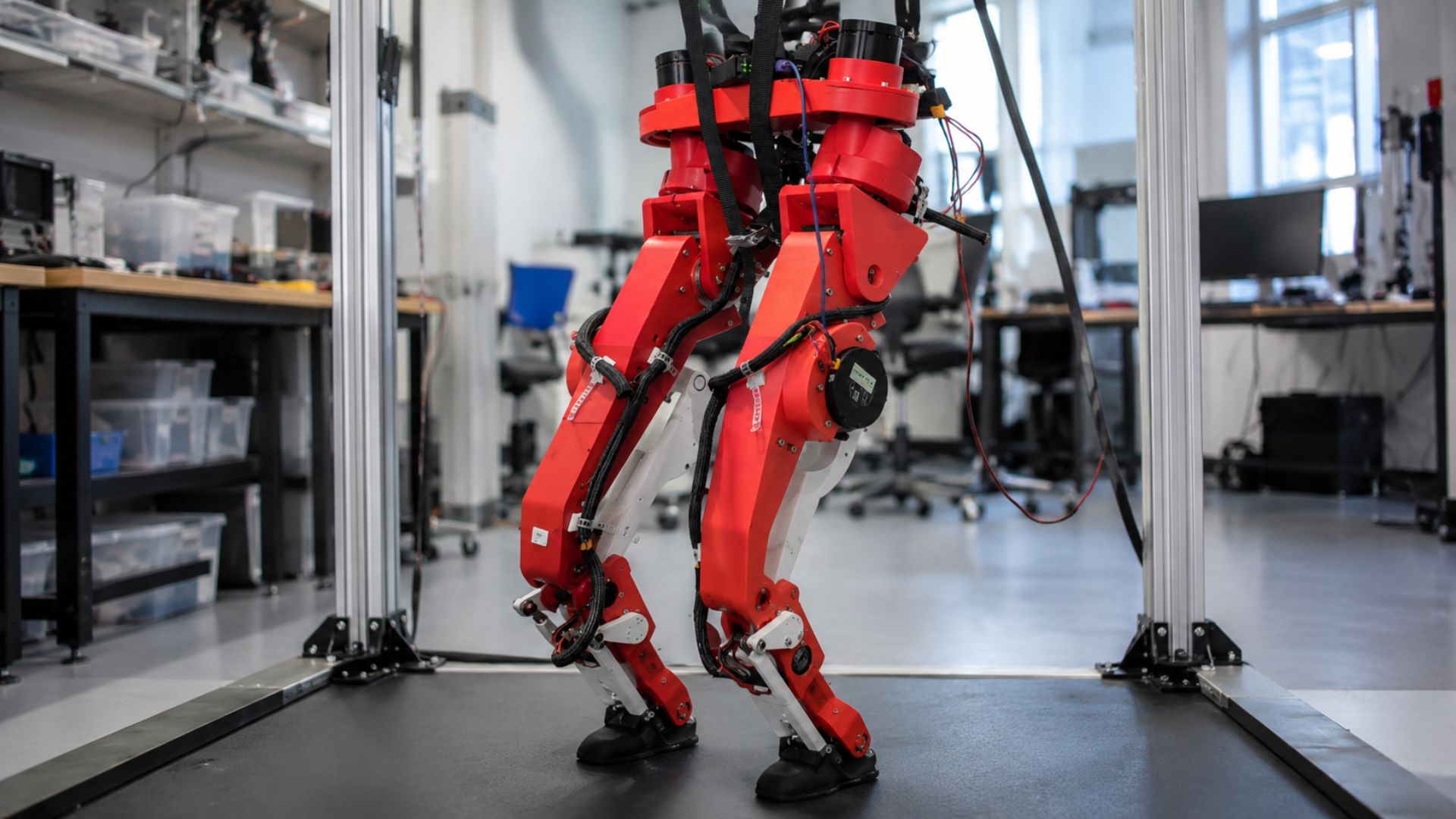
Hugging Face launched the LeRobot Humanoid, an open-source project that allows building a bipedal humanoid robot for about $2,500 using 3D printed parts and off-the-shelf components. The humanoid robot, for now, consists only of robotic legs designed for experimentation in locomotion, posture, and balance. The platform includes printable mechanical files, assembly instructions, wiring documentation, and simulation and artificial intelligence training tools. Hugging Face entered the hardware market in April 2025 by acquiring the French startup Pollen Robotics, creator of the open-source humanoid robot Reachy 2.
Building a humanoid robot has always been a privilege of million-dollar laboratories and tech corporations. Hugging Face, an artificial intelligence company based in New York, wants to change that with the LeRobot Humanoid, an open-source project that turns a home 3D printer and $2,500 in components into the starting point for assembling a functional humanoid robot. The system is modular, printable, and designed for experimentation, allowing researchers, developers, and robotics enthusiasts to test concepts of locomotion, balance, and control without the financial barrier that typically excludes those without access to equipment costing hundreds of thousands of dollars.
The caveat is important: the LeRobot humanoid robot, in its current version, is just a pair of legs. There is no torso, arms, or head. The platform focuses on lower body locomotion, supporting experiments in standing posture, walking, and calibration, while upper body integration and advanced manipulation are part of the future roadmap. For those expecting a complete humanoid, it’s early. For those wanting to learn bipedal robotics in practice, it’s the most accessible project available.
What comes inside the $2,500 humanoid robot

The LeRobot package includes 3D printable mechanical files, a complete list of materials, assembly instructions, wiring documentation, and motor setup tools. The structural components can be reprinted and replaced easily, allowing developers to test design modifications without rebuilding the entire humanoid robot with each iteration, an approach that accelerates the experimentation cycle.
-
Space technology used to search for water on Mars is now hunting for invisible leaks under the streets of São Paulo, using satellites, AI, and chlorine signals to help Sabesp recover up to 6.7 billion liters of water.

-
Japan sends ship to extract mud rich in rare earths at nearly 6,000 meters deep in the Pacific, attempts to lift 350 tons per day from the seabed, and transforms sediments near Minamitori Island into a strategic weapon to reduce dependence on China.
-
Venus Aerospace promises a rotating detonation hypersonic engine that takes the Stargazer to Mach 9 and crosses oceans in 1 hour, but the flight that made history barely surpassed the speed of sound.

-
Brazilian student creates a cheap formula that makes plants grow up to 90% faster and wins an award in a global scientific competition.





The cost of approximately $2,500 covers the actuators, electronics, and off-the-shelf hardware that complement the printed parts. It does not include the 3D printer, which the developer needs to have or access separately. The price is significantly lower than most systems used in robotics labs, where a research humanoid robot can cost from $50,000 to over $100,000.
How the humanoid robot learns to walk


LeRobot is not just hardware: it is a complete learning platform. The project is integrated with the LeRobot-legged-zoo AI framework, which includes simulation environments to train and test reinforcement learning policies for walking and movement tasks. Developers can train the humanoid robot in simulation, adjust parameters based on real data, and transfer the learned policies to the physical hardware, reducing the risk of damaging components during experiments.
The simulation-to-reality workflow is one of the core features. Data generated by the physical humanoid robot is replicated in the simulation to identify differences between virtual and real behavior. Engineers adjust the simulator settings to more accurately reflect hardware performance, improving the reliability of trained policy transfer.
Why Hugging Face entered the humanoid robot market
Hugging Face is known as the leading open-source platform for artificial intelligence models, with millions of developers using its repositories for language, computer vision, and data processing models. The entry into the hardware market occurred in April 2025 with the acquisition of Pollen Robotics, a French startup creator of Reachy 2, an open-source humanoid robot aimed at research.
The LeRobot Humanoid is the first proprietary hardware product emerging from this acquisition. The logic is to extend to robotics the same model that worked for AI: open source, collaborative community, and accessible tools that allow anyone to contribute. For Hugging Face, a $2,500 humanoid robot that any developer can assemble and modify is the robotic equivalent of a language model that any researcher can download and train.
What is needed for the humanoid robot to be complete
The project’s roadmap includes the addition of a torso, arms, and advanced manipulation, but without a defined timeline. The current version of the humanoid robot is explicitly experimental and aimed at those who want to learn, test, and contribute to the development of open-source bipedal robotics, not for those who need a product ready for commercial use.

The potential impact lies in democratization. If hundreds of developers around the world build their own LeRobot humanoid robots and share data, simulations, and improvements, the project could advance faster than any individual lab could achieve. The history of artificial intelligence shows that open source and community accelerate innovation, and Hugging Face bets that the same will happen with robotics.
Would you assemble a $2,500 3D-printed humanoid robot, even knowing that for now, it is just a pair of legs? Do you think open source will democratize robotics as it did with AI? Share your thoughts in the comments.


Be the first to react!