






 Portuguese
  Spanish
  6 min of reading
  0 comments


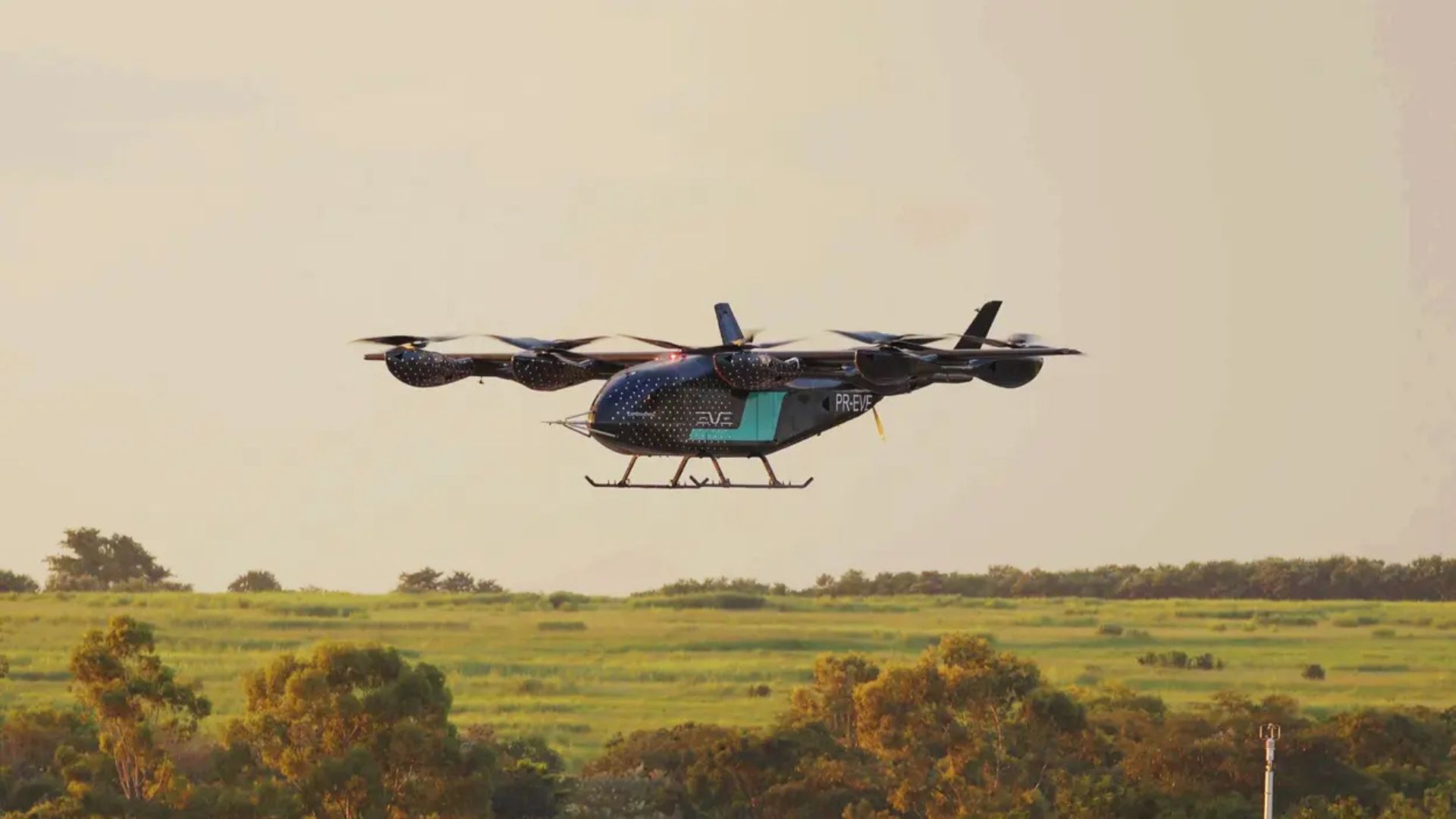
Eve’s electric prototype advances after dozens of test flights, as the company prepares a decisive phase to validate the transition between vertical flight and horizontal movement, a central step for the future of eVTOLs and urban air mobility.
Eve Air Mobility has completed the phase of hovering and low-speed flights of the full-scale engineering prototype of its eVTOL, an electric vertical takeoff and landing aircraft developed within Embraer’s ecosystem.
According to the company, the campaign reached 59 successful flights and accumulated 2 hours, 27 minutes, and 33 seconds of operation, in a stage considered essential before the transition tests to wing-sustained flight.
Announced on May 21, 2026, from Melbourne, Florida, the announcement details a campaign conducted at Embraer’s center in Gavião Peixoto, in the interior of São Paulo.
-
Space technology used to search for water on Mars is now hunting for invisible leaks under the streets of São Paulo, using satellites, AI, and chlorine signals to help Sabesp recover up to 6.7 billion liters of water.

-
Japan sends ship to extract mud rich in rare earths at nearly 6,000 meters deep in the Pacific, attempts to lift 350 tons per day from the seabed, and transforms sediments near Minamitori Island into a strategic weapon to reduce dependence on China.
-
Venus Aerospace promises a rotating detonation hypersonic engine that takes the Stargazer to Mach 9 and crosses oceans in 1 hour, but the flight that made history barely surpassed the speed of sound.

-
Brazilian student creates a cheap formula that makes plants grow up to 90% faster and wins an award in a global scientific competition.





In this testing environment, the aircraft is being used to validate control models, loads, aerodynamics, propulsion, and energy management, points considered central for the next stages of the program.
The conclusion of this phase does not mean that the model is ready for commercial operation, but it indicates the completion of a specific block of the testing campaign.
With this stage completed, Eve gathers data on hovering flight, low-speed maneuvers, and operational stability before advancing to more complex trials in the development of the eVTOL.
Transition to horizontal flight of Eve’s eVTOL
In the next phase, ground preparations will precede the transition flights, when the aircraft needs to leave the vertical regime, supported by the takeoff rotors, and switch to horizontal movement, with the support of the wings.
The forecast informed by Eve is to start this block in the Northern Hemisphere summer of 2026, between July and August, a period in which the program should expand the flight envelope of the prototype.
Considered one of the most sensitive stages in the development of eVTOL aircraft, the transition requires precise coordination between propulsion systems, electronic controls, and aerodynamic behavior in different flight regimes.
In Eve’s project, the tests will evaluate the synchronization between the rotors responsible for vertical lift and the propeller used in forward flight, before stages focused on cruising.
To reduce technical risks, the company claims to adopt a block development strategy, with gradual expansion of speed, altitude, commands, and complexity in each phase of the campaign.

This methodology allows for comparing the actual behavior of the aircraft with predictions made in simulations and computational models, adjusting the program before the prototype advances to more demanding maneuvers.
Tests reinforce control, battery, and propulsion
During the completed stage, the prototype demonstrated stability in hovering flight and predictable behavior under progressively more demanding commands, according to data released by Eve when announcing the end of the block.
The first part of the tests involved low-speed entries below 15 knots, about 28 km/h, focusing on control laws, downwash effects, thermal behavior, and propulsion.
As the campaign progressed, operations advanced to approximately 20 knots of ground speed, equivalent to about 37 km/h, still within a controlled envelope.
In this phase, the aircraft performed simultaneous maneuvers on four axes, a feature used to validate aerodynamic and load models before expanding to higher speeds and greater deflections.
Throughout the block, the company executed more than 100 flight test points, a number that reinforces the database used to correlate simulations with observed behavior in operation.
Also within the completed stage, the prototype reached 215 feet above ground level, approximately 65 meters, and recorded a flight of up to 3 minutes and 48 seconds.
Automatic landing and fly-by-wire system under evaluation
Among the technical milestones highlighted by Eve are the first demonstrations of automatic landing and the simplified fly-by-wire mode, both evaluated within the prototype’s engineering campaign.
This mode acts as a secondary layer of the electronic command system, activated when the normal control mode is not available, expanding the evaluation of alternatives foreseen in the project.
Known in aviation for replacing traditional mechanical linkages with electronic commands, fly-by-wire transmits orders from the pilot or control system to the actuators responsible for moving the aircraft.
In the Eve prototype, the validation of the simplified layer helps assess redundancy, control behavior, and expected responses in scenarios defined by the engineering team during the campaign.

The noise levels observed in the tests were in line with the expectations informed by the company, while the propulsion and battery performance exceeded what was expected for this phase.
Although relevant for an electric project, this result still belongs to a limited test campaign, conducted with an engineering prototype and without commercial passenger operation.
Executives highlight progress in the test campaign
Johann Bordais, CEO of Eve, stated that the completion of the block validates the discipline of the strategy adopted by the company, based on gradual advances and data collection in real conditions.
According to the executive, the 59 flights confirmed stable performance in hovering flight and predictable control behavior within the evaluated envelope, in addition to expanding the technical understanding of the program.
Bordais also highlighted that the campaign provided data on loads, aerodynamics, propulsion, and energy management, elements pointed out by him as fundamental for the transition and certification.
In the same vein, Marcelo Basile, head of tests at Eve, stated that hovering and low-speed flights offer highly reliable data to refine aerodynamic, propulsion, and load models.
According to Basile, the correlation between models and real behavior is what allows expanding the flight envelope in a disciplined manner before advancing to more complex phases.
eVTOL certification still depends on new prototypes
Used to mature the project and reduce risks before the next phases, the current prototype is a full-scale engineering aircraft, not the final certification configuration.
For the regulatory process, Eve plans to use conforming prototypes, built according to the expected configuration for evaluation by the authorities responsible for aircraft certification.
In April 2026, the company had already reported the completion of 50 test flights since the first flight of the prototype, conducted in December of the previous year.


On the occasion, the company said it planned to start in 2026 the production of six compliant prototypes intended for the certification campaign with the National Civil Aviation Agency.
Listed on the New York Stock Exchange under the codes EVEX and EVEXW, Eve also has BDRs traded on B3 under the code EVEB31, expanding its presence in financial markets.
The company is involved in the development of eVTOL aircraft, support services, and air traffic management solutions aimed at urban air mobility, a segment still dependent on regulation and infrastructure.
Commercial operation requires new regulatory steps
Despite the technical advancement, the aircraft still needs to go through decisive phases before any commercial operation, including transition flights, cruise validation, and tests with compliant prototypes.
In addition to flight tests, the development of eVTOLs depends on adequate infrastructure, operational rules, airspace integration, and regulatory acceptance in different operating markets.
For this reason, the results released by Eve represent progress within the engineering campaign but do not indicate an immediate start of commercial service with passengers or regular operation.
The company states that the next ground tests will prepare the prototype for the transition between vertical lift and forward flight, a step planned before wing-sustained flight.
With this new block, the program should expand the flight envelope and provide additional data for the development of the final aircraft, maintaining technical progression before the certification stages.


Be the first to react!