Portuguese
  Spanish


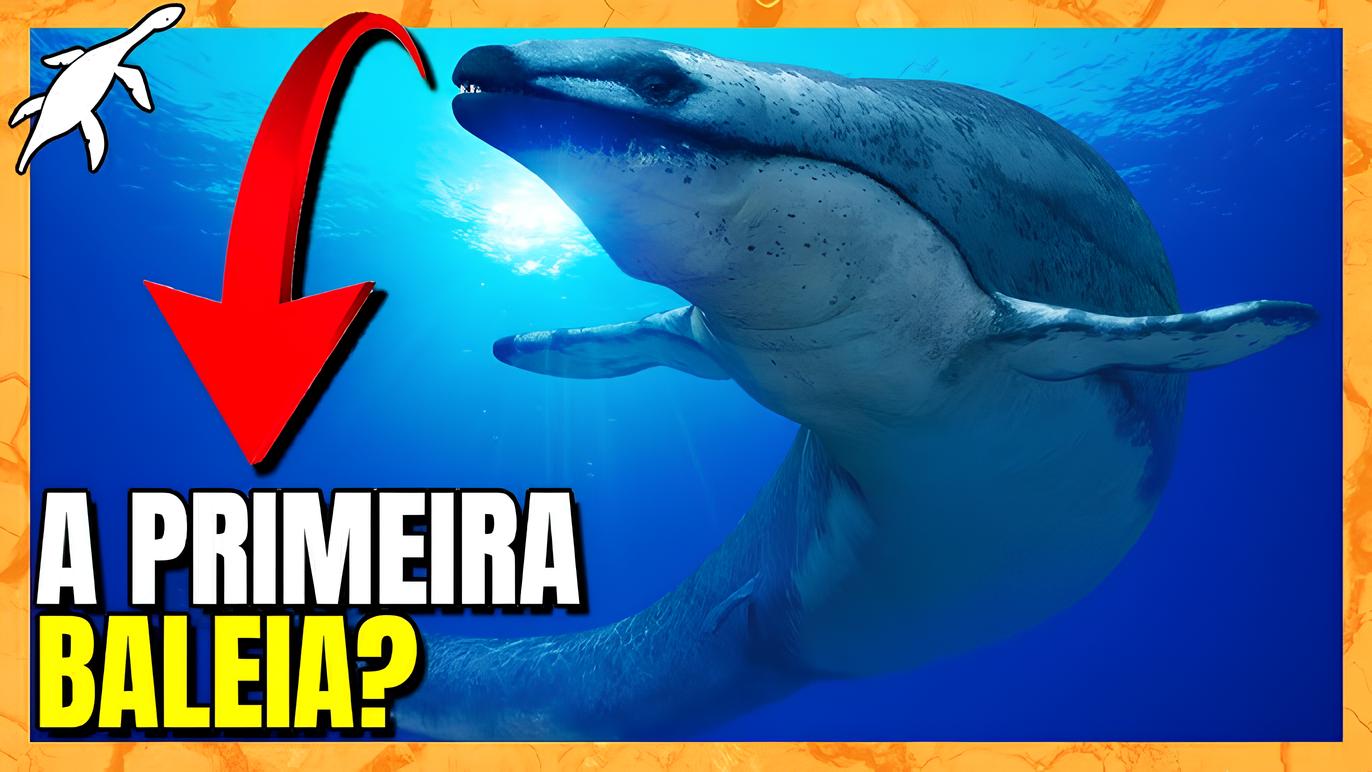


With Up to 18 Meters, Carnivorous Teeth, and a Serpentine Body, the Basilosaurus Was a Prehistoric Predator Whose Dominated the Oceans 40 Million Years Ago.
The Basilosaurus is one of the most impressive animals ever discovered by paleontology. Although its name literally means “king lizard,” it was not a reptile, but rather a totally carnivorous primitive whale that lived between 41 and 34 million years ago, during the Late Eocene. Its colossal size, combined with an unusual body and aggressive predatory habits, places it among the largest marine predators that have ever existed.
The largest known specimens reached up to 18 meters in length, surpassing many modern whales in body length. Unlike today’s whales, its body was extremely elongated and serpentine, resembling more of a giant eel or a sea snake, which for decades confused the early scientists who studied its fossils.
Actual Dimensions and Body Structure of the Basilosaurus
From a technical standpoint, the Basilosaurus impresses not only with its length but also with its unique anatomy. Estimates suggest that it weighed between 15 and 30 tons, depending on the species and individual. Its long body was supported by a backbone with more than 70 vertebrae, a number far superior to that of modern whales.
-
Iraq floats and sinks under an arm of the Euphrates 10 giant concrete boxes of 46,000 tons and 125 meters each to assemble a 2.4 km submerged tunnel and open a new land route between Asia and Europe.

-
Scientists use more than 20,000 artificial birds and solar speakers to “trick” seabirds, reactivate nesting routes, and revive a colony on an island that seemed abandoned.

-
She spent 73 years breathing inside an iron lung, survived the aftereffects of polio, and became the last woman in the United States dependent on the equipment before dying at 78 years old.
-
Brazilian students created a $1 filter using pine bark, cotton, and 3D-printed parts to clean cassava wastewater, reduce the toxicity of a hazardous waste, and transform contaminated water into biofertilizer.






Another striking detail is that, despite its gigantic size, the Basilosaurus had vestigial hind flippers, about 60 centimeters long, completely useless for locomotion. These structures are a clear proof of the evolutionary transition of whales, which descend from terrestrial mammals.
Movement was primarily achieved through the undulating motion of the body and tail, in a pattern similar to that of large aquatic snakes, which explains its very unusual appearance.
Powerful Jaw and Extreme Carnivorous Diet
Unlike today’s filter-feeding whales, the Basilosaurus was an absolute top predator. Its skull could exceed 1.5 meters in length, equipped with large, sharp, and serrated teeth, perfectly adapted to grasp, cut, and crush flesh.
Studies of fossils show bite marks consistent with Basilosaurus on bones of other primitive cetaceans, indicating that it hunted smaller whales, as well as large fish and prehistoric sharks.
Microscopic analyses of the teeth reveal wear typical of an animal that consumed large, tough prey, not just small fish.
In ecological terms, it occupied the exact role now belonging to large orcas or great white sharks—only on an even larger scale.
Where the Basilosaurus Lived and Dominated the Oceans
Fossils of the Basilosaurus have been found in various parts of the world, especially in regions that, during the Eocene, were shallow tropical seas.
The most famous records come from Egypt, in deposits known as Wadi Al-Hitan, the “Valley of Whales,” as well as discoveries in the United States, especially in the states of Alabama, Mississippi, and Louisiana.
These regions were covered by warm, life-rich seas, ideal for sustaining a predator of this size. The wide geographic distribution indicates that the Basilosaurus had a great capacity for adaptation and dominated vast oceanic areas.
Why the Basilosaurus Does Not Look Like Modern Whales
The Basilosaurus belongs to an extinct group of primitive cetaceans known as archaeocetes. They represent a crucial intermediate phase in the evolution of whales, when these mammals still retained characteristics inherited from terrestrial ancestors.
Unlike today’s whales:
- Its body was not compact and hydrodynamic
- It did not have a thick layer of insulating fat
- It relied more on body movements than on efficient flippers
These limitations explain why, despite its colossal size, the Basilosaurus ultimately went extinct, giving way to more efficient, faster, and energetically economical cetaceans.
Comparison with Modern Whales and Other Predators
When compared to a blue whale, the Basilosaurus was smaller in weight, but extremely competitive as a predator.
While the blue whale can exceed 180 tons and feeds on krill, the Basilosaurus was an active hunter, capable of facing other large marine animals.
In relation to orcas, its length could be more than double, although modern orcas are more agile and intelligent.
Against prehistoric sharks, like the ancestors of the megalodon, the Basilosaurus occupied a similar level in the food chain, being one of the absolute lords of the Eocene seas.
Extinction and Scientific Legacy
The disappearance of the Basilosaurus is linked to global climate changes, cooling of the oceans, and transformations in marine ecosystems. Its long and energetically inefficient body likely became a disadvantage in a world that demanded greater efficiency in hunting and locomotion.
Today, the Basilosaurus is one of the most important species for understanding how giant whales evolved from terrestrial mammals, being a key piece in reconstructing the evolutionary history of the oceans.
A Strange Colossus That Redefined Whales
The Basilosaurus was not only large, it was strange, extreme, and dominant. Its serpentine body, carnivorous teeth, and colossal size show that evolution does not always follow predictable paths. It represents a chapter in which whales were not peaceful filter feeders, but predatory monsters capable of dominating entire oceans.
Even millions of years after its extinction, the Basilosaurus continues to impress scientists and readers alike, proving that the seas of the past were just as frightening, if not more so, than any modern fiction.