Portuguese
  Spanish


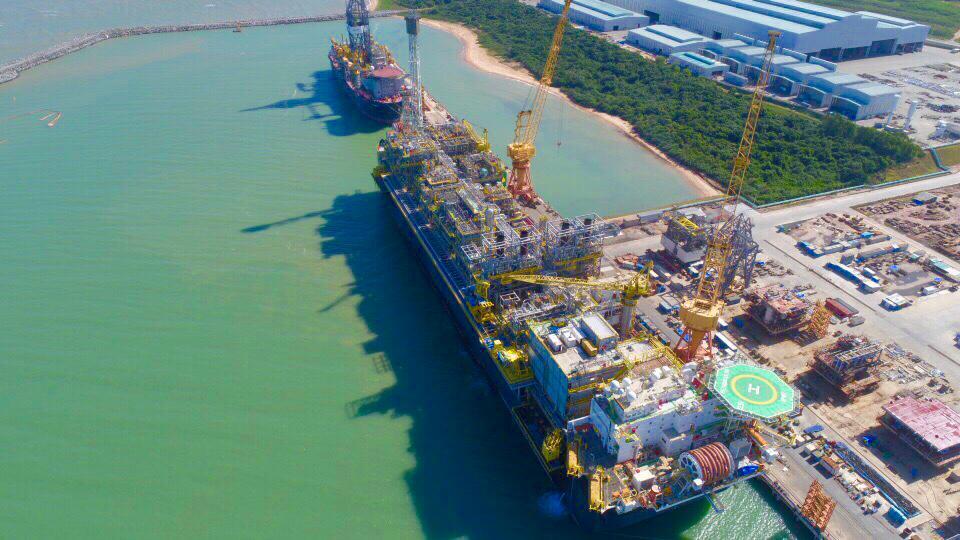

With Inspections by the Brazilian Navy and Inclination Tests Successfully Conducted Since Last Wednesday (11), Petrobras’ FPSO Leaves EJA Towards the Pre-Salt of the Santos Basin
Petrobras spent about R$ 10.66 billion for the construction of the FPSO P-68 at the Jurong Aracruz Shipyard in Espírito Santo. With excellence and work within the expected schedule, the unit finally left EJA today (16) around 6:00 AM heading towards the pre-salt of the Santos Basin, where it will produce in the Berbigão and Sururu fields.
According to ANP (National Agency of Petroleum), 1,200 oil wells will be drilled by 2023, and although this is Petrobras’ last request in 2019, there will still be other units commissioned for the coming years.
The FPSO has a daily processing capacity of 150,000 barrels of oil and six million cubic meters of gas, can store up to 1.6 million barrels of oil, and will operate in a water depth of 2,200 meters.
-
Brazil to Issue “Panda Bonds” in China, Aiming to Raise Up to 5 Billion Yuan at Lower Interest Rates Than Dollar Debt
-
Brazil to Issue “Panda Bonds” in China, Aiming to Raise Up to 5 Billion Yuan at Lower Interest Rates Than Dollar Debt
-
Over 2,000 Tons of Discarded Fishing Nets Since 2020 Repurposed into Durable Caps, Fins, and Parts

-
Seals and Sea Lions Lose Habitat and Food as Climate Change Advances, Impacting Ice, Prey, and Coastal Communities


The first oil is expected to be produced in 2019, if the tests are successful.
The Berbigão and Sururu fields, as well as the West of Atapu, were delineated in the former Iara area (block BM-S-11A). Petrobras operates with 42.5%, alongside Shell (25%), Total (22.5%), and Petrogal (10%).
The Next Project EJA Will Execute in 2020
The FPSO P-71, which is under construction in China, will come to Brazil in 2020 for EJA to integrate the modules to the hull of the unit. Despite the sinking of these two power generation modules (M-15 and M-16), about 120 km off the coast of Itajaí – SC, Petrobras stated at the time that it is making every effort to ensure there are no delays in the established production schedule.