Portuguese
  Spanish


Discover the Ameca Robot, the Most Advanced Humanoid Robot in the World, with Stunning Facial Expressions and Cutting-Edge Artificial Intelligence — but Still Struggling to Perform Basic Actions.
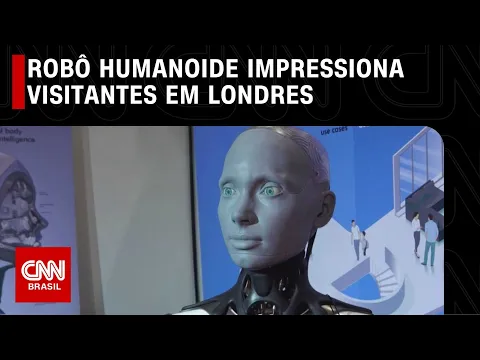
In a laboratory in the UK, a machine capable of smiling, furrowing its brow, and even showing surprise in real-time in front of a human is attracting worldwide attention. Its name is Ameca, and it not only looks human — it acts like one. Developed by the British company Engineered Arts, the humanoid robot Ameca represents the most sophisticated convergence of artificial intelligence, advanced robotics, and biomimetic design. With an estimated cost of US$ 2 million, Ameca is not an ordinary prototype. Experts consider it the most realistic humanoid robot in the world in terms of facial expressions and social interaction. However, despite its impressive communication ability, it still cannot perform simple physical tasks, such as opening a door or picking up a cup accurately.
This contradiction — between a nearly human face and limited bodily movements — exposes the advances and challenges of modern robotics. After all, to what extent can AI imitate humans? Understand what still prevents machines from reaching the level of physical autonomy that science fiction has promised for decades.
The Birth of Ameca: A Showcase of Social Robotics
The Ameca Robot is a creation of Engineered Arts, a British company specializing in entertainment and research robots based in Cornwall. The project was first presented to the public at CES 2022 (Consumer Electronics Show), and since then, it has gone viral in videos showing the robot reacting to people with incredibly natural expressions.
-
Living Robots Made from Human Cells Crawl on Their Own in Lab, Help Heal Neuron “Wounds” and Turn Human Tissue into Microscopic Biological Machines

-
Xlinks Project to Lay 3,800 Kilometers of Cable Across the Atlantic to Export Solar Energy from Morocco Directly to UK Outlets Without Using a Single Turbine

-
Floating Solar Panels Aim for Rougher Seas with Norwegian Rope Mesh Technology, Following DNV Review, Opening New Clean Energy Opportunities in Coastal Areas
-
Olympus Mons: The Solar System’s Tallest Volcano, Over Three Times the Height of Mount Everest, Puzzles Scientists with Its Prolonged Volcanic Activity



Unlike industrial robots or automated assistants like Boston Dynamics’ Spot, Ameca was not created to carry objects or perform mechanical tasks. It is, above all, a platform for human-machine interaction, focused on studies of non-verbal communication, emotional reading, and artificial social intelligence.


With sensors integrated into its face and torso, eye cameras, and a neural network that interprets commands and reactions, Ameca can respond to visual and auditory stimuli in real-time. When someone approaches or talks to it, the robot turns its head, focuses its gaze, and adjusts its facial expression with a fluidity that mimics human musculature — a rare feat in the field of advanced robotics.
Facial Expressions as a Technological Differentiator
One of Ameca’s great differentiators is its ability to express emotions with unprecedented realism. This is made possible by a complex set of mechanical actuators located beneath its gray silicone “skin.”
These actuators mimic the muscles of the human face and allow the robot to:
- Gradually smile
- Lift its eyebrows in surprise
- Show disapproval or confusion
- Blink and move its eyes fluidly
According to the founder of Engineered Arts, Will Jackson, the goal is to create a development platform that represents the closest form of how humans communicate. “Facial expressions are more important than words in many social situations. Ameca was designed to understand this and react appropriately,” he told TechCrunch.
The contextualized emotional reaction is a milestone in the advancement of social robotics and has the potential for applications in public reception, emotional support, and even therapies for autistic individuals or the elderly.
But Why Can’t Ameca Still Open a Door?
Despite its visual sophistication and advancements in embedded artificial intelligence, Ameca still lacks sufficient physical autonomy to perform basic motor tasks. It can move its arms, make gentle gestures with its hands, but it still cannot grip objects firmly, nor open a doorknob accurately.
This occurs because the development of physical robotics faces technical challenges different from those of cognitive AI. Fine motor skills, for example, require extremely sensitive pressure sensors, real-time 3D mapping, and force control — technologies that are still expensive and unstable for integration into social robots.
Moreover, Ameca is not an autonomous robot in the traditional sense. It operates as a “body” connected to external control and processing systems, which limits its ability to move or perform physical commands without supervision.
According to Engineered Arts, the project’s current focus is on improving social and linguistic interactions. The physical aspect — such as walking or manipulating objects — is expected to evolve in future versions or in integration with more complete AI systems, such as the Boston Dynamics Atlas.
Ameca and ChatGPT: Integration with Conversational AI
Since 2023, Engineered Arts has begun integrating Ameca with AI-based language models, such as ChatGPT from OpenAI. This has allowed the robot not only to react with expressions but also to answer questions and engage in conversations with visitors coherently and fluently.
This combination of a realistic robotic body and an advanced conversational system has been seen as a turning point in the development of interactive humanoid robots. At technology events, Ameca has demonstrated the ability to formulate answers, make light jokes, and even politely decline requests — something crucial for its social acceptance.
The most promising application of this functionality is in public environments such as hotels, museums, fairs, and receptions, where interaction with humans requires empathy, quick responses, and understandable body language.
Humanoid Robot Market: Where Does Ameca Fit In?
The humanoid robotics sector is still a growing niche. According to data from Statista and the IFR (International Federation of Robotics), most industrial robots today are geared towards automated production — robotic arms, AGVs (autonomous guided vehicles), and exoskeletons.
Robots that look human, like Ameca, are rare and often have limited applications, both due to cost and technical challenges. However, with the advancement of generative AI, cheaper sensors, and greater social acceptance, this segment is expected to grow exponentially by 2030.
Ameca is today a symbol of this transition, serving as both a technological showcase and a testing tool for the future of coexistence between humans and machines.
Experts’ Critique of the Ameca Humanoid Robot
Despite the positive reception at events and the virality of videos, some experts in AI and robotics have raised important warnings about Ameca and similar projects. The main critique revolves around the so-called “Uncanny Valley Effect” — when something is almost human, but not quite, causing psychological discomfort.
Furthermore, Ameca’s facial realism may create a false impression of consciousness or general intelligence when, in reality, the robot is still a machine programmed to respond based on statistical patterns.
Physicist and futurist Michio Kaku once stated in an interview that “what we see with Ameca is a brilliant advancement in engineering, but we are still very far from creating real consciousness or an AI with self-awareness.”
Understand What Will Happen with the Ameca Humanoid Robot in the Coming Years
The next step for Ameca, according to Engineered Arts, will be to improve its body structure — with the aim of integrating it with robotic legs to provide more freedom of movement. Furthermore, the company is working to connect the robot to more advanced computer vision systems that allow for real-time facial recognition and navigation in public environments.
However, there is still no forecast for a fully autonomous model. The high cost, the need for external support, and operational risks make Ameca a more viable platform for demonstrations, academic research, and controlled environments.
In the short term, it will continue to be a star at technology events, museums, and research facilities — a true “ambassador of social robotics.”
The humanoid robot Ameca represents an impressive leap in advanced robotics, combining artificial intelligence with incredibly realistic facial expressions. It not only shows how far we have come in terms of social interaction between humans and machines but also highlights the technical limits we still face.
Its inability to perform basic physical tasks, such as opening a door, contrasts with its emotional fluidity and reflects the complex challenges of integrating body and mind in a machine. But this does not diminish its importance: Ameca is already considered one of the greatest milestones in the evolution of robotics.
As the world watches its next steps, what is clear is that robots like it are not here just to work — but to talk, learn, and perhaps teach us something about ourselves.