






 Portuguese
  Spanish


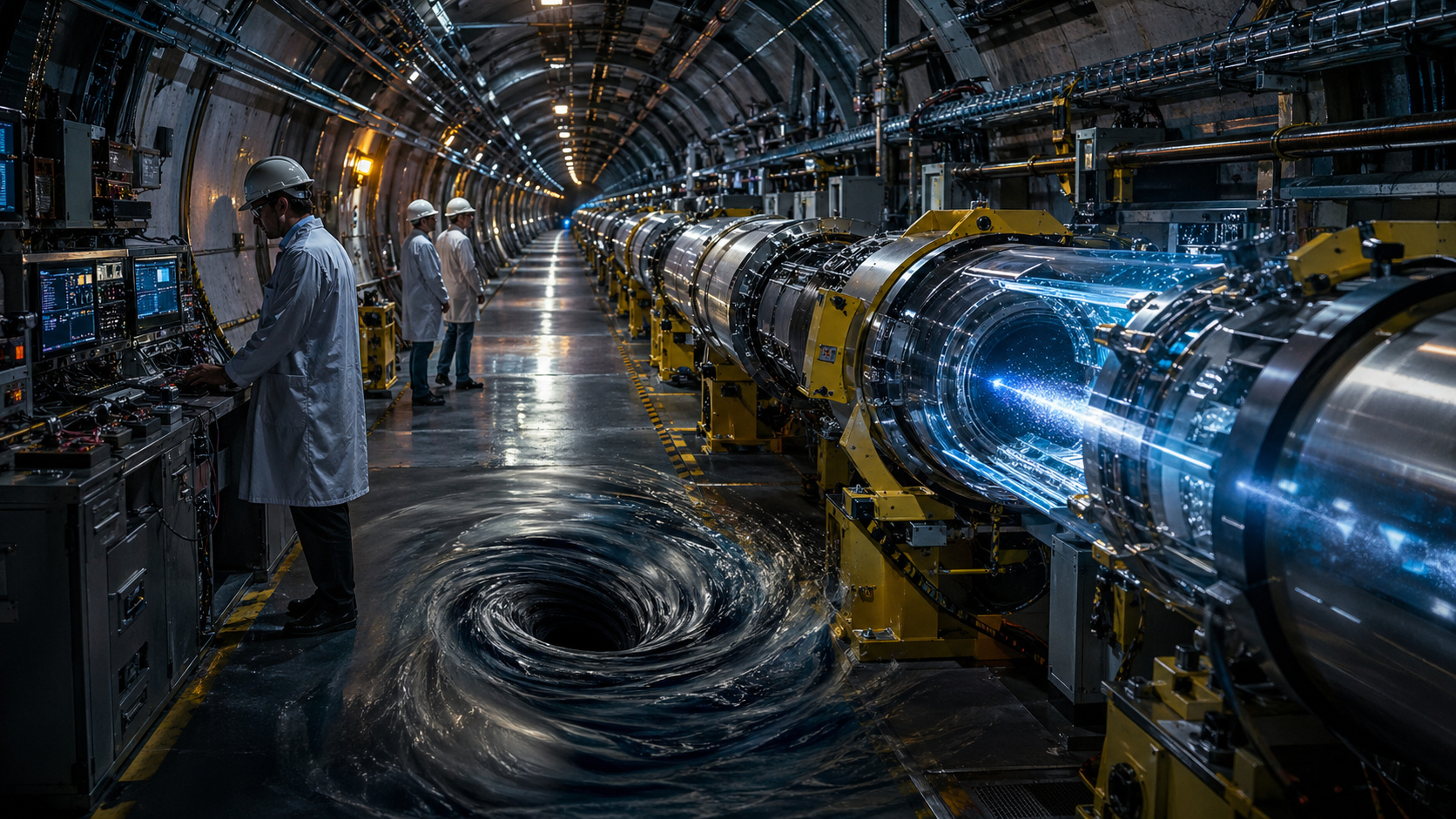


The Large Hadron Collider, one of the largest scientific machines, became the target of legal action, fear campaigns, and public explanations after critics claimed that particle collisions could create black holes and threaten the Earth
One of the largest scientific machines on the planet was almost halted before it could operate for a reason that seems like a movie plot: critics feared that the Large Hadron Collider could create black holes and put the Earth at risk.
The information was released by CERN, the European laboratory for particle physics research. The entity states that the LHC is not dangerous and explains that more energetic collisions than those of the accelerator already occur naturally when cosmic rays hit the Earth’s atmosphere.
The case gained attention because it mixed real science, public fear, and apocalyptic imagination. What was an experiment to study particles turned into a scientific communication crisis, with legal actions and campaigns trying to prevent the machine’s operation.
-
Entrepreneur Who Started at 13 Delivering Flyers by Bike in São Paulo Now Runs a 4,000 m² Culinary Complex in Brazil

-
In China, Workers Use VR Goggles and Body Sensors to Train Humanoid Robots for Tasks Like Folding Clothes and Stocking Stores
-
12-Year-Old Math Prodigy from Brazil Wins Two Gold Medals and Aims for Elite IMPA Tech
-
Magnet Weighing Over 360 Kilograms, Designed for Cardiac Surgery Machine and Valued at $100,000, Retrieves Sawed-Off Shotgun with Scratched Serial Number from Sea During Magnetic Fishing


The CERN particle accelerator became a court matter due to fears of black holes and the end of the world
The Large Hadron Collider, known as LHC, was surrounded by controversy even before it began operating. Critics claimed that particle collisions could generate black holes capable of destroying the planet.
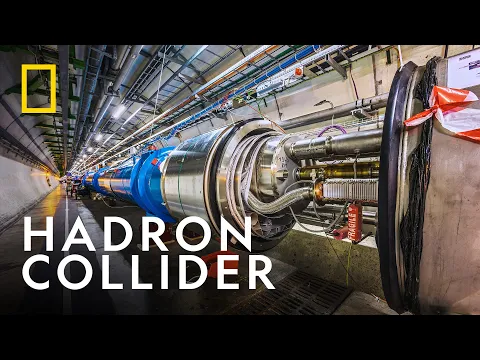

The concern moved from public debate to the courts. A lawsuit was filed in Hawaii by critics attempting to stop the accelerator from operating.
The case drew attention because it placed a scientific facility at the center of extreme fear. A machine created to study matter came to be seen by part of the public as a potential threat to Earth.
What is the Large Hadron Collider and why did this machine scare so many people
The Large Hadron Collider is a particle accelerator used to study very small parts of matter. It makes particles collide at very high energy so scientists can observe phenomena that do not appear in everyday life.
The idea may seem difficult for those not following physics. Simply put, the equipment accelerates particles and causes controlled collisions. These collisions help researchers better understand how nature works on a microscopic scale.
The problem is that words like extreme energy collisions and black holes easily scare people. When these terms reach the general public without simple explanation, fear grows faster than information.
CERN’s response showed that nature itself already produces collisions stronger than those of the LHC
CERN, the European laboratory for particle physics research, detailed that cosmic rays hit the Earth’s atmosphere with energies greater than those produced in the LHC. This point was used to explain why the accelerator did not pose a risk to the planet.
Cosmic rays are particles coming from space. They naturally reach Earth and cause collisions in the atmosphere. Even so, the planet continues to exist, and this phenomenon has not caused global destruction.
This comparison helped turn a technical explanation into something easier to understand. If stronger natural collisions happen without ending the Earth, the fear that the LHC would destroy the planet loses strength.
The lawsuit in Hawaii became a symbol of a scientific communication crisis
The lawsuit filed in Hawaii showed how a mega scientific project can go beyond laboratories and become a matter of collective fear. The issue was not just the machine, but how the public understood its risks.
The science involved in the LHC is complex. Therefore, cold and technical explanations are not always enough. For many people, the mere mention of black holes seemed sufficient to imagine a disaster.
This episode showed that researchers also need to communicate better. When science is not translated into simple language, rumors and exaggerated interpretations fill the void.
A machine built to study matter was accused of being able to end the planet
The most curious aspect of the case lies in the contradiction. The LHC was built to investigate particles and expand human knowledge. Even so, part of the public began to see the accelerator as a threat to the world.
This reaction happened because the topic brought together three powerful elements: a gigantic machine, difficult science, and the idea of the **end of the world**. The combination was enough to transform a scientific experiment into a global agenda of fear.
The real impact was not a physical catastrophe. The impact was the need to face **legal actions**, public campaigns, and a wave of doubts about the project’s safety.
The Large Hadron Collider case still teaches how fear and science can collide
The story of the **Large Hadron Collider** shows that major scientific advances can be misinterpreted when they reach the public without context. The larger the project, the greater the need for clear explanation.
The LHC was not only marked by particle physics. It also became an example of how a scientific machine can be transformed into a symbol of fear when technical terms take on an apocalyptic outline.
In the end, CERN’s particle accelerator did not become a doomsday machine. It became an important case study on trust, communication, and science on a global scale.
But after all, when science advances too quickly for the public to understand, who should better explain the risks and limits of this technology? Leave your opinion in the comments and share this story with those who enjoy science, mystery, and curious debates.


