






 Portuguese
  Spanish
  5 min of reading
  0 comments


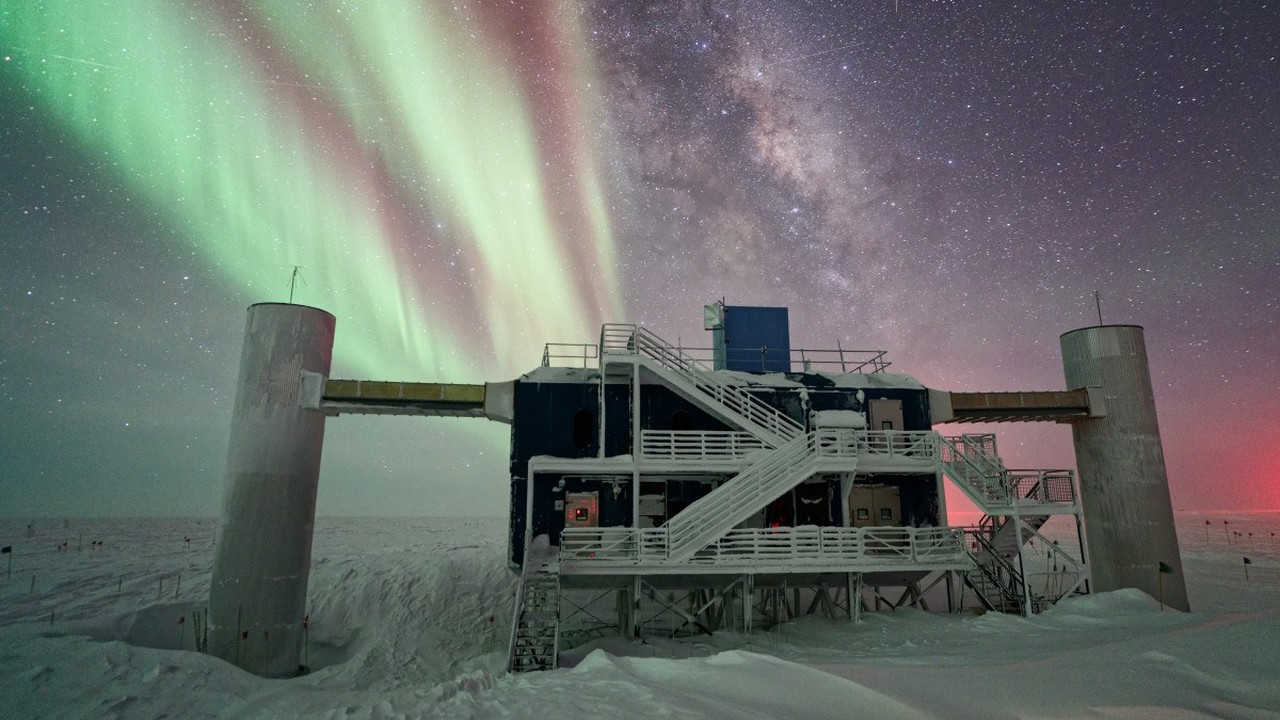
At the coldest and most remote point on the planet, the South Pole, an observatory called IceCube has transformed more than a kilometer and a half of Antarctic ice into a gigantic detector to hunt the most ghostly particles in the universe and discover if gravity obeys the strange rules of quantum physics.
Of all the scientific instruments that exist, IceCube might be the most improbable. Instead of being a machine built in a laboratory, it uses the ice of Antarctica itself as part of the equipment. Deep down, more than a kilometer and a half deep, there are thousands of optical sensors frozen within the ice, spread over a vast volume, all watching the dark in search of a rare flash.
What these sensors are looking for are neutrinos, nicknamed ghost particles for a good reason. They pass through practically everything without leaving a trace, passing through entire planets as if they were air. Every second, billions of them pass through your body without you feeling anything. Precisely because they are so elusive, capturing them is one of the greatest challenges in physics and requires a detector the size of a mountain.
And it’s worth understanding where these invisible messengers come from. The high-energy neutrinos that IceCube seeks are not born nearby; they are launched by the most violent events in the universe, such as star explosions, the surroundings of giant black holes, and phenomena that release more energy in seconds than the Sun does in billions of years. Because they travel through the cosmos almost undisturbed, they reach us carrying intact information about these distant cataclysms, something that ordinary light, easily blocked by dust and gas, cannot always bring. Capturing one of these neutrinos is like receiving first-hand news from a remote and extreme corner of the universe, something impossible to obtain in any other way.
-
Space technology used to search for water on Mars is now hunting for invisible leaks under the streets of São Paulo, using satellites, AI, and chlorine signals to help Sabesp recover up to 6.7 billion liters of water.

-
Japan sends ship to extract mud rich in rare earths at nearly 6,000 meters deep in the Pacific, attempts to lift 350 tons per day from the seabed, and transforms sediments near Minamitori Island into a strategic weapon to reduce dependence on China.
-
Venus Aerospace promises a rotating detonation hypersonic engine that takes the Stargazer to Mach 9 and crosses oceans in 1 hour, but the flight that made history barely surpassed the speed of sound.

-
Brazilian student creates a cheap formula that makes plants grow up to 90% faster and wins an award in a global scientific competition.





Why use ice as an instrument
The idea behind IceCube is brilliant in its audacity. Since neutrinos almost never interact with matter, a huge amount of material is needed for one of them to occasionally hit something and produce a signal. And what better, abundant, and transparent material than the deep ice of Antarctica, formed over millennia and so pure and crystalline that it allows light to travel far within it.
When a neutrino, a rare exception, collides with the ice, it generates a brief flash of blue light. The buried sensors capture this flash and, by cross-referencing data from several of them, scientists can reconstruct where the particle came from and how much energy it carried. It’s like building a giant telescope, but one that is focused not on light, but on these invisible messengers of the cosmos.

Drilling the ice at the end of the world
Installing these sensors was an engineering feat as great as the science they serve. To place them in position, it was necessary to drill the ice more than a kilometer and a half deep, melting the column with hot water to open the wells and lower the equipment before everything froze again, trapping the sensors forever. Each hole is a delicate operation, carried out in one of the most hostile environments on the planet.
The recent fieldwork, which took several ten-week seasons over the past few years, required teams living at the South Pole to drill the ice and expand the detector. I confess I have enormous respect for those who face months in that absolute cold, working to bury instruments that will study the universe from the most inhospitable place on Earth. It’s science done at the limit of human endurance.

Gravity in the crosshairs
What IceCube is now pursuing is one of the deepest questions in physics, whether gravity follows the bizarre rules of the quantum world. This is one of the great unresolved mysteries of science because the two great theories that describe reality, the one that governs the very large and the one that governs the very small, simply do not fit together. And high-energy neutrinos may be the key to testing this.
The idea is that, by traveling cosmic distances, these neutrinos could suffer tiny effects if gravity had a quantum nature, and IceCube is sensitive enough to try to detect these effects. If successful, it would be opening a window to a physics that unites the two theories, something scientists have been pursuing for almost a century without success. It’s an ambitious bet, the size of the detector.

The telescope made of ice
I imagine the poetic strangeness of all this, one of the largest telescopes on the planet does not point to the sky, it is buried in the ice of the South Pole, looking down, allowing ghost particles to pass through it to tell secrets about the origin and laws of the universe. It’s the kind of contraption that seems like fiction, but it’s cutting-edge science happening now.
Each captured neutrino is a letter from some distant corner of the cosmos, perhaps from a stellar explosion or the surroundings of a black hole. And it is in the frozen silence of Antarctica that humanity has set up the ear capable of listening to these messages. Few places show so well how far human curiosity can go to understand where we came from, and for now, it remains there, at the end of the world, listening to the ice in absolute silence.
Did you imagine that one of the largest telescopes in the world was buried in the ice, looking down instead of at the sky?




-

1 person reacted to this.