





 Portuguese
  English
  Spanish
  4 min of reading
  0 comments


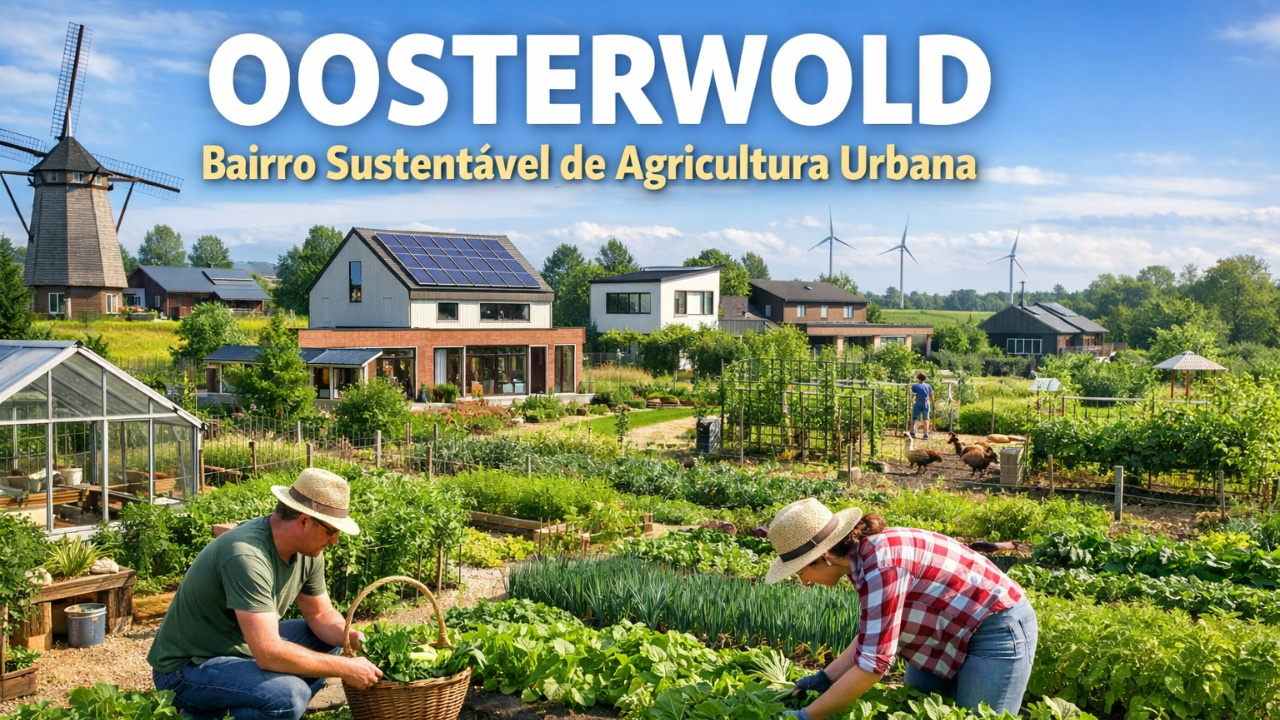
Oosterwold Became an International Reference by Integrating Mandatory Urban Agriculture into Sustainable Planning.
In Oosterwold, a neighborhood located in Almere, the Netherlands, residents are required to allocate at least 50% of their land for food production as a formal condition of residency.
The project brings together about 5,000 people in an area of 4,300 hectares and has become a symbol of integrated urban agriculture within sustainable planning.
Created as an urban experiment to reduce dependence on large supply chains and address the climate crisis, the model transforms backyards into productive infrastructure and strengthens food self-sufficiency.
-
New Fiat EV, priced at R$ 77,000, will bring a reinterpretation of the 147 and a consumption equivalent to 70 km/l.

-
China accelerates environmental plan and targets a historic mark of 76% in urban recycling by 2030 while expanding plants, tightening regulations, and transforming 297 cities into a global reference in waste treatment.

-
Brazil joins a 5-year international mega project to combat plastic pollution on the coast with scientific monitoring, new environmental policies, and integrated actions that promise to reduce waste in strategic coastal cities of the country.
-
More than 10 tons of garbage are removed from Vila da Barca during a revitalization operation in Belém, in an initiative that combines urban cleaning, structural recovery, and environmental improvements to transform one of the most well-known areas of the capital of Pará.




The proposal emerged as an alternative to the traditional Dutch urbanization model, historically centralized and technical.
Instead of a neighborhood planned exclusively by the public authority or large developers, Oosterwold transferred much of the decision-making to the residents themselves.
This resulted in a sustainable neighborhood that combines housing, agricultural production, and community participation.
Currently, in addition to the residents already settled, there is a waiting list for those who wish to live in this format.
The growing interest shows that the concept goes beyond green aesthetics: it is about rethinking how cities produce and consume food.
Urban Agriculture as a Rule in Oosterwold
In Oosterwold, urban agriculture is neither optional nor decorative.
Each property owner must dedicate half of the lot to growing food, either for personal consumption or local supply.
In practice, this means that traditional gardens give way to vegetable patches, orchards, small vineyards, greenhouses, and even areas for raising animals.
The landscape is diverse and reflects the individual choices of each resident. There is no single planting standard, which reinforces the experimental character of the sustainable neighborhood.
This freedom, however, comes with responsibility.
Growing food is part of the urban planning rules and integrates into the sustainable planning of the region.
In other words, producing food is just as important as building a house.
Sustainable Planning Beyond Green Aesthetics
Unlike projects that use the term “sustainable” merely as a marketing strategy, Oosterwold incorporated food production into the official structure of the neighborhood.
Agriculture is no longer a complementary component but a part of the urban infrastructure.
Moreover, residents participate in the creation of streets, drainage planning, waste management, and the implementation of community facilities.
This decentralized model reinforces the concept of a sustainable neighborhood based on shared responsibility.
The main goal is to strengthen local food self-sufficiency.
By shortening supply chains, the neighborhood reduces reliance on long-distance transportation and, consequently, the emissions of greenhouse gases associated with the global food system.
Food Self-Sufficiency and Climate Impact
The global food system is among the largest contributors to carbon emissions, especially due to long-distance transportation, refrigerated storage, and intensive use of industrial inputs.
In light of this scenario, Oosterwold bets on production close to the consumer.
By promoting urban agriculture, the sustainable neighborhood reduces trips powered by fossil fuels.
Therefore, the environmental impact tends to be lower compared to conventional models.
In addition to food, sustainable planning also guides construction.
The project prioritizes durable structures, material reuse, and a long-term vision, reducing the carbon footprint both in infrastructure and agricultural production.
Routine Shaped by Harvest in Oosterwold
Daily life in Oosterwold directly reflects this logic.
In a report by The Guardian, resident Marco de Kat describes a routine where meals are defined by what is ready to harvest.
This direct relationship with food strengthens the bond between production and consumption.
Meanwhile, the restaurant Atelier Feddan, also mentioned by the newspaper, primarily uses ingredients grown in the neighborhood, creating a short and localized food circuit.
Thus, a significant portion of consumption ceases to rely exclusively on global networks.
Food self-sufficiency, in this context, moves from an abstract concept to a daily practice.
Challenges of Mandatory Urban Agriculture
Despite the benefits, maintaining half of the land for production requires dedication.
Not all residents have agricultural experience or available time to care for the crops.
This is why initiatives for cooperation and technical support among neighbors arise.
Community coordination becomes a key piece to ensure that the sustainable neighborhood model functions in a balanced way.
This aspect reinforces that Oosterwold is not just an urban project but also a social one.
The success of urban agriculture depends on continuous collaboration among residents.
Oosterwold as a Laboratory for Future Cities
More than an alternative neighborhood, Oosterwold functions as an urban laboratory.
The experiment tests, in practice, how to integrate housing, food production, and sustainable planning on a large scale.
The experience shows that food self-sufficiency can be incorporated into the city’s rules, rather than just encouraged as an individual habit.
Moreover, it reveals that urban agriculture can play a structural role in the design of future metropolises.
In the face of climate pressures and growing global food insecurity, the Oosterwold model points towards a possible transformation.
By uniting community participation, environmental responsibility, and urban innovation, the Dutch sustainable neighborhood consolidates itself as an international reference in sustainable planning and local food production.








-

-

2 people reacted to this.