Portuguese
  Spanish


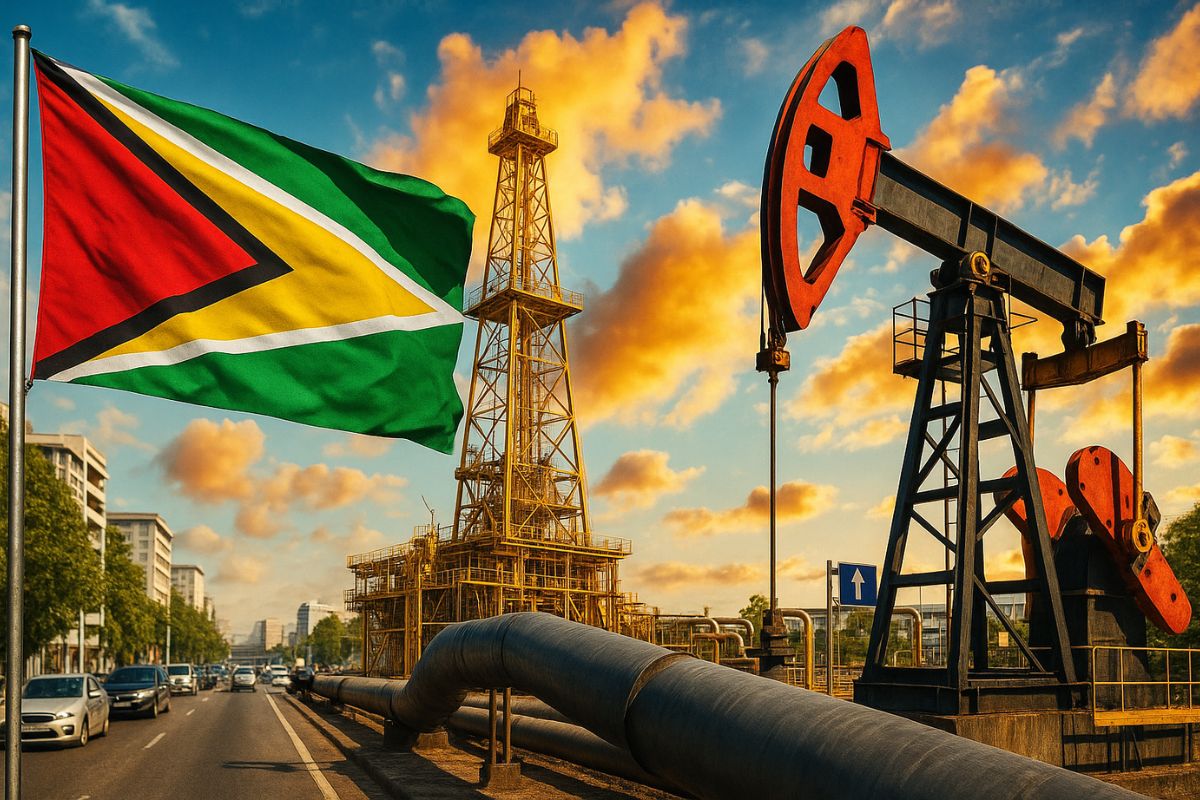


With Production Exceeding 650 Thousand Barrels Per Day, Guyana Establishes Itself as a New Oil Power in South America, Projecting 10.3% Growth in 2025 and Rekindling Territorial Dispute with Venezuela
Guyana, a small South American country of British origin, has become one of the greatest economic phenomena on the continent in just a few years. Driven by an explosive advance in oil extraction, the Guyanese economy is projected to grow 10.3% in 2025, according to the International Monetary Fund (IMF) — four times more than Brazil, which has a projection of 2.5%.
The pace is sustained by multibillion-dollar investments from ExxonMobil and new offshore exploration fields, capable of bringing the country to produce 1.5 million barrels per day by 2029. The abrupt transformation has rekindled the neighbor Venezuela’s greed, which claims part of the Guyanese territory and sees the oil advance as a strategic threat.
The Historic Leap of Guyana Driven by Oil
Until 2019, Guyana did not produce a drop of oil.
-
Brazil’s Micro-Entrepreneur Program May See Major Changes: Income Cap Could Increase to R$ 130,000, Annual Inflation Adjustments, and Allow Hiring of an Additional Employee

-
DoorDash Founder Tony Xu, CEO of an $85 Billion App, Becomes Delivery Driver for an Hour, Completes Four Orders, Makes $19

-
Lufthansa CEO Jens Ritter Takes on Flight Attendant Role, Uncovers Overlooked Issue in Economy Class
-
7-Year-Old Estela Wins Ballet Qualifier; Family Crowdfunds for Argentina Finals in October


In less than six years, it moved from a peripheral economy to one of the most dynamic in the world, recording a 63% growth in 2022.
This leap was made possible by discoveries in deep Atlantic waters and by exploration agreements with American ExxonMobil, which operates the main blocks in the region.
The most recent project, called Hammerhead, was authorized in September and is expected to significantly increase national production capacity.
With it, the government estimates it will exceed 1.5 million barrels daily by the end of the decade, solidifying the country among the largest per capita producers on the planet.
Only the oil sector already accounts for more than 70% of the Guyanese GDP.
Economic Growth Four Times Higher Than Brazil’s
The IMF’s projections place Guyana at the top of the growth ranking in South America in 2025.
While Guyana is expected to advance 10.3%, Brazil is projecting 2.5%, and countries like Chile and Argentina are below 3%.
The combination of high royalties, increasing revenue, and foreign direct investment creates a cycle of expansion that shows no signs of exhaustion yet.
However, economists warn that accelerated growth carries typical risks of commodity-dependent economies, such as abrupt fluctuations in oil prices and structural inflation in non-oil-related sectors.
The challenge now is to transform the boom into productive diversification and avoid the so-called “Dutch Disease” — a phenomenon where an abundance of natural resources weakens other economic activities.
Venezuela Reacts and Intensifies Dispute Over Essequibo
The rise of Guyana has also triggered geopolitical alarms.
Venezuela, which claims the Essequibo region, equivalent to two-thirds of Guyana’s territory, recently passed a law that annexes the area as a new Venezuelan state.
The move generated protests from Georgetown and an immediate response from the international community.
In March, Nicolás Maduro reinforced the rhetoric of sovereignty over the region, claiming that Guyana was “handing over Venezuelan resources” to foreign companies.
The United States reacted firmly, warning that an attack on Guyana or ExxonMobil would have “serious consequences.”
The impasse exposes the new energy power dynamics in South America, where a previously peripheral country challenges Venezuela’s historical monopoly in the regional oil market.
A New South American Energy Power
Guyana is positioned in a transforming energy map.
The country, with just over 800,000 inhabitants, is on track to become the largest per capita oil power in the world.
The large-scale influx of revenue allows the government to fund infrastructure, health, and education, although experts warn of risks of income concentration and institutional fragility due to the influx of foreign capital.
With growing exports and reserves still expanding, the country is expected to maintain record fiscal and external surpluses until the end of the decade.
For investors and governments, Guyana represents the new South American energy epicenter, capable of redefining the balance between Venezuela, Brazil, and the United States in the region.