






 Portuguese
  Spanish


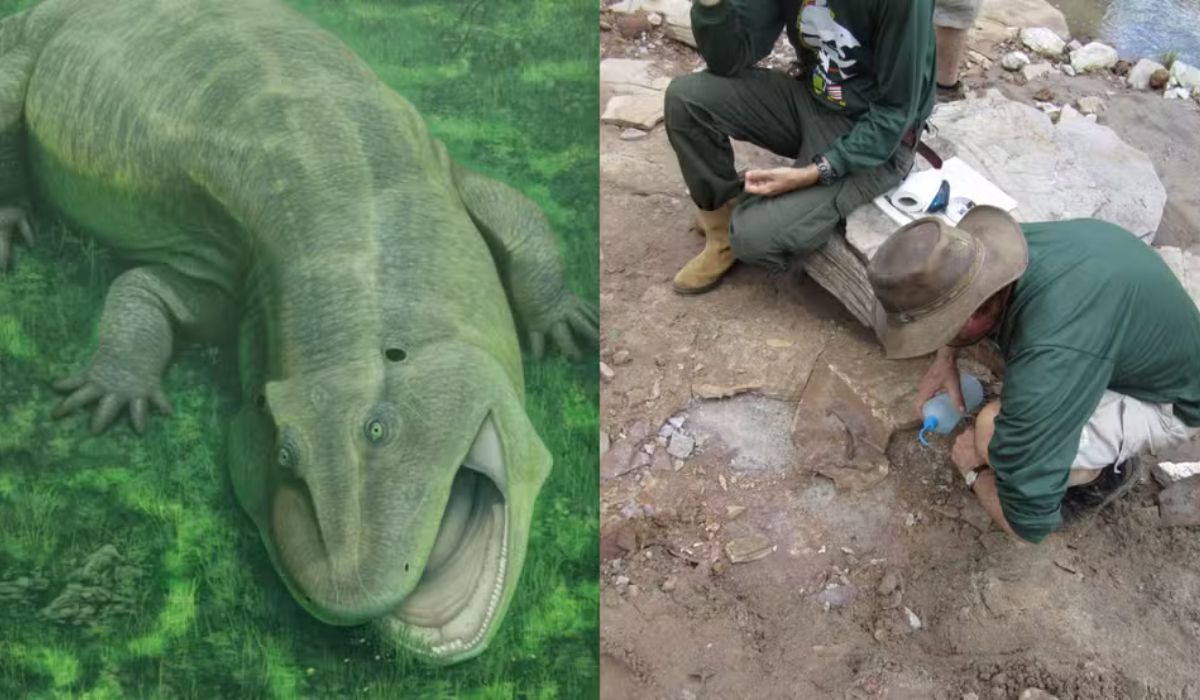

Discovery made in Brazil reveals a prehistoric animal with unusual anatomy, a link to ancient lineages, and clues about how some vertebrates fed long before dinosaurs.
A fossil found in Brazil revealed a previously unknown species of basal tetrapod that lived approximately 275 million years ago, in the early Permian period, before the emergence of dinosaurs.
Named Tanyka amnicola, the animal was described by researchers based on fossilized jaws that show an unusual combination: bone torsion, teeth facing sideways, and signs of a feeding method associated with food grinding.
The discovery was published in the scientific journal Proceedings of the Royal Society B and involves fossils found in rocks of the Pedra de Fogo Formation, in Northeast Brazil.
-
James Webb Telescope Uncovers Unexpected Clues on Mysterious Moon, Potentially Redefining Planetary Origins

-
$1.5 Billion Sleipnir Vessel Transforms Ocean into Floating Construction Site with 12 Hybrid Engines and Capacity to Lift 20,000 Tons

-
23 Years After Tragedy, Brazil’s Alcântara Space Center to Launch New Suborbital Rocket in 2026 with South Korean SEBIT Project Targeting Near-Space Tests
-
Entrepreneur Turns Neighbor’s Coffee Grounds Waste into Eco-Friendly Pellets, Earning Up to $40,000 Monthly in Brazil


This geological unit preserves records of animals that lived when the region was part of Gondwana, an ancient supercontinent that brought together areas now corresponding to South America, Africa, Antarctica, Australia, and India.
To date, the material reliably attributed to Tanyka amnicola consists mainly of fossilized jaws.
Researchers have not identified a complete skull or an associated skeleton that would allow for the reconstruction of the animal’s full appearance.
Therefore, conclusions about its body, size, and way of life are presented in the study based on anatomical comparison with related groups.
Nevertheless, the preserved jaws provided sufficient data for the description of the new species.
In total, nine specimens attributed to the animal were identified.
In all of them, the lower jaw shows a torsion that alters the position of the teeth, causing some of them to be oriented outwards and sideways.
According to the researchers, the repetition of this pattern in different fossils indicates that the characteristic was not caused by deformation after death or by the fossilization process.
Jason Pardo, the lead author of the study, stated that the team considered this possibility for years until they confirmed that well-preserved jaws exhibited the same structure.
“The jaw has this weird twist that drove us crazy trying to understand,” said the researcher, commenting on the analysis of the material.
Twisted Jaw Indicates Rare Feeding Method
The jaw structure is the main element used by scientists to interpret the feeding of Tanyka amnicola.
In addition to the lateral teeth, the inner part of the lower jaw has small teeth, called denticles, distributed on a surface that could participate in food grinding.
In humans, the equivalent area of the jaw faces the tongue.
In Tanyka, this region appears oriented upwards, towards the roof of the mouth.
According to the authors’ interpretation, this arrangement could allow for friction between denticles of the lower jaw and similar structures in the upper part of the mouth.
As the bones of the upper jaw have not yet been reliably found, researchers treat this reconstruction as a hypothesis based on preserved anatomy.
Pardo stated that the team expects the lower denticles to rub against similar teeth in the upper part of the mouth, creating a relatively distinct feeding method among known tetrapods.
The presence of this grinding surface led the authors to suggest that the animal consumed plants at least as part of its diet.
Juan Carlos Cisneros, a researcher at the Federal University of Piauí and co-author of the study, stated that the teeth indicate a herbivorous or partially herbivorous animal.
This assessment is relevant because many known basal tetrapods are interpreted as carnivorous.
Based on this data, Tanyka amnicola began to be treated by researchers as a possible ancient example of a tetrapod adapted to process plant material.
The study, however, does not state that its diet was exclusively plant-based, as the analysis depends on the available record and there are no other skull elements associated with the jaws yet.

Tanyka amnicola and the tetrapod lineage
The expression “living fossil” appears in the study and scientific disclosures to describe the evolutionary position of Tanyka amnicola.
The term does not mean that the animal survived to the present, but that it belonged to an ancient lineage that continued to exist when other groups of tetrapods had already diversified.
Tetrapods are vertebrates with four limbs or descendants of animals with this characteristic.
The group includes amphibians, reptiles, birds, and mammals.
Before the consolidation of these modern lineages, older forms existed, classified as basal tetrapods or stem tetrapods.
Tanyka belongs to this set of archaic lineages.
For the authors, its presence in the early Permian shows that some ancient branches still occupied Gondwanan environments while other more derived groups were already part of the ecosystems.
This interpretation is based on the animal’s position in the evolutionary tree and the estimated age of the fossils.
Jason Pardo compared the case to that of modern mammals that preserve characteristics of ancient lineages, such as the platypus.
The comparison was used by the researcher to explain that Tanyka was not a “less evolved” form, but a late representative of a group with an older origin relative to other tetrapods of its period.
Animal’s body still depends on new fossils
Although the new species was described based on its jaws, the rest of the body remains without confirmed identification.
Ken Angielczyk, curator at the Field Museum and co-author of the study, stated that the fossils were found in isolation.
According to him, without a jaw connected to a skull or other bones, it is not possible to reliably attribute other nearby materials to Tanyka.
By comparison with close relatives, the authors suggest that the animal might resemble a salamander with a slightly more elongated snout.
This description, however, does not correspond to a definitive reconstruction.
It serves as an approximate reference for the public to understand the type of body expected for a basal tetrapod of this group.
The size is also estimated.
Researchers cite the possibility of Tanyka amnicola reaching up to about 90 centimeters in length, equivalent to approximately three feet.
The measurement does not come from a complete skeleton, but from inferences made from the jaws and related animals.
The environment in which the species lived is interpreted from the rocks where the fossils were preserved.
According to the study, these deposits indicate an association with aquatic environments, such as lakes or areas near bodies of water.
For this reason, the authors consider it probable that the animal had water-related habits.
The scientific name also refers to the material found and the environment associated with the discovery.
“Tanyka” comes from a Guarani term related to “jaw,” while “amnicola” means “river dweller” or “one who lives by the river.”
The choice refers both to the fossilized part that allowed the species’ identification and to the sedimentary context of the findings.


Brazilian fossil expands record of ancient Gondwana
When Tanyka amnicola lived, the territory corresponding to present-day Brazil was part of Gondwana.
The fossil record from this period in the Southern Hemisphere is less documented than that of some areas in the Northern Hemisphere, according to researchers in the field.
Therefore, fossils found in the Pedra de Fogo Formation are used to investigate what vertebrate communities were like in the early Permian.
The Pedra de Fogo Formation occurs mainly in the states of Piauí and Maranhão and has already provided different records of fossilized animals and plants.
In the case of Tanyka, the fossils add information about the presence of basal tetrapods in ancient Gondwana environments and about possible feeding strategies of these animals.
For the authors, the species indicates that ancient lineages of tetrapods still existed in tropical ecosystems of the period and could exhibit specific feeding adaptations.
The twisted jaw, in this context, is treated as anatomical evidence to investigate how the animal processed food, and not just as an unusual visual characteristic.
The research also involves Brazilian participation.
The Federal University of Piauí is among the institutions linked to the study, with the involvement of Juan Carlos Cisneros, one of the co-authors of the article.
The work adds to other investigations into the Pedra de Fogo Formation and expands the set of known species from this geological interval in the country.


