






 Portuguese
  Spanish


Understand How Frozen Caves Resist Extreme Heat in Arid Deserts. Understand Why These Ice Caves Don’t Melt and Challenge Science for Decades, Revealing Surprising Natural Phenomena
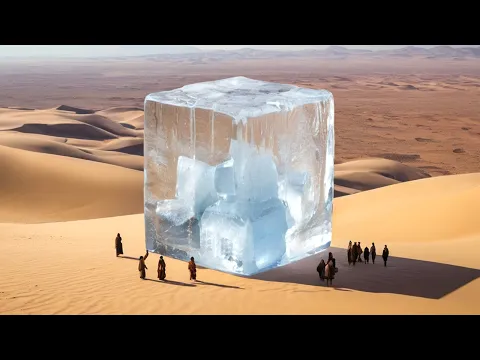
In the middle of the desert, where heat is extreme and humidity is almost nonexistent, underground caves harbor ice formations that remain intact throughout the year. This surprising phenomenon — and at first glance contradictory — has been the subject of fascination and scientific investigation for decades. The existence of ice caves in hot deserts challenges common sense and raises questions about thermal equilibrium in extreme environments.
In recent reports, scholars explain how these natural structures operate as true passive refrigeration systems. The result is the persistence of ice even under external temperatures that often exceed 40 °C. The answer lies in the interaction between geology, air circulation, and natural architecture.
How Does Ice Survive in Deserts?
These caves generally form on slopes or deep rock formations, with narrow entrances well protected from direct sunlight. This strategic positioning prevents internal heating caused by solar radiation, one of the main villains of ice melting.
-
The U.S. is Repurposing Giant Retired Wind Turbine Blades in an Ambitious Project to Tackle Energy Transition Waste

-
Indian Engineers Break Through Two Tunnels in 278-Meter Himalayan Dam, Advancing 2,880 MW Hydroelectric Project in Dibang Valley
-
India Deploys High-Speed Lifesaving Drone in Bay of Bengal Rescue Operations
-
Hong Kong Converts Former Coastal Landfill into Desalination Plant Producing 135 Million Liters of Drinking Water Daily


Moreover, the interior of these caves features characteristics that favor the accumulation and maintenance of cold air. During the winter, cold air currents penetrate the cracks and accumulate at the bottom of the cave.
Since cold air is denser, it stays there, while the warmer summer air — lighter — has difficulty entering, creating an isolated and stable microclimate.

A minimum ventilation and natural insulation prevent rapid thermal exchanges with the external environment. Thus, the ice formed in cold seasons can persist for months or even years.
Ice Caves in Iran: A Real Example in the Desert
In Iran, a country known for its scorching summers and extensive deserts, there are numerous reports of caves with permanent ice. Among the most notable examples is the Chelgerd Ice Cave, located in the Iranian province of Chaharmahal and Bakhtiari, where ice persists throughout the year, even with external temperatures above 40 °C at certain times.
According to Iranian researchers, the cave’s location and geological structure are crucial for the ice’s persistence.
The entrance faces north, drastically reducing sunlight exposure, and the interior has little ventilation, which retains the cold air accumulated in winter. The ice that forms inside the cave also acts as a “thermal buffer,” cooling the surrounding air and preventing the internal temperature from rising significantly.
The Role of Ice in Internal Thermal Regulation
The ice present in the cave itself acts as a thermal regulator. When warm air eventually enters, it is cooled upon contact with the ice before reaching other parts of the structure. This creates a self-regulating cycle: the ice keeps the air cold, and in turn, the cold air prevents the ice from melting quickly.
The cave functions, in practice, as a natural refrigerator, where the processes of conduction, convection, and thermal radiation are controlled by specific geological conditions. This demonstrates how nature can, on its own, create highly efficient and sustainable thermal regulation systems — even in hot deserts.

Intrigued Scientists Seek to Understand and Preserve These Environments
The persistence of ice in arid regions is a topic that intrigued scientists have been studying closely, especially in times of climate change. These caves function as natural indicators of thermal balance and historical recorders of atmospheric conditions from other times.
Research suggests that the ice found in caves around the world may contain particles of dust, gases, and microorganisms preserved for centuries, serving as a kind of “climatic archive.”
Additionally, there is a growing interest in studying these formations as models for extraterrestrial environments — such as underground caves on Mars — where ice could exist shielded from solar radiation. These caves are also relevant for studies on thermal resilience and passive architecture, potentially inspiring solutions for buildings in extreme climates.
Curiosities: Similar Caves in Other Parts of the World
Although the phenomenon is widely reported in Iran and Asian deserts, there are records of ice caves in other improbable places, such as California (USA), regions of Mongolia, and parts of Eastern Europe. In these areas, the combination of altitude, volcanic geology, and low solar exposure favors the persistence of ice.
In the Lava Beds Ice Cave, for example, the presence of basalt rocks helps maintain a low internal temperature, while the terrain and vegetation limit direct sunlight exposure. This shows that, although rare, these formations can occur in various points around the globe, as long as the natural conditions align.
Beyond Science: Tourism and Conservation
Caves with permanent ice are not only objects of research but also tourist attractions. However, uncontrolled tourism can harm the internal microclimate of these formations, accelerating ice melting and compromising their thermal balance.
Many countries are implementing controlled visitation policies and environmental monitoring to preserve these unique environments. Protecting these structures is essential not only for the advancement of science but to ensure that future generations can also witness this rare natural phenomenon.
Ice Where Least Expected: The Power of Nature to Surprise
The ice caves that exist in deserts prove that nature is more complex and ingenious than we often imagine. They show that even in environments considered extreme and inhospitable, favorable conditions for cold conservation can arise — something that defies logic and stimulates scientific curiosity.
Through natural strategies of thermal insulation, solar positioning, and cold air retention, these formations maintain ice where it theoretically should not exist. Researchers around the world continue exploring these sites in search of answers that may have implications far beyond geology — reaching climatology, architecture, and even space exploration.
What once seemed impossible, therefore, reveals itself not only as possible but natural, demonstrating once again how the planet holds phenomena that we are only just beginning to understand.


