





 Portuguese
  English
  Spanish
  4 min of reading
  0 comments


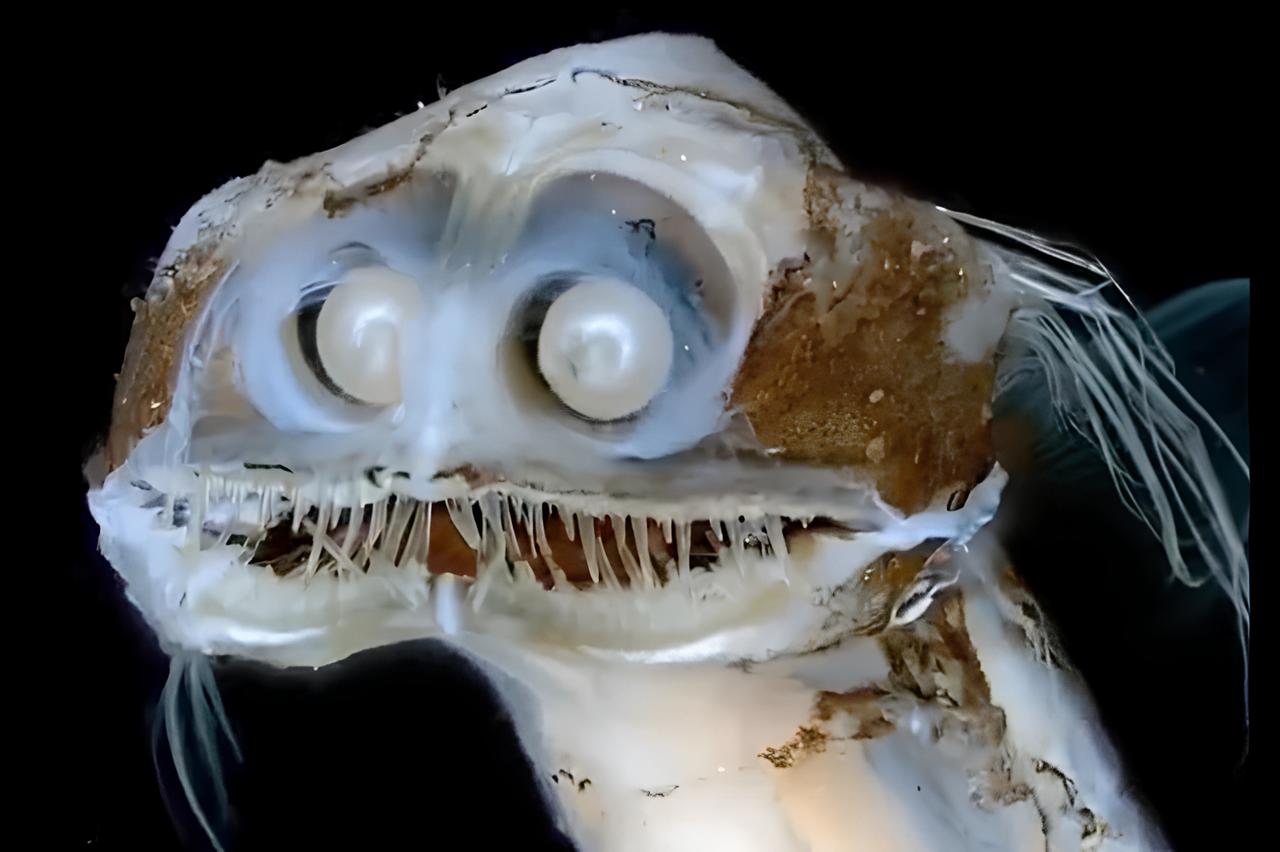
With Transparent Head and Rotating Eyes, the Telescope Fish Fascinates Scientists and Proves That Deep-Sea Creatures Are Stranger Than Fiction.
Few animals on the planet can challenge logic as much as the telescope fish (Macropinna microstoma), one of the most intriguing creatures of the ocean depths. Discovered for the first time in 1939, but clearly observed only in 2009, this small being of about 15 centimeters inhabits regions of the Pacific at over 600 meters below sea level, where sunlight never reaches and the environment is dominated by extreme cold and absolute darkness.
For decades, it was only known from accidental captures in fishing nets. The specimens caught would reach the surface deformed, making it difficult to understand the animal’s actual anatomy. It was only when researchers from the Monterey Bay Aquarium Research Institute (MBARI) were able to film it alive in its natural habitat that the world truly got to know the surreal appearance of the telescope fish — a creature that seems to have come straight out of science fiction.
Transparent Head and Eyes That Rotate Within the Skull
The most impressive feature of the telescope fish is its transparent, liquid-filled head, which serves as a kind of protective bubble. Inside it, there are two green tubular eyes that can rotate forward and upward.
-
USA issues warning after the advancement of a 10,400 km railway linking China to Iran; the $400 billion corridor crosses 4 countries, spans thousands of kilometers of desert, and challenges traditional maritime routes.

-
Bricklayer goes viral by revealing profession’s salary and saying that ‘nobody wants to get their hands dirty’: at 22 years old, young man reveals high salary, exposes the lack of young people in construction and also warns about the future of the sector
-
Xuxa’s mansion sold for R$ 45 million features a tropical garden, spaces for animals, automated systems, and constant climate control in its 2,600 m²; but what sparks curiosity is the energy bill.
-
New Zealand remains among the happiest countries in the world, but is on alert: 71.8 thousand citizens left the country in one year, the exodus reaching the highest level in 13 years, and the economic crisis is pushing an entire generation to Australia and the United Kingdom.




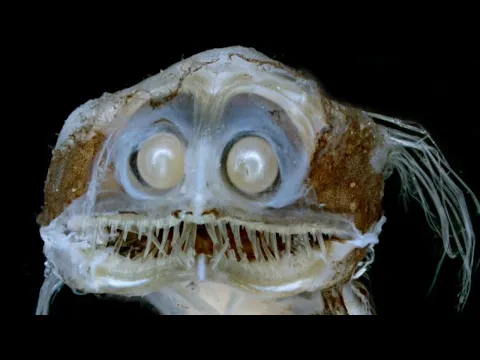

This eye mobility is essential for survival: when the animal is stationary, its eyes look upward, allowing it to observe silhouettes of prey passing above; when it approaches a target, it changes the angle of its eyes forward and attacks with millimeter precision.
Scientists explain that the transparency of the skull also serves to reduce the reflection of bioluminescence in the environment, helping the fish remain invisible amid the blue-green darkness of the deep sea. This level of biological adaptation is so extreme that zoological experts have compared the telescope fish to a “biological underwater telescope,” made by nature itself.
A Silent Hunter of the Abyssal Zones
Living between 600 and 800 meters below sea level, the Macropinna microstoma belongs to a layer known as the mesopelagic zone, or “twilight zone,” where the pressure is dozens of times greater than at the surface. There, it moves slowly, conserving energy and hunting small prey like plankton, crustaceans, and bioluminescent jellyfish.
Because it lives in an environment where nearly everything glows, the telescope fish has developed a highly sensitive vision, capable of detecting minimal traces of light. This ability makes it a formidable predator, despite its fragile appearance. Its small yet precise mouth opens to capture food in a fraction of a second.

Researchers believe that the fish maintains a symbiotic relationship with certain species of jellyfish, using their tentacles for shelter while feeding on small organisms trapped in them. This behavior is extremely rare and sophisticated for an animal of such depths.
The Impossible Anatomy
The body of the telescope fish is short, laterally compressed, and covered by dark scales, contrasting with the translucent shine of its head. Inside the cranial bubble, the eyes are supported by a complex system of muscles and fluids that stabilize vision even under high pressure.
While most deep-sea fish have fixed eyes, the Macropinna can rotate them nearly 90 degrees, something unprecedented in the animal kingdom. This mobility has even inspired projects in optical engineering and underwater robotics.
Curiously, the two small spots in front of its face, often mistaken for eyes, are actually olfactory organs, which help in the chemical detection of prey — a reminder that appearances in the depths can often be deceiving.
The Evolutionary Mystery
There is still no consensus on how the telescope fish developed this unusual anatomy. Studies in genetics and embryology suggest that cranial transparency is the result of a mutation that eliminated pigments from the dermal tissue, allowing light to pass through to the eyes.
This extreme evolution indicates a process of millions of years of adaptation to an ecosystem where seeing the invisible is the difference between living and being eaten.
Since its iconic filming in 2009, the Macropinna microstoma has become a symbol of abyssal biodiversity and how much humanity still does not know about the oceans. It is estimated that more than 80% of deep-sea species have never been documented. Therefore, the telescope fish is just a glimpse of the vast catalog of creatures that challenge our conceptions of what is possible in nature.
With each new underwater expedition, scientists discover organisms so exotic they seem to exceed the known biological limits. The telescope fish is an emblematic example: a small, fragile, and silent being, yet representing the triumph of evolutionary adaptation in one of the planet’s most hostile environments.
While many see it as an exotic curiosity, for science, it is a living window into an invisible world, a reminder that the boundaries of Earth are still far from being fully explored.





-

-

-

-

-

13 people reacted to this.