Portuguese
  Spanish


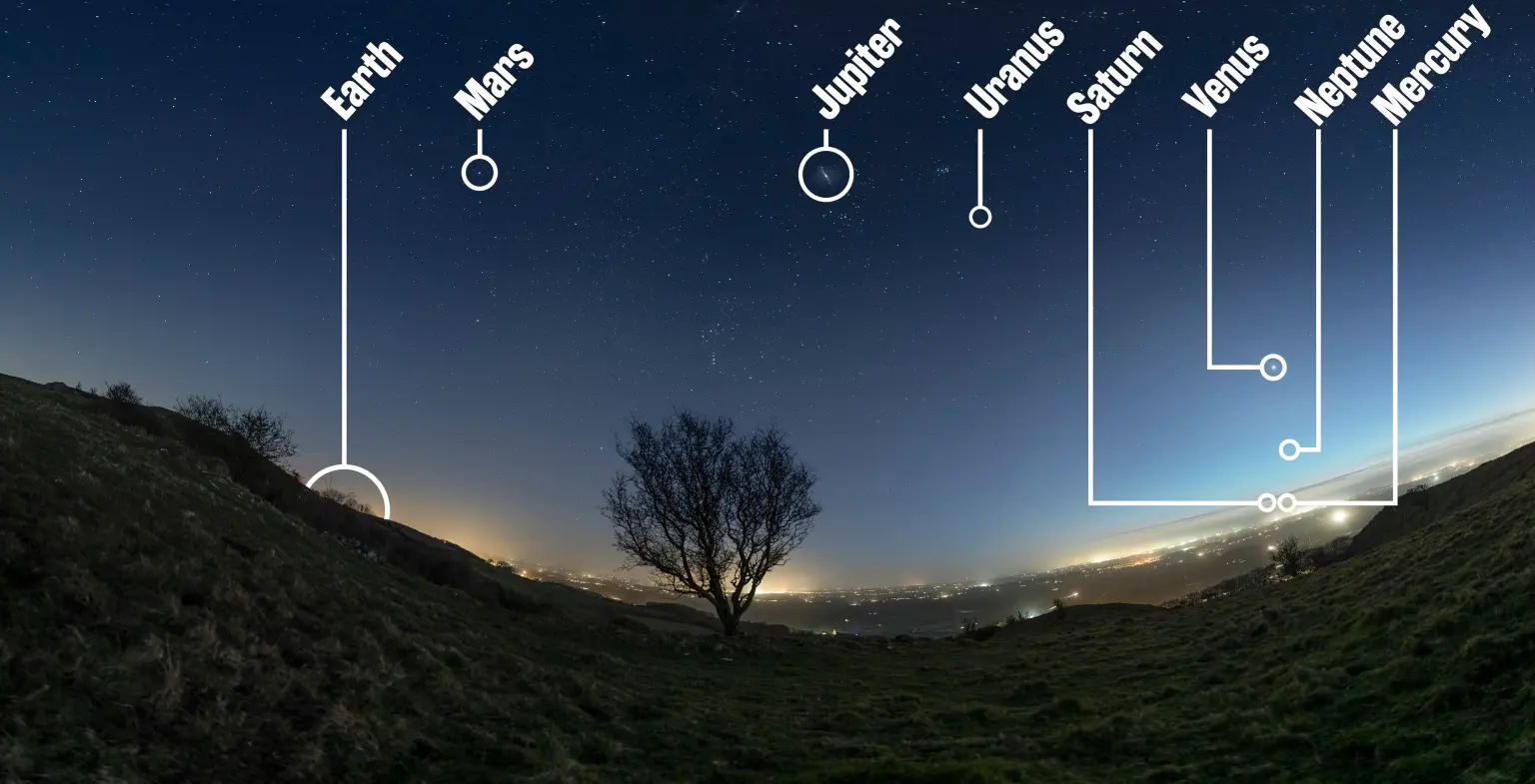

Space Always Surprises Us With Fascinating Discoveries, and Now a New Feat Impresses Astronomers: For the First Time, a Photo Managed to Capture All the Planets of the Solar System, Including Earth, in a Single Frame, Revealing a Rare and Exciting Perspective of Our Place in the Universe.
At the beginning of 2025, a rare celestial phenomenon caught the attention of astronomers and space enthusiasts. The so-called “planetary parade” saw Mars, Jupiter, Mercury, Venus, Saturn, Uranus, and Neptune appear to align in the sky.
For the first time, a photographer managed to capture this extraordinary scene in a single image.
The Photo and the Technical Challenge
The historic capture was made by Josh Dury, 27, on February 22, in the Mendips Hills, near Bristol, England. The image was composed of nine individual captures, later combined into a panorama.
-
Brazilian Student Invents Low-Cost Rainwater Harvesting System Using Recycled Materials, Showcased at World’s Largest Science Fair

-
Italy Considers Next-Gen Nuclear Reactors for Warships, Aiming to Boost Naval Autonomy and Join Elite Maritime Powers

-
Extreme Heat in Antarctica Sets Record 15.4°C at Esperanza Base in June, Raising Concerns Among Scientists with Temperatures 20°C Above Normal, Rain Instead of Snow, and Unusual Melting Transforming the White Continent’s Landscape
-
UFG’s Innovative Use of Air Conditioner Drip Saves 400 Liters of Water Daily in Brazilian Public Building


Dury explained that Saturn, Mercury, and Neptune were the hardest to detect. To ensure accuracy, he used several astronomical analysis apps. “It was a complex process. The wide-angle lens helped, but it required detailed work to reveal the less visible planets,” reported the photographer.

Unprecedented Record in the History of Astronomy
Experts suggest that this may be the first time an image captures all eight planets of the Solar System, including Earth, in a single frame. In the past, similar events have occurred, but technology did not allow for such comprehensive recordings.
Before 2006, Pluto was considered the ninth planet, making such a capture difficult. With its reclassification as a dwarf planet, the composition of the image became possible.
Dury’s photograph represents a milestone for both amateur and professional astronomy. In addition to its visual impact, the record contributes to the study and documentation of these rare celestial alignments.