Portuguese
  Spanish





The Pentagon Invested US$ 120 Million in the Active Denial System, a Microwave Weapon That Heats Skin to ~55 °C to Disperse People and Was Nearly Used in Iraq and at the Border.
In March 2012, journalist Spencer Ackerman of Wired magazine volunteered to be hit by one of the most controversial weapons ever developed by the Pentagon. He was at a military base in southern Virginia, surrounded by cameras and military officials eager to demonstrate their new technology.
“When the signal was given to fire at me, there was no warning — no flash, no smell, no sound, no projectile”, Ackerman wrote later. “Suddenly, my chest and neck felt like they had been exposed to a furnace, with a burning sensation thrown in for good measure.”
Ackerman managed to endure it for only 2 seconds before fleeing. Most volunteers can’t last more than 3 seconds. No one has ever lasted more than 5 seconds. The official name of the weapon: Active Denial System (ADS). The nickname that everyone uses: “Pain Ray”.
-
China Unveils Laser Weapon Capable of Instantly Neutralizing Military Drones, Marking a Significant Advancement in Air Defense Technology

-
U.S. Navy’s Ticonderoga-class Cruiser Becomes a 9,800-Ton Missile Fortress with Advanced Aegis System Capable of Tracking Hundreds of Targets

-
France’s Charles de Gaulle: The Sole Nuclear-Powered Aircraft Carrier Outside the US, Weighing 42,500 Tons and Equipped with Two Atomic Reactors

-
The military spaceplane that almost took the Cold War into orbit: Boeing X-20 Dyna-Soar was designed to re-enter above Mach 20, fly for up to 40 hours, land like a plane, and transform Titan rockets into a gateway to a new era of orbital warfare.
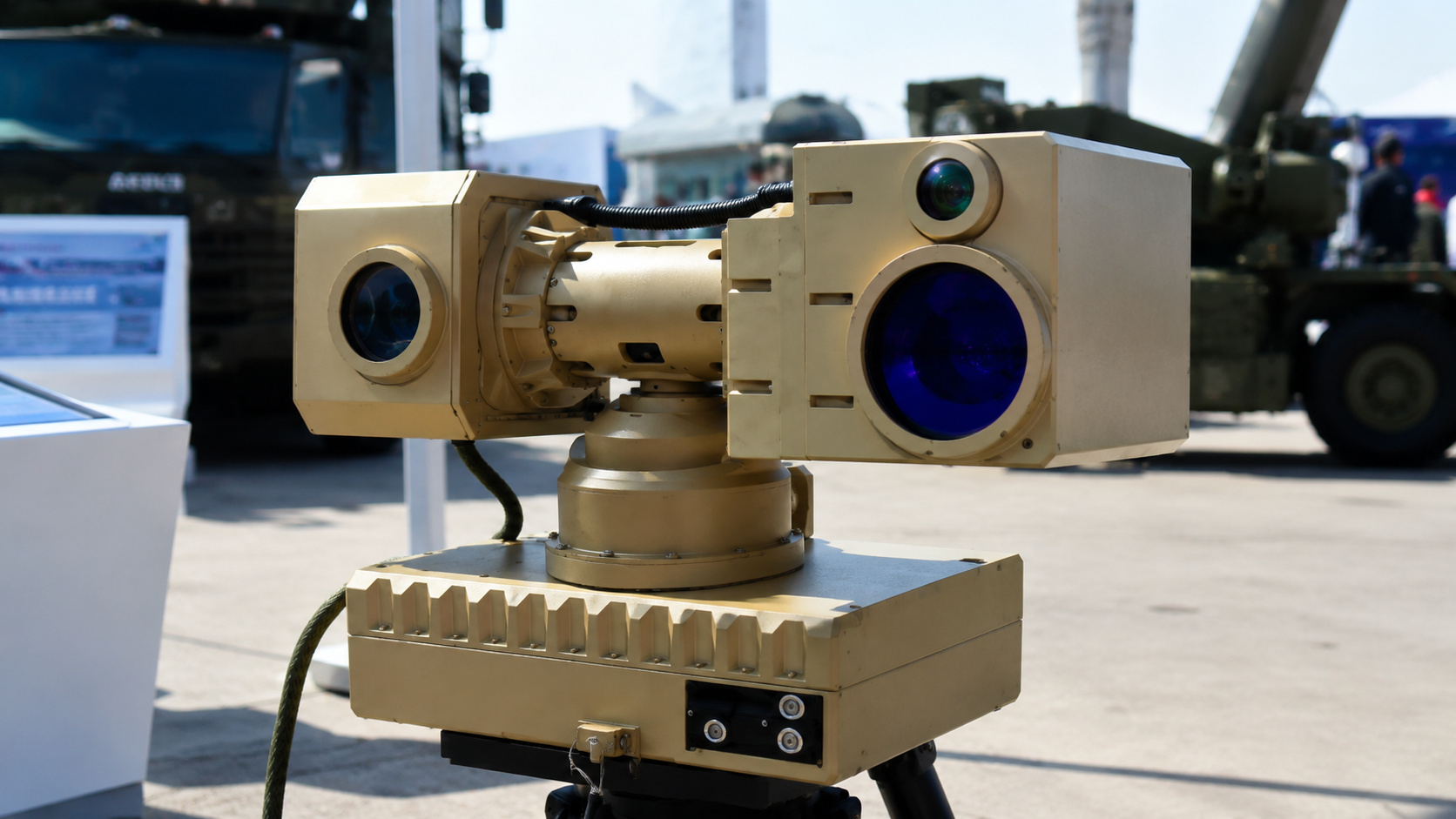



After nearly two decades of development and more than US$ 120 million spent, this weapon that seems like science fiction is ready for use. But there is a problem: no military commander really wants to use it.
What Is the Active Denial System
The Active Denial System is a directed energy weapon developed by the U.S. military, designed for area denial, perimeter security, and crowd control. Informally, the weapon is also called a “heat ray”, as it works by heating the surface of targets — specifically the skin of humans.


The ADS works by firing a high-power beam (100 kW output power) of 95 GHz waves at a target, which corresponds to a wavelength of 3.2 mm. The millimeter wave energy of the ADS operates on a principle similar to that of a microwave oven, exciting the water and fat molecules in the skin and heating them instantly through dielectric heating.
A significant difference is that a microwave oven uses the much lower frequency (and longer wavelength) of 2.45 GHz. The short millimeter waves used in the ADS penetrate only the upper layers of the skin, with most of the energy being absorbed at 0.4 mm (1/64 inch), while microwaves would penetrate human tissue about 17 mm.
In simpler terms: imagine a microwave oven that heats only the outer surface of your skin, but does this with such high intensity that you feel like you’re on fire.
How It Works: The Science of Instant Pain
The physics behind the ADS is elegant and terrifying at the same time.
The electromagnetic radiation emitted by the military device penetrates only 0.4 mm into human skin. It does not cause injury but causes immense discomfort, the feeling of heat at 55°C, which gives the impression that clothes are about to catch fire.
The effect of repelling humans from the ADS occurs at just over 44°C (111°F), although first-degree burns occur at around 51°C (124°F), and second-degree burns occur at about 58°C (136°F).
The surface temperature of a target will continue to rise while the beam is applied, at a rate dictated by the material of the target and the distance from the transmitter, along with the frequency and power level of the beam set by the operator.
Most human test subjects reached their pain threshold in 3 seconds, and no one could endure more than 5 seconds. A spokesperson for the Air Force Research Laboratory described their experience as a test subject: “In the first millisecond, it just felt like the skin was warming up. Then it got hotter and hotter, and you felt like you were on fire”.
What makes the ADS particularly effective as a crowd control weapon is the combination of three factors:
- Extraordinary Range: Up to 500 meters
- Total Invisibility: You see, hear, or feel nothing until you are hit
- Instant and Intolerable Pain: Forces people to flee immediately
The Secret History: Decades of Development
The ADS was developed in the 1980s by the U.S. Air Force Research Laboratory and the Joint Non-Lethal Weapons Directorate at a cost of over US$ 51 million. Approximately US$ 9 million was the investment volume in human testing, which began in 2000 at Kirtland Air Force Base.
But the project had even deeper and more controversial roots. In 2001, the Air Force publicly announced that it had made substantial progress in developing microwave weapons aimed at people.
The development included three projects with revealing code names:
- “Hello” — studied how to modulate the clicking or buzzing sounds produced by the heating of microwaves in the inner ear, to produce psychologically devastating “voices in the head”
- “Goodbye” — explored the use of microwaves for crowd control
- “Good Night” — investigated whether they could be used to kill people
Only the “Goodbye” effect entered development as a weapon. Further research on bioeffects was conducted in secret at Brooks Air Force Base near San Antonio, Texas.
Over the following decades, approximately US$ 40 million was spent on this technology over ten years. When all the costs of development, testing, and prototype production are added, estimates reach more than US$ 120 million.
Human Testing: 11,000 Exposures
The Pentagon took testing seriously — possibly too seriously.
The military claims to have tested the weapon on more than 11,000 people, noting that only two so far needed medical treatment afterward. Those two suffered second-degree burns and have since fully recovered.
But other data is more concerning. In tests, pea-sized blisters were observed in less than 0.1% of ADS exposures, indicating that second-degree superficial burns were caused by the device.

The initial testing methodology raised serious ethical questions. The initial testing methodology, in which volunteers were asked to remove glasses, contact lenses, and metallic objects that could cause hot spots, raised concerns about whether the device would remain true to its purpose of temporary non-lethal incapacitation if used in the field, where safety precautions would not be taken.
In other words: in controlled tests, people were prepared to minimize risks. In the real world, someone wearing metal glasses or with piercings could suffer serious burns from hot spots.
It Almost Went to War — But Did Not
The story of the ADS is marked by multiple failed attempts to use it in real combat.
Iraq, 2005: In July 2005, it was reported that the Active Denial System would be deployed in Iraq before the end of the year. Under an initiative called Project Sheriff, troops would receive a total of 15 vehicles. Colonel James Brown, commander of the 18th Military Police Brigade in Iraq, requested the system to suppress insurgent attacks and quell prison riots.
These deployments never happened.
Iraq, 2006: A similar request was made in 2006 by Brigadier General of the Marine Corps Robert Neller, also in Iraq, who issued an urgent statement requesting ADS for entry control points and observation posts, as well as anti-sniper initiatives.
Again, nothing happened.
Afghanistan, 2010: In 2010, the Pentagon even sent the weapon to Afghanistan, only to have it returned to the U.S. unused. Again, the military was concerned about the optics of microwaving people.
General Stanley McChrystal sent the machine back, anticipating that the Taliban could see the weapon as a propaganda opportunity and accuse the United States of microwaving Afghans.
U.S.-Mexico Border, 2018: During the Trump administration, there were reports that the ADS could be used for crowd control at the southern border. Again, the idea was abandoned due to concerns about public perception.
Why No One Wants to Use the “Pain Ray”
If the weapon works as advertised — and tests prove it does — why did no military commander really want to use it in the field?
Concerns About Torture: Some focused on concerns that weapons whose operating principle is to inflict pain (although “non-lethal”) could be useful for purposes such as torture, as they may leave little or no evidence of use but undoubtedly have the capacity to inflict horrible pain on a restrained subject. According to Wired, the ADS was rejected for deployment in Iraq out of Pentagon fears that it would be viewed as a torture instrument.
Public Image Problems: The idea of “microwaving” people — even if technically different from a regular microwave — is a public relations disaster waiting to happen. No commander wants to be responsible for headlines saying “U.S. Military Cooks Live Protesters”.
Practical Limitations: Although the Active Denial System works (for the most part) as advertised, its massive size, energy consumption, and technical complexity make it effectively unusable in the battlefield.
The complete system is mounted on a modified Humvee truck. It requires massive generators. It needs trained operators. And in adverse weather conditions — rain, snow, heavy dust — its effectiveness decreases drastically.
Unresolved Health Risks: Despite 11,000 controlled exposures, concerns about long-term effects persist. Experts note that exposure to the microwave beam can cause eye damage. “People will step out of the beam, but [eye injury] depends on how much exposure they receive.”
There is also the issue that the only researchers studying the health effects of electromagnetic radiation are the same ones developing the weapon — the Air Force Laboratory. This raises obvious questions about conflicts of interest.
The Commercial Version: Silent Guardian
While the Pentagon hesitated, defense contractor Raytheon saw a different market opportunity.
Defense contractor Raytheon developed a smaller version of the ADS, the Silent Guardian. This simplified model is directly marketed to law enforcement agencies, military, and other security providers. The system is operated and directed with a joystick and targeting screen.
The Silent Guardian is smaller, more portable, and theoretically more suitable for use in prisons, border control, and critical facility security. But so far, sales have been limited — again due to the same concerns about public perception and potential abuse.
The Future of Directed Energy Weapons
Despite frustrations with the ADS, the Pentagon has not abandoned the concept of directed energy weapons.
For future developments, the U.S. Army is working on solid-state microwave monolithic integrated circuits to improve the size, weight, and cooling of the ADS that will allow integration into various mobile platforms. Gallium nitride (GaN) is more efficient than silicon for integrated circuits.
The goal: to create a version that is:
- Smaller and lighter
- More energy efficient
- Mountable on drones, robots, or smaller vehicles
- Capable of operating in various weather conditions
The Paradox of the Perfect Non-Lethal Weapon
The Active Denial System represents a fascinating paradox of modern warfare.
On one side, it is exactly the type of weapon that we theoretically should want: non-lethal, reversible, capable of dispersing hostile crowds without killing anyone. It is infinitely preferable to real bullets or tear gas.
On the other side, it is precisely because it causes such intense pain — without leaving visible marks — that it becomes frightening. A weapon that causes extreme suffering but leaves no evidence is a torturer’s dream.
As a human rights expert noted: “The line between crowd control and torture can be very thin when you have a weapon that causes unbearable pain at the push of a button.”
Lessons from a US$ 120 Million Project
After nearly two decades and more than US$ 120 million spent, the Active Denial System is technically ready for use. It has been thoroughly tested. It works as designed. It is in stock and available for deployment.
And yet, no military commander really wanted to use it.
The story of the “pain ray” is a reminder that military technology does not exist in a vacuum. Even weapons that work perfectly from a technical standpoint can fail spectacularly in the real world due to political, ethical, and public perception considerations.
It is also a warning about the future of directed energy weapons. As technology improves and systems become smaller, cheaper, and more efficient, these weapons will inevitably become more commonplace — not only in battlefields but in domestic law enforcement contexts.
The question is not whether the technology will work. It already works. The question is: as a society, are we comfortable with a world where authorities can inflict unbearable pain from a distance, instantly, without leaving marks?
The Active Denial System forces us to confront that question. And so far, even the Pentagon seems uncomfortable with the answer.