Portuguese
  Spanish


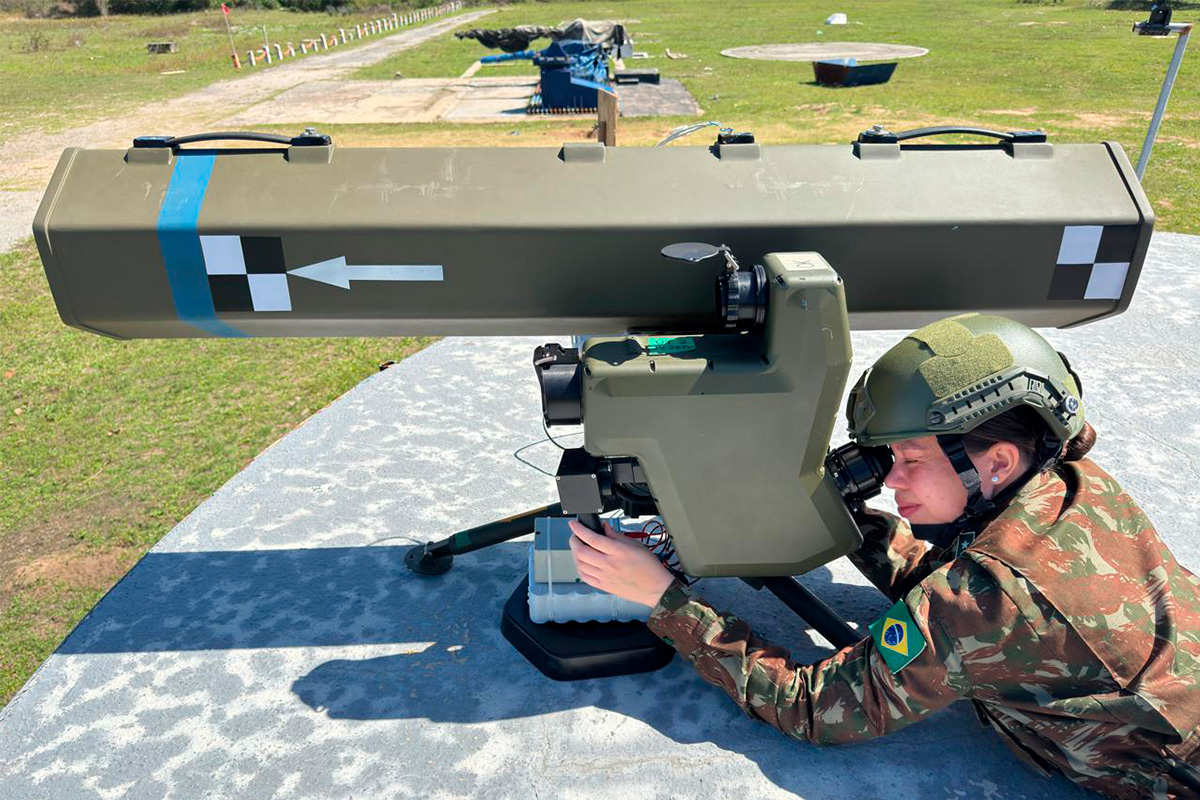

MAX 1.2 AC enhances the Army’s anti-tank capability with national technology, laser guidance, range of up to 3.2 km, and 92% accuracy.
The Brazilian Army incorporated in July 2025 the anti-tank missile MAX 1.2 AC, a national medium-range system developed to enhance the Infantry’s capability against armored targets. According to an official Army publication on November 7, 2025, the weapon was tested and evaluated by the Army Evaluation Center (CAEx), approved by the Department of Science and Technology (DCT), and has become the main national weapon system for use against armored vehicles.
The incorporation gained significance after a statement by the Army commander, General Tomás Miguel Miné Ribeiro Paiva, during the Infantry Day ceremony on May 18, at the Presidential Guard Battalion in Brasília. According to the commander’s statement, the anti-tank capability added to the Infantry with the MAX missile raises the Force’s lethality level.
MAX 1.2 AC enhances the Brazilian Infantry’s anti-tank capability
The MAX 1.2 AC is a medium-range surface-to-surface anti-tank system. According to the Army, it consists of a missile encapsulated in a launch tube and a portable firing unit, designed for use against armored targets.
-
U.S. Navy’s Ticonderoga-class Cruiser Becomes a 9,800-Ton Missile Fortress with Advanced Aegis System Capable of Tracking Hundreds of Targets

-
France’s Charles de Gaulle: The Sole Nuclear-Powered Aircraft Carrier Outside the US, Weighing 42,500 Tons and Equipped with Two Atomic Reactors

-
The military spaceplane that almost took the Cold War into orbit: Boeing X-20 Dyna-Soar was designed to re-enter above Mach 20, fly for up to 40 hours, land like a plane, and transform Titan rockets into a gateway to a new era of orbital warfare.
-
FAB bets on national drones and increases investments to strengthen the Brazilian aerospace industry




The strategic importance of the system lies in the fact that it is a defense product of national design and manufacture. The Army states that the missile strengthens the Defense Industrial Base, expands technological autonomy, and increases the deterrent capability of the Ground Force.


In practice, the arrival of the MAX addresses a sensitive gap for Infantry troops and mechanized formations. Armored vehicles remain central elements in modern conflicts, and portable or vehicle-mounted anti-tank systems have become essential to provide ground forces with means to counter protected vehicles.
Army Commander cites leap in lethality with the MAX missile
The statement by General Tomás Paiva places the MAX within a larger process of Infantry modernization.
According to the Brazilian Army, the commander mentioned the creation of Mechanized Infantry brigades, the use of Guarani vehicles, and the incorporation of anti-tank missiles as examples of evolution in troop protection and combat power.

The strongest statement is the assessment that the MAX missile represents “a new capability” and raises the lethality level of the Infantry Weapon. The term is relevant because it indicates a doctrinal and operational change, not just a one-time equipment purchase.
This type of system allows ground units to have an additional layer of deterrence against armored threats. It’s not just about range or accuracy, but the ability to create a real risk for protected vehicles in territorial defense scenarios.
Technical specifications of the MAX 1.2 AC anti-tank missile
| Item | MAX 1.2 AC |
|---|---|
| Type | Surface-to-surface anti-tank missile |
| Class | Medium-range system |
| Origin | Brazil |
| Manufacturer | SIATT |
| Involved organizations | CTEx, CAEx, DCT and Brazilian Army |
| Guidance | Laser, according to specialized sources |
| Use | Against armored targets |
| Configuration | Missile encapsulated in launch tube and portable unit |
| Range cited by specialized source | Up to 3.2 km |
| Speed cited by specialized source | 240 m/s |
| Accuracy cited by specialized source | Greater than 92% |
| Penetration cited by specialized source | Greater than 700 mm |
| Recent test confirmed | Target at 2,500 meters, with 100% success in the test |
| Status in the Army | Adopted in July 2025 |
| Industrial relevance | National defense product |
The data on composition, adoption, approval, and strategic relevance are included in an official publication by the Army.
The numbers for speed, range, penetration, and hit probability were published by the Brazilian Army on May 29, 2026. The test at 2,500 meters was reported by Air & Naval Defense on May 29, 2026, citing an Army source.
MAX 1.2 AC missile test hit target at 2,500 meters
On May 29, 2026, Air & Naval Defense reported that the Army Evaluation Center supported the Army Technological Center in a new test of the MAX 1.2 AC missile at the Marambaia Proving Ground in Rio de Janeiro. The test aimed to verify the system’s performance at ranges greater than two thousand meters.
According to the publication, the missile used in the test was equipped with an active warhead and achieved 100% accuracy on a target positioned at 2,500 meters. The result would have confirmed operational parameters predicted after adjustments made to the laser receiver.

The Army had already informed, in November 2025, that a firing activity with the MAX took place between October 21 and 24 at CAEx, involving CTEx and SIATT, the missile manufacturer. The activity aimed to qualify component and subsystem suppliers, ensuring compliance, reliability, and traceability of the production chain.
National anti-tank missile strengthens the Defense Industrial Base
The MAX 1.2 AC is not only important as a weapon. It also represents an attempt to reduce external dependence in a sensitive area of land defense.
According to the Army, the system contributes to national technological autonomy and the strengthening of the Defense Industrial Base. This point is central because modern anti-tank systems are strategic products, subject to export restrictions, embargoes, long lead times, and geopolitical disputes.

SIATT appears as the company responsible for manufacturing the missile in communications and reports about the program.
The involvement of CTEx, CAEx, DCT, and COLOG shows that the system went through an institutional structure of evaluation, approval, testing, and acquisition within the Army.
92% accuracy places MAX at the center of anti-tank modernization
The information of accuracy probability above 92% was published by the Brazilian Army, along with other technical data of the system, such as speed of 240 meters per second, range of up to 3.2 km, and penetration power greater than 700 mm.
These data help explain why the incorporation of the MAX gained prominence in the command’s discourse.
A national anti-tank system with a range in the kilometers extends the operational radius of small Infantry fractions and increases the cost of any enemy armored advance.

Nevertheless, it is important to separate officially confirmed data from data published by specialized sources.
The Army confirmed the adoption, approval, anti-tank nature, national manufacturing, tests, and strategic relevance of the system. However, the numbers for accuracy, speed, penetration, and range of 3.2 km appear in the consulted specialized publication.
Adoption of MAX 1.2 AC marks a new phase of anti-armor defense in Brazil
The adoption of MAX occurs at a time when recent conflicts have once again highlighted the importance of anti-tank systems on the battlefield. Armored vehicles remain relevant but have started to face increasingly distributed, portable threats connected to sensors.
For the Brazilian Army, the incorporation of the MAX 1.2 AC represents a national layer within this scenario. The system can be integrated into the modernization process of mechanized and Infantry units, reinforcing the deterrence capability against armored threats.
New national anti-tank missile opens debate on autonomy, industry, and land defense
The arrival of the MAX 1.2 AC to the Brazilian Army raises a larger discussion about the future of national defense.
Brazil historically faces difficulties in maintaining long-term military programs, especially when they involve sensitive technology, continuous budget, and scale production.
In this context, a nationally approved and adopted anti-tank missile by the Army carries political, industrial, and military weight. It strengthens the combat capability of the Infantry, gives visibility to the national defense industry, and reduces part of the dependency on foreign suppliers in a critical area.