






 Portuguese
  Spanish
  3 min of reading
  0 comments


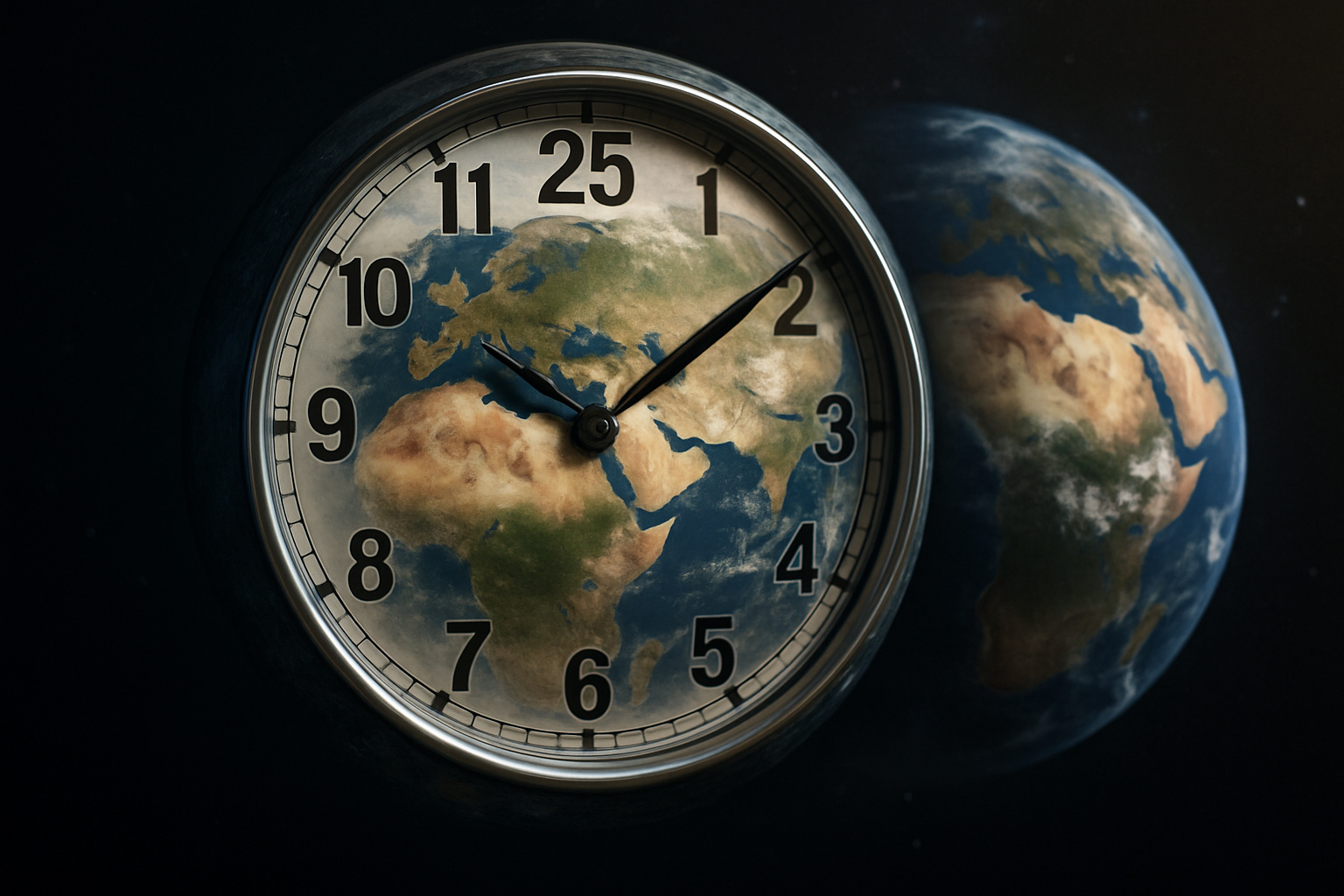
International Research Confirms That The Rotation Of The Earth Is Slowing, Which May Make Days Longer In A Distant Future.
Researchers from the Technical University of Munich (TUM) reported, in 2024, that the rotation of the Earth is experiencing gradual deceleration, according to measurements taken at the Wettzell Observatory in Germany. Although the change is minimal, it occurs continuously, reinforcing long-term analyses of the Earth’s spin.
Additionally, scientists monitored the planet using a high-precision laser, which detected variations of approximately six milliseconds over two weeks, according to data released by TUM in April 2024. These measurements show small, but consistent fluctuations that clarify the planet’s rotational behavior.
Consequently, NASA indicated, in a report from 2023, that the gravitational interaction between the Earth and the Moon has been slowing the planet since its formation, about 4.5 billion years ago. Thus, the agency emphasizes that this phenomenon will continue for millennia, potentially leading the planet to days with 25 hours in the distant future.
-
Helicopter Drops 180 Tons of Sand and Gravel on Swedish River to Revive Ecosystem Damaged by Decades of Exploitation

-
Brazilian Company Launches Retro Smartphone with 48 MP Camera, T9 Keyboard, and Privacy Features for Social Media-Free Use

-
Self-Taught Chinese Farmer Builds 5-Ton Submarine from Scrap, Launches It in Anhui River
-
Invisible Induction Technology Enables Wireless Power for Blenders, Coffee Makers, and Air Fryers, Reducing Countertop Cables





Rotational Deceleration Is Influenced By Multiple Geological And Gravitational Factors
Experts explain that the slower pace of the Earth’s rotation results from various combined elements. Thus, scientists highlight that:
- The liquid core of the planet alters its speed over time, influencing rotational variations.
- The tectonic plates move large masses, changing the distribution of weight on the Earth’s surface.
- The lunar gravity, as emphasized by NASA, exerts frictional force that gradually reduces the speed of the planet’s spin.
Furthermore, studies published by the American Geophysical Union (AGU) in 2023 suggest that the solid inner core is slowing its rotation relative to the rest of the planet. This behavior adds new layers of complexity to the rotational dynamics.
Experts Analyze Possible Impacts On Natural Phenomena And Biological Cycles
Researchers assert that a potential shift to 25-hour days may influence various natural processes. Thus, experts cite that:
- The human circadian cycles will undergo gradual adaptations.
- The patterns of sleep and productivity may experience natural adjustments over millennia.
- The tides may display new behaviors due to gravitational interaction with the Moon.
- The climate, subtly, may register changes caused by the slower rotation.
Even so, scientific institutions emphasize that no significant change will occur on the current human timescale, as the process develops extremely slowly.
The Historical Trajectory Shows That The Duration Of Days Has Always Changed Over Billions Of Years
The reduction in rotational speed is not a recent phenomenon. Research from the University of Wisconsin, published in 2018, reveals that, about 1.4 billion years ago, a day on Earth lasted about 18 hours. Thus, scientists state that the current pattern simply follows a natural trend.
Additionally, contemporary studies — like those conducted by TUM, NASA, and AGU — confirm this continuous evolution. The data reinforce that the planet follows a slow and steady cycle, sustained by the internal and external dynamics of the Earth.
Perspectives For The Future Of Earth’s Rotation And Its Effects On Life On The Planet
Experts highlight that it will take thousands of years for the planet to complete the necessary advancement to 25-hour days. Thus, they explain that the phenomenon will not bring immediate impacts to current civilization. However, studies help to better understand how the planet evolves over time and how its internal processes shape life on the surface.
Thus, while science continues to monitor each rotational variation with increasingly precise instruments, an inevitable question remains: how will humanity adapt when the Earth’s natural clock finally marks a day with 25 hours?





Be the first to react!