Portuguese
  Spanish


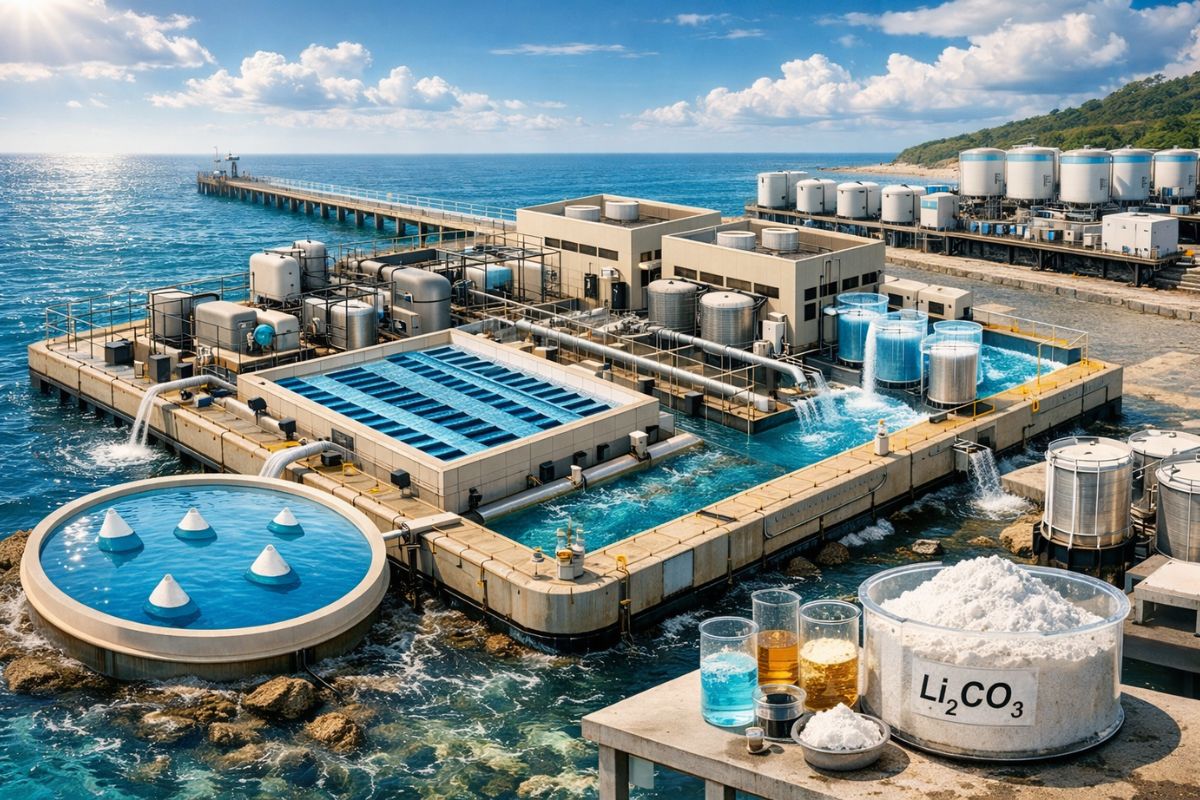


New Swing-Type Extractor Powered by Solar Energy Turns Ocean Water into Drinkable Seawater While Concentrating Lithium from Seawater and Presents Itself as a Complementary Alternative to Lithium Mining on Land.
The proposal is aligned with two global challenges that usually go hand in hand: reducing the environmental impact of lithium mining and increasing access to water in coastal regions facing water scarcity. Instead of land drilling and large evaporation ponds, the concept uses solar light, smart surfaces, and a controlled tilting motion to extract lithium directly from seawater while generating drinkable seawater as a useful byproduct.
An Ocean Full of Lithium, but Difficult to Harness
In theory, the ocean serves as the largest lithium deposit on the planet. Estimates suggest around 230 billion tons of lithium dissolved in seawater. In practice, this potential is impeded by a significant physical and chemical obstacle: lithium is extremely diluted.
On average, the concentration is around 0.2 milligrams of lithium per liter, while sodium exceeds 12,000 milligrams per liter. In simple terms, each lithium ion is lost in an environment dominated by much more abundant salts, making selective separation a high-precision exercise.
-
Brazilian Innovator Transforms 1962 Mercury Comet with Nissan Leaf Electric Motor, Achieving 125 km Range for Under $6,000

-
China Tests Giant 582-Ton Magnets to Contain Plasma Hotter Than the Sun’s Core, Aiming to Cut Superconductor Costs and Generate First Electricity from “Artificial Sun” by 2030
-
Seventh Grader Builds Nuclear Fusion Machine at Home, Aiming for Guinness World Record

-
Ancient Ritual Circle, Hidden for 5,000 Years, Discovered in Scotland’s Machrie Moor Using Sensors, Revealing a “Phantom Stonehenge”



Separation technologies already used in other fronts, such as electrochemical intercalation, nanofiltration, and liquid-liquid extraction, struggle in this context.
They tend to consume a lot of energy, lose selectivity when other ions are present, or accumulate competing salts on active surfaces.
Lithium sieves based on metal oxides have an affinity for the Li⁺ ion, but the slowness and accumulation of competing salts limit practical gains.
The Recurring Enemy: Salt Deposits That Clog the System
Whenever one attempts to concentrate lithium by solar evaporation, the same problem reappears. Before lithium becomes significant, other salts precipitate, form deposits, and block transport channels. The system starts to work and soon loses efficiency.
The formation of salt crusts on the active surface forces the operation to halt for mechanical cleaning or application of chemicals. This increases costs, generates waste, and shortens the lifespan of materials.
The consequence is clear: processes that seem efficient in the lab, with a few controlled cycles, become fragile when envisioning continuous operation in the real marine environment.
As reported by the portal Ecoinventos, it was this bottleneck that researchers aimed to overcome by proposing a solar extractor with a smart tilting motion, capable of dissolving the deposits without external intervention.
How the Solar-Powered Swing-Type Extractor Works
The device is described as an inclinable solar extractor, resembling a small floating swing. The core of the system is a hydrophilic lithium adsorbing layer, positioned between two hydrophobic layers with photothermal properties.
The upper layer absorbs light and heats the surface, which causes localized water evaporation. This heating generates a concentration gradient and a continuous capillary flow that brings water and ions to the adsorbing region.
There, lithium is preferentially captured, while other salts remain in solution and begin to concentrate at the interface.
The differentiator lies in how the system deals with the accumulating salts. The assembly starts the tilting cycle at approximately 30 degrees.
As the salt deposition grows on one side, the weight shifts. Over time, the swing slowly rotates, submerging the encrusted area and allowing the crystallized salts to dissolve back into the seawater. The active surface is cleared, and the process restarts.
This cyclical tilting motion, guided solely by gravity and mass distribution, acts as an automatic cleaning mechanism. There is no need to stop the system or use additional reagents to remove the deposits, which reduces complexity and waste.
The hydrophobic layers serve two strategic functions. They direct salt crystallization to the edges, reducing direct blockage of the capturing area, and help the assembly float stably with less resistance to movement.
Lithium 15.5 Times More Concentrated and Drinkable Seawater as a Parallel Result

In laboratory tests, the solar swing achieved local lithium concentrations 15.5 times higher than those of the incoming water. This intensification of lithium content accelerates the adsorption process in the active layer and improves the utilization of the available area.
The selectivity in the separation between lithium and sodium is also noteworthy. Experiments indicate a separation factor greater than 370,000, a rare value in passive systems powered only by solar energy.
When the inclinable extractor was compared to a fully submerged equivalent system, the lithium capture gain was 69% after 120 hours of operation, a result directly associated with the tilting strategy and periodic dissolution of the deposits.
Another important point is the fate of the residual water. After optimizing the process, this water meets drinking water quality standards, meaning it ceases to be just a waste product of extraction and becomes an additional resource.
In real application scenarios, this opens up space for integrated use in coastal regions facing water scarcity, where the possibility of generating drinkable seawater while recovering lithium can represent a valuable combination.
Limitations, Material Wear, and Next Steps
Despite promising results, the swing-type extractor is still in the experimental phase. After 30 cycles, researchers observed a performance loss of 21.6%, associated with the degradation of manganese-based lithium sieves. This wear limits continuous operation and points to the need for more stable materials.
Another critical issue relates to pH. Many lithium sieve materials used today require alkaline conditions to function properly. This means adjusting the pH of seawater, adding an extra step that increases the complexity of the system and may generate local impacts.
The stated goal is to develop materials capable of capturing lithium in natural pH, eliminating the need for chemical corrections.
The team suggests using more stable titanium-based sieves as a mid-term alternative. It will also be necessary to test the performance of the solar swing in real ocean conditions, with biofouling, waves, temperature variations, and the presence of organic matter.
The sea is much more unpredictable than a laboratory tank and may expose weaknesses that have not yet appeared.
Even so, the fact that the concept has worked in a controlled environment, with production of drinkable seawater and significant lithium concentration, already indicates that the design logic is solid enough to justify new development cycles.
From Intensive Mining to Controlled Environmental Capture
The swing-type extractor illustrates a shift in focus in how critical resources are perceived. Instead of large mines on land, with high water consumption and direct impact on ecosystems, the possibility of controlled environmental capture on coastal platforms, desalination plants, or port structures powered by solar energy and adjustable by modules emerges.
In a realistic scenario, solutions like this do not completely replace traditional mining but can alleviate pressure on new deposits on land, complement recycling chains, and favor more circular economy models for lithium.
The same infrastructure that produces drinkable seawater can simultaneously supply stationary battery chains, renewable energy storage, or industrial processes that depend on this metal.
In a world where demand for lithium is only increasing and good-quality water continues to be scarce in various regions, do you see this type of solar swing more as a real contender to compete with traditional mining or as a complementary solution for specific niches where the joint production of lithium and drinkable seawater makes more sense?