Portuguese
  Spanish


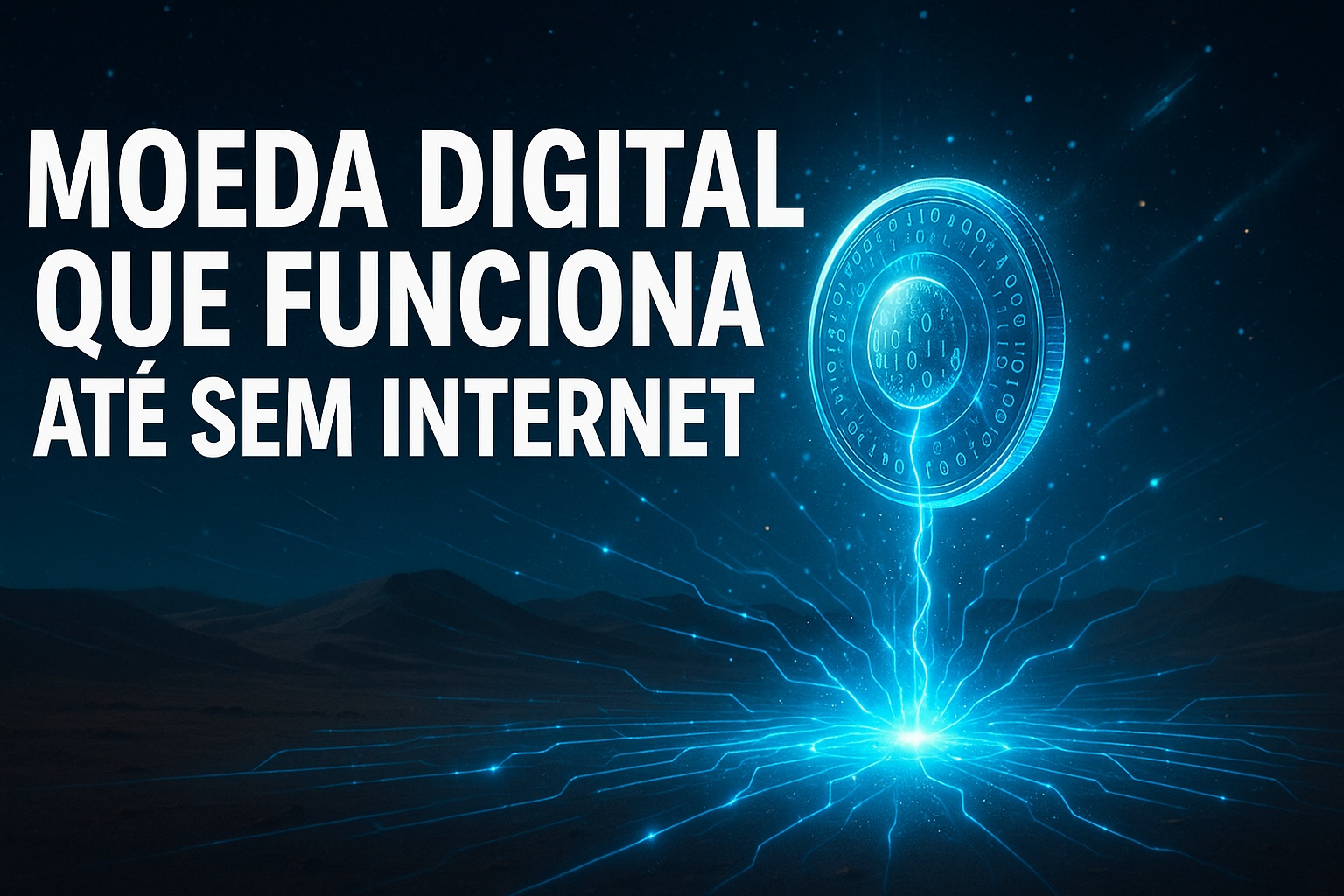

Researchers Are Working on a Digital Currency That Works Without Internet or Mobile Network. Semi-Quantum Tokens System Allows Offline Payments with Quantum Security and Could Revolutionize the Global Financial System.
Imagine making a digital payment without needing a connection, mobile network, or even electricity. A group of scientists is turning this fiction into reality. According to a study recently published in the Cryptology ePrint Archive and reported by institutions such as Cambridge University and the National Institute of Standards and Technology (NIST), researchers proposed a system for offline digital payments based on semi-quantum tokens, capable of operating with total security even in environments without internet access.
The innovation promises one of the greatest disruptions ever seen in the world of digital currencies and decentralized finance, and if proven at scale, could change the way the world understands electronic money.
A New Paradigm: Offline Digital Payment
The advancement was led by a team of scientists from the Hong Kong University of Science and Technology (HKUST) and the University of Luxembourg, who have been studying for years how to reduce dependence on connected systems.
-
The industrial waste that even recyclers didn’t want has gained value in the interior of Bahia: two entrepreneurs invested R$ 2.8 million to transform 350 tons per year of foam, rubber, and plastic into boards that can replace wood and MDF.

-
What is a red flashlight used for, after all? See why it is so commonly used at night.

-
He has never read a line of code, but he already knows how to work: the French company UMA presented in Paris the Northstar, its first AI-powered humanoid robot designed for factories and warehouses, capable of copying tasks just by observing an employee in action.

-
A young Kenyan engineer collects plastic waste from the streets and transforms it into robots that translate physics lessons into sign language in real-time, a machine made with old bottles that teaches what was missing to deaf children left out of science.




The result is a protocol that uses semi-quantum tokens, digital units endowed with unique and non-replicable cryptographic signatures, preventing the so-called double spending — when the same value is spent twice.


The big revolution here is the concept of “wireless money” (wirelessless money), which does not rely on servers, banks, or online intermediaries.
The system stores information about value and cryptographic identity in a physical chip or portable device, allowing two parties to conduct a face-to-face transaction, validated locally, even in remote locations.
In summary: it is the first model of offline digital payment with partial quantum security, without needing blockchain or access to a centralized network.
What Are Semi-Quantum Tokens
Semi-quantum tokens are the heart of the proposal. Unlike a traditional cryptocurrency, such as Bitcoin or Ethereum, which requires validation from a public blockchain, this system uses principles of quantum physics to ensure that each digital unit has a unique and impossible-to-copy signature.
Each token functions as a “tagged” photon, a packet of information with properties that change if someone tries to intercept or duplicate it. This characteristic comes from quantum mechanics, which prevents perfect cloning of a quantum state.
In practical terms, what the researchers have created is a means of autonomous, tamper-proof, and traceable payment, which can be transferred between devices even in areas without communication infrastructure such as rural areas, military bases, disaster zones, or even underwater environments.
Global Applications and Implications
The impact of this type of technology is enormous. In countries where digital exclusion is still high, such as parts of Africa, Latin America, and Southeast Asia, a currency capable of operating offline could democratize access to the financial system, allowing digital transactions to occur in places without internet or constant electricity.
Economist Dr. Ramesh Subramanian, advisor to the Asian Development Bank, highlighted in an interview with the Asian Economic Review:
“If this system is implemented at scale, it could bring financial inclusion to places where even paper money does not reach. It is a revolution comparable to the emergence of cell phones in the 2000s.”
Beyond the social impact, there is a question of national and military security. Armies and governments could conduct confidential and instantaneous transfers in war zones where networks are compromised, without relying on satellites or civilian infrastructure.
From the Laboratory to the Real World
Initial tests were conducted in 2024 and 2025 in controlled environments, simulating transactions between devices over 2 kilometers apart, with electromagnetic interference and total absence of network signal. The result: the system maintained 100% integrity and traceability of transactions.
The prototype uses a portable device the size of a USB drive, containing a simplified quantum microchip and a set of optical sensors that ensure the integrity of the token.
Each unit of value is generated by a monetary authority (such as a central bank) and can be recharged or converted into electronic money when the connection is restored.
The team explains that to ensure privacy and security, the information is erased after the transaction is confirmed, eliminating any duplicate traces.
Central Banks Monitor the Advancement
Although still in the academic phase, the study has already drawn the attention of monetary authorities. The European Central Bank (ECB), which is conducting the digital euro project, included a direct mention of research on “offline payments based on locally authenticated tokens” in its 2025 report.
The Bank of England and the Bank of Japan are also exploring versions of the concept, seeking a hybrid solution that allows the use of official digital currencies (CBDCs) offline, but with subsequent validation on the network.
In Brazil, the Central Bank, which is developing the Drex, mentioned in a technical note in 2024 the possibility of including an “offline layer” in future versions of the digital real, which would allow transactions in areas without coverage.
The Connection with Quantum Computing
The term “semi-quantum” is not casual. It refers to an intermediate stage between classical cryptography and complete quantum cryptography — a balance point that does not require complete quantum infrastructure, but already utilizes principles of quantum physics to reinforce security.
The idea is to create resilient and scalable systems, compatible with current technologies, but ready to integrate with quantum networks in the future. According to physicist Tobias Baecker, one of the authors of the study:
“We are building the bridge between current electronic money and future quantum money. This is the first step toward a fully decentralized financial system that is resistant to interference.”
A Future Where Money “Walks by Itself”
The proposal for semi-quantum tokens also raises a deeper discussion: what if money could exist without depending on banks, governments, or connections?
This vision combines decentralized economy, particle physics, and cutting-edge cryptography — a field where the boundaries between science and economics blur.
Experts believe that if this technology reaches the market in the next ten years, it could redefine the concept of digital transaction, transforming money into something entirely portable, secure, and independent.
The Impact for Brazil and Latin America
For countries with vast rural areas, such as Brazil, this innovation would have a direct impact. Farmers, riverine communities, and small entrepreneurs could make payments, purchases, and transfers without relying on internet signal, one of the biggest challenges in the countryside.
Combined with Drex, the Central Bank’s digital currency, semi-quantum technology could eliminate logistical barriers and integrate millions of Brazilians into the digital financial system.
The research is still in the experimental stage, but it has already attracted interest from universities, central banks, and cybersecurity companies. For specialists, it represents a watershed moment in the concept of digital currency, offering something that no traditional system has achieved to date: total autonomy from networks.
If all goes well, the future of money may lie in a small device that fits in your pocket — capable of making payments in real time, anywhere on the planet, even in the middle of the desert.