






 Portuguese
  Spanish
  5 min of reading
  0 comments


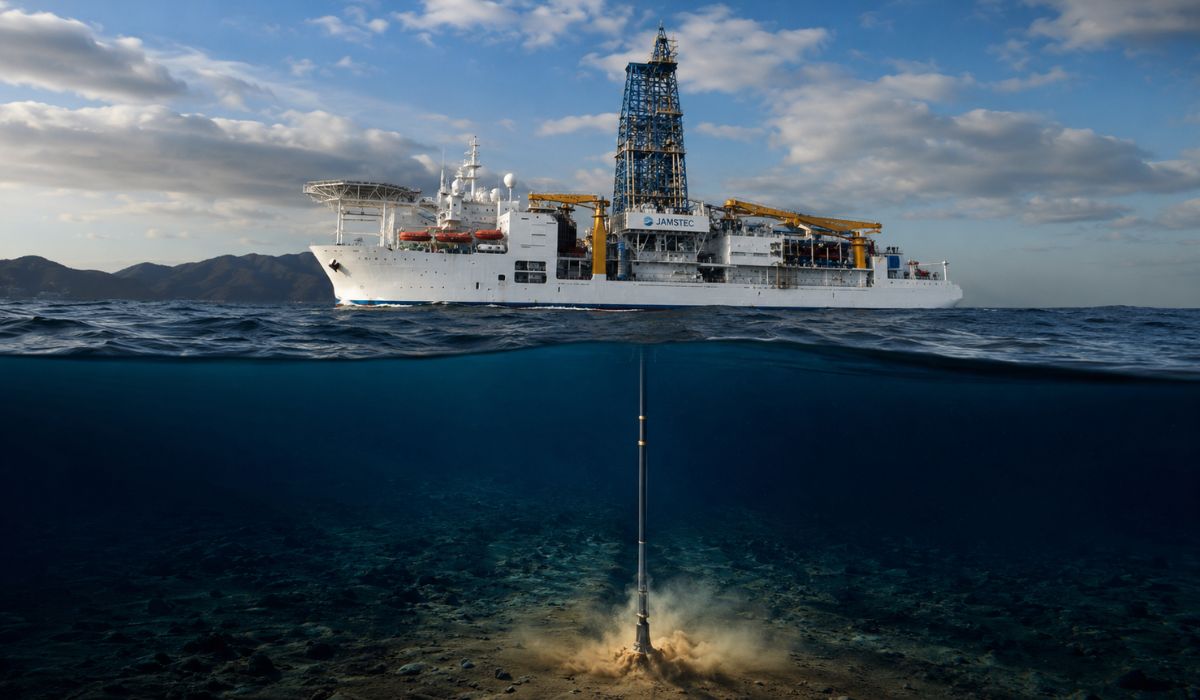
Operated by Japan, the drilling ship Chikyu lowered a drill to about six kilometers below the Pacific surface and brought up a type of mud that could be worth strategic gold because it is loaded with rare earths, the metals that drive technology and today almost all come from China’s hands.
From a distance, the Chikyu looks like a lost oil platform at sea, but it’s something else. It’s a research ship with a giant drilling tower planted in the middle of the deck, capable of lowering drills to depths that very few vessels in the world can reach. Earlier this year, it went to the region of Minamitorishima, a tiny island in the Pacific marking the easternmost point of Japanese territory, and conducted a test there that could have enormous consequences.
The mission lasted about three weeks and ended in February. The goal was to collect, approximately six thousand meters below the sea surface, samples of the mud covering the ocean floor in that area. And this mud is not just any mud, because previous studies have shown that it is extremely rich in rare earths, precisely the most coveted elements of the high-tech industry.
Why rare earths have become a global obsession
The name is misleading. Rare earths are not that scarce in the Earth’s crust, but they are spread out in a way that makes extraction difficult and expensive. The point is that they are irreplaceable. Without these metals, there are no powerful magnets for electric motors, nor a good part of the components for cell phones, wind turbines, medical equipment, and military systems. In other words, the technology that drives the modern world depends on them.
-
Space technology used to search for water on Mars is now hunting for invisible leaks under the streets of São Paulo, using satellites, AI, and chlorine signals to help Sabesp recover up to 6.7 billion liters of water.

-
Japan sends ship to extract mud rich in rare earths at nearly 6,000 meters deep in the Pacific, attempts to lift 350 tons per day from the seabed, and transforms sediments near Minamitori Island into a strategic weapon to reduce dependence on China.
-
Venus Aerospace promises a rotating detonation hypersonic engine that takes the Stargazer to Mach 9 and crosses oceans in 1 hour, but the flight that made history barely surpassed the speed of sound.

-
Brazilian student creates a cheap formula that makes plants grow up to 90% faster and wins an award in a global scientific competition.




And here’s the geopolitical knot. China currently dominates most of the production and refining of these metals, which gives Beijing enormous power over the entire global technology chain. When a country controls the supply of something so essential, it also controls a lever of pressure over others. That’s why nations like Japan treat the search for their own sources of rare earths almost as a matter of national security.

The engineering of drilling the ocean floor
Collecting mud six thousand meters below the sea surface seems simple when written in a sentence, but it is one of the most difficult feats of ocean engineering. The ship needs to stay stationary at an exact point, fighting against currents and waves, while lowering kilometers of pipe to touch the seabed and bring the sample back intact. Any mistake and the equipment bends, the column breaks, or the sample gets contaminated along the way.
The Chikyu was made precisely for this kind of feat and already holds records for scientific drilling in the ocean. I confess I find it fascinating that the same type of technology used to understand the interior of the planet is now being aimed at a much more earthly goal, ensuring Japan its own path to the metals of the future, without needing to ask anyone’s permission.

From the ocean floor to the technological race
This test is, for now, a first step. Proving that it’s possible to collect rare earth-rich mud from the ocean floor is one thing, but doing it on a commercial scale, processing enough volume to supply entire industries at a cost that makes sense, is quite another. This is the gigantic challenge that separates today’s sample from a potential underwater mine of tomorrow.
It’s worth noting that Japan is not alone in this race but has taken the lead with an important advantage, the deep ocean drilling technology that few countries possess. While much of the world is still discussing how to reduce dependence on Chinese rare earths, the Japanese are already at sea, practically testing how to extract these metals from the ocean floor. It’s the difference between complaining about the problem and pursuing a concrete solution, even if it’s expensive and far from becoming a commercial reality. The bet is long-term, the kind that only makes sense for those who see decades ahead. And there’s something symbolic about an island nation, surrounded by sea on all sides, deciding that it’s precisely in the ocean that it will seek the mineral independence that solid ground has never given it.
Still, the symbolism is strong. Japan, a country poor in mineral resources and historically dependent on imports, is saying that it intends to seek in its own ocean floor the raw material that sustains the century’s economy. If successful, it changes the balance of a chain that is currently too concentrated in the hands of a single country.

The next frontier is at the bottom of the sea
I imagine how much of the technological race of the coming decades will be decided not in shiny laboratories but in remote ocean points where ships like the Chikyu extract from the depths the raw material that no one wants to depend on a rival to obtain. The race for rare earths is silent, but it may be one of the most decisive of our time.
The deep sea is the last great mineral frontier of the planet, and what Japan did there in Minamitorishima is a reminder that this frontier has begun to be truly tested. The next generation of clean technology and electronics may very well be born from dark mud collected six kilometers below the waves.
Did you trust that the technology of the future depended so much on mud hidden at the bottom of the ocean?


Be the first to react!