






 Portuguese
  Spanish


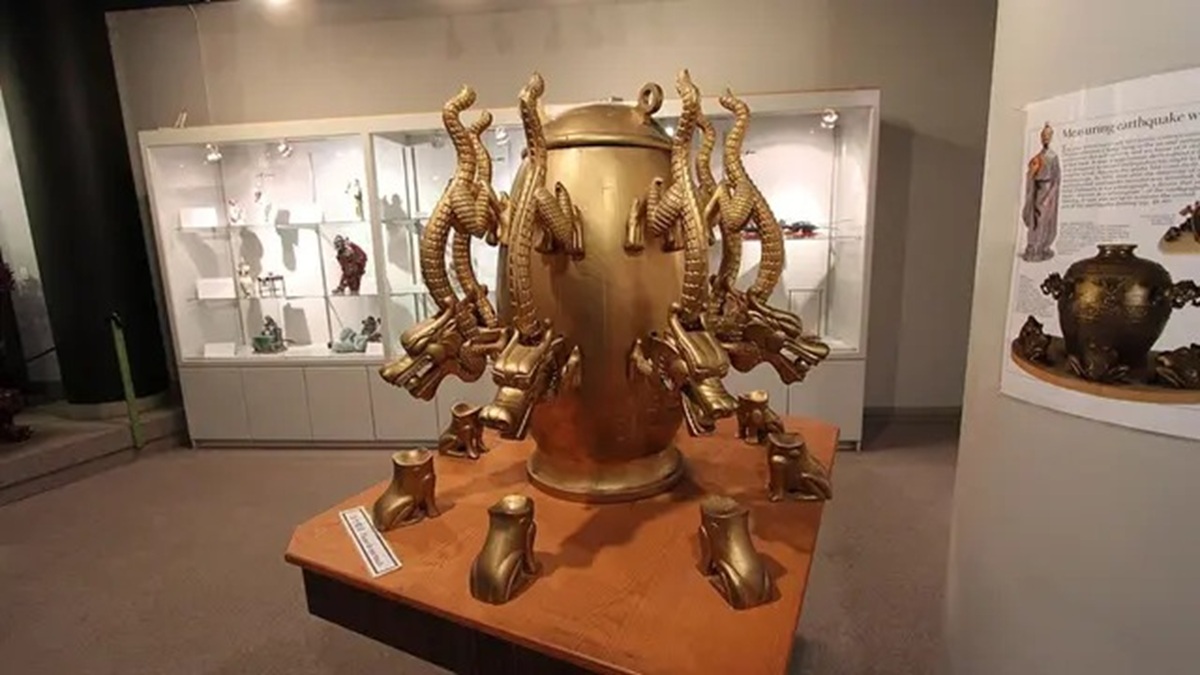

Chinese Researchers Develop a Project to Recreate the Legendary Houfeng Didong Yi, Considered the First Earthquake Sensor in the World.
Chinese scientists are ready to revive an ancient earthquake sensor, steeped in legends, that is said to have been created nearly 2,000 years ago.
The Houfeng Didong Yi, considered by many as the world’s first earthquake detector, sparks curiosity and debate.
The project aims to combine modern engineering with historical knowledge to reconstruct the ingenuity of a distant time.
-
Xiaomi Unveils Smart Glasses in Brazil with 12MP Camera, 4K Video, and AI Features, Challenging Ray-Ban Meta

-
Volkswagen Unveils Bold Strategy to Compete with Chinese Automakers in Brazil, Featuring 5,000 Parts, 76% Localization, and a Surprising Turnaround
-
Three Teens Win Global Prize for Low-Cost AI Microscope Diagnosing Malaria Species in Seconds for Remote Villages
-
Xiaomi Unveils Revolutionary Fridge: Eliminates Odors in 3 Minutes, Sterilizes in 2, Offers 508 Liters in Compact Design, Operates at 31 dB, and Is Smartphone-Controlled.


Origin and Mystery of the Device
The Houfeng Didong Yi, according to reports, was invented in 132 A.D. by the Chinese polymath Zhang Heng. According to tradition, it was a bronze vessel decorated with eight dragons. Each dragon held a ball, positioned to fall into the mouth of a frog, indicating the direction of the tremor.
Most importantly, this mechanism was said to detect earthquakes before they could be felt. However, many scholars have questioned the actual existence of the object.
Some assert that it was too advanced for its time. Due to these doubts, Chinese school textbooks removed mentions of the device in 2017.
Modern Reconstruction of the Mechanism
Researcher Xu Guodong from the China Disaster Prevention Institute decided to investigate ancient records. He re-examined historical texts and attempted to create a realistic version of the sensor using seismic science and current engineering.
The new model features a central pendulum that reacts to the slightest ground movement. When an earthquake occurs, the pendulum swings and activates an L-shaped lever. This lever releases the corresponding dragon’s ball, which falls into the mouth of the frog, showing the direction of the tremor.
Additionally, the system includes a locking mechanism that ensures only one ball is released at a time. This increases directional accuracy and prevents errors.
According to Xu’s calculations, the device could detect tremors of just 0.5 millimeters.
Impressive Historical Functioning
Ancient records indicate that the Houfeng Didong Yi actually worked. An account from 138 A.D. states that it detected an earthquake 850 kilometers away, before the population felt any impact.
After 132 A.D., the capital Luoyang began to record more earthquakes, suggesting that the device was quite sensitive.
To increase its efficiency, Xu asserts that the pendulum amplified the ground’s movement. Although it could not determine the exact epicenter, the device reliably indicated the direction of the tremor.
This shows that the Chinese of the Han dynasty mastered advanced techniques long before the West.
A Lost and Coveted Legacy
The original piece was lost throughout history, along with its diagrams and notes.
According to Xu, wars and disputes among noble families may have contributed to the disappearance of the seismoscope. This loss is considered a significant blow to the scientific knowledge of the time.
“In Chinese history, only two bronzes have been deified: the Nine Tripod Cauldrons of the Xia dynasty… and this – a testament to its extraordinary historical significance,” Xu said.
Restoration of the Past
Now, Xu’s team plans to build a replica of the Houfeng Didong Yi using only techniques and materials from the Han dynasty. The idea is to rescue a nearly forgotten legacy and demonstrate the importance of Chinese contributions to science.
Therefore, this project is not just a recreation, but a recognition of the historical value of an invention that preceded the West by nearly 1,700 years.
Furthermore, researchers believe that the rediscovery may inspire new technologies based on ancient concepts that remain relevant today.


