Portuguese
  Spanish


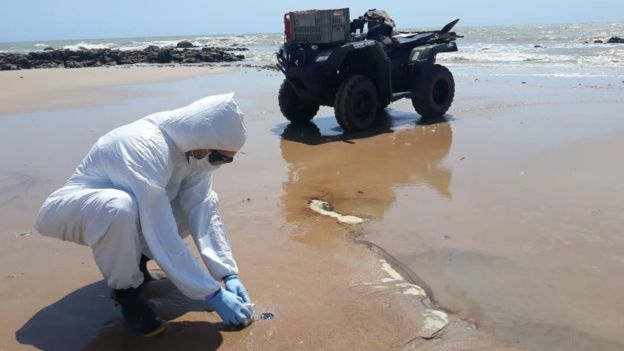

It Is Still Not Clear to Petrobras How Oil Extracted in Venezuela, Whose Coast Is in the Caribbean Sea, Could Have Reached the Coast of the Northeast.
A confidential report sent by Petrobras to the Brazilian Institute of Environment and Renewable Natural Resources (Ibama) raises the hypothesis that the oil that spread in a stain along the Northeast coast is from Venezuela. Last Thursday, the 26th, we at Click Petróleo e Gás reported on the oil spill that had so far affected 99 locations along the Northeast coast; understand the facts.
In a note released five days ago, Ibama stated that the oil contaminating different beaches is the same and that the agency was working with the possibility of multiple sources of contamination. Officially, it is still unknown what caused the stain.
-
Japan Constructs World’s Deepest Sea Wall in the Pacific, Sinking Massive Concrete Structures for Three Decades
-
Over 2,000 Tons of Discarded Fishing Nets Since 2020 Repurposed into Durable Caps, Fins, and Parts

-
Seals and Sea Lions Lose Habitat and Food as Climate Change Advances, Impacting Ice, Prey, and Coastal Communities

-
Brazilian Innovator Uses 3D-Printed Device to Cool Two Rooms with One Air Conditioner


What is unknown is how the oil extracted in the South American country, which has a coast in the Caribbean Sea, reached the Atlantic Ocean.
The updated report by Ibama last Sunday, the 29th, shows that the oil was detected in about 109 areas, located in 54 cities across eight states.
In seven of these locations, birds and turtles died due to contamination. Other animals are in recovery and cleaning centers.
The oil stains reached the beaches of Ponta Negra, Pipa, and Tibau do Sul in Rio Grande do Norte; Boa Viagem, Carneiros, and Porto de Galinhas in Pernambuco; Tambaba in Paraíba; and Gunga and Francês Beaches in Alagoas, among others.
In Ceará, 500 liters of oil were collected from nine beaches last Saturday (29) and Sunday. The results of water quality tests in 35 Cearense beaches will be released this Tuesday (1st).
Leon Aguiar from the Institute for Environmental Defense (IDEMA) of Rio Grande do Norte states that the situation along the state’s coastline is under control, but teams continue working on pollution cleanup.
The Fire Department of the Federal District, the Navy, and Petrobras are assisting Ibama in cleanup and investigation efforts. Petrobras has also hired community agents to carry out cleaning services.
Petrobras Exits the Natural Gas Distribution Segment in Uruguay