Portuguese
  Spanish


Celebrated on July 10, Pizza Day reveals a growing market, but also exposes the reduction in purchasing power of Brazilian consumers.
The Pizza Day presents a striking contrast in the Brazilian economy. The country opens, on average, 13 new pizzerias per day, yet the dish weighs increasingly on the family budget.
Lower-income families face the greatest impact. The rise in prices has reduced purchasing power, even with the sector’s rapid growth.
Data from the United Pizzerias of Brazil Association, Apubra, shows that the market reached a record in 2025. Brazil ended the year with 40,332 active pizzerias.
-
It’s official: Petrobras takes 75% of block 3 in São Tomé and Príncipe and debuts as an offshore operator outside South America.

-
US$ 1.5 billion dam project on the Rio Indio promises water for the Panama Canal for 50 years, but it could flood rural areas and displace 2,000 residents from 38 farming communities.

-
At 14 years old, she worked in a factory in Hong Kong, studied economics abroad, and then entered the Chinese real estate market, which helped change the landscape of Beijing.

-
While NATO secured more than $10 billion in missiles and space surveillance at a single forum, Brazil still spends 1.1% of its GDP on defense and is stalling its own anti-aircraft system.




Mozzarella Index reveals drop in purchasing power
The Mozzarella Index, developed by the São Paulo State Technology College, Fatec, measures how many pizzas a family can buy.
The indicator uses the average family income and the price of mozzarella pizza in each district of the São Paulo capital.
Half of São Paulo’s districts could buy at least 131 pizzas monthly in 2021.
This number fell to 120 pizzas per month in 2025, highlighting a loss in purchasing power over the period.
The methodology was inspired by the Big Mac Index. Mozzarella pizza was chosen for representing a traditional and generally more affordable flavor.
The São Paulo capital has the highest number of pizzerias in Brazil. This scenario makes the city an important barometer of prices, income, and consumption.
Mozzarella price rose almost 40%
The increase in production costs helps explain the rise in pizza prices.
Mozzarella accumulated a valuation of almost 40% between 2021 and 2025, becoming one of the main pressure factors on establishments.
Work earnings did not keep pace with the cost of living, according to Rodolfo Ribeiro, the researcher responsible for the Mozzarella Index.
This imbalance mainly compromises the budget of lower-income families.
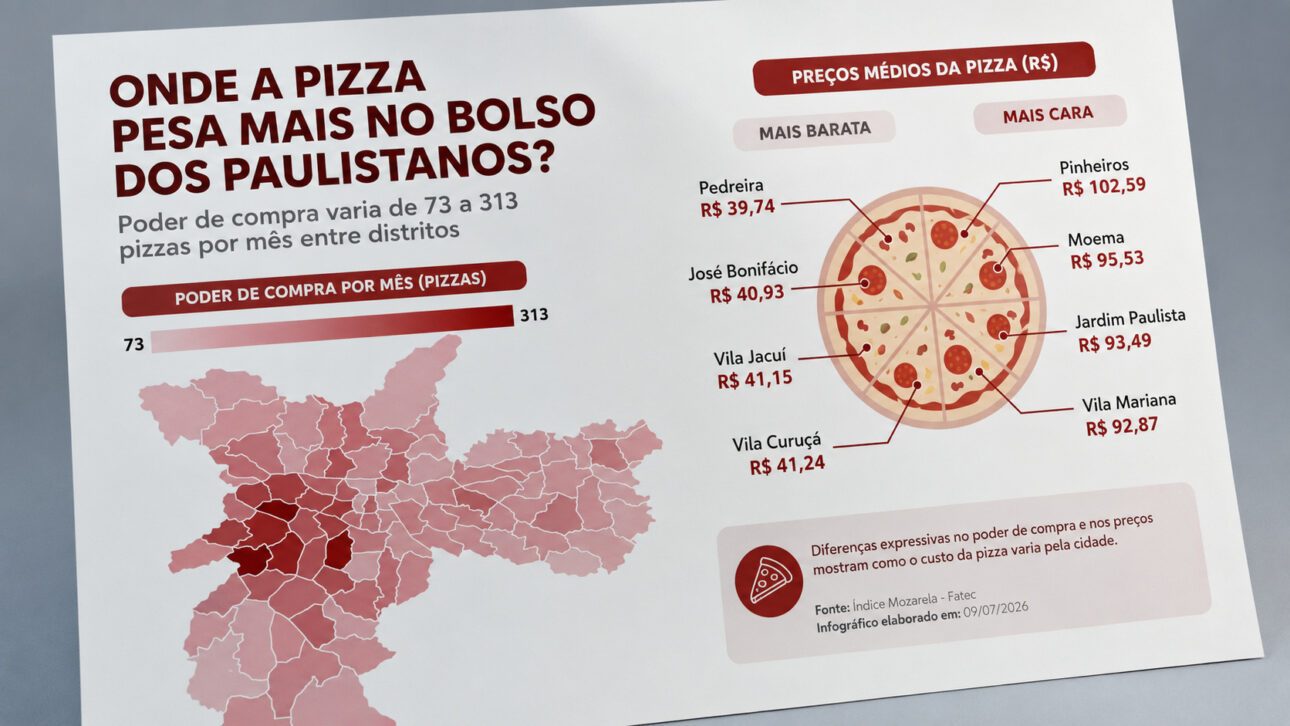
Significant differences also appear between São Paulo neighborhoods.
The average income in Alto de Pinheiros allows for the purchase of 313 pizzas per month, the highest index in the city.
The purchasing power in Anhanguera drops to 73 pizzas monthly, revealing a considerable gap between regions.

Prices vary between neighborhoods of São Paulo
The prices charged by pizzerias also change according to location.
- Pinheiros: R$ 102.59;
- Moema: R$ 95.53;
- Jardim Paulista: R$ 93.49;
- Pedreira: R$ 39.74;
- José Bonifácio: R$ 40.93;
- Vila Jacuí: R$ 41.15.
Peripheral regions concentrate competition mainly based on price.
Consumers with lower purchasing power limit the margin for entrepreneurs to use expensive ingredients or invest in differentiated services.
Higher-income neighborhoods offer a different scenario. Higher consumption allows for menu diversification, ingredients, and sales strategies.
Brazil surpassed 40,000 pizzerias in 2025
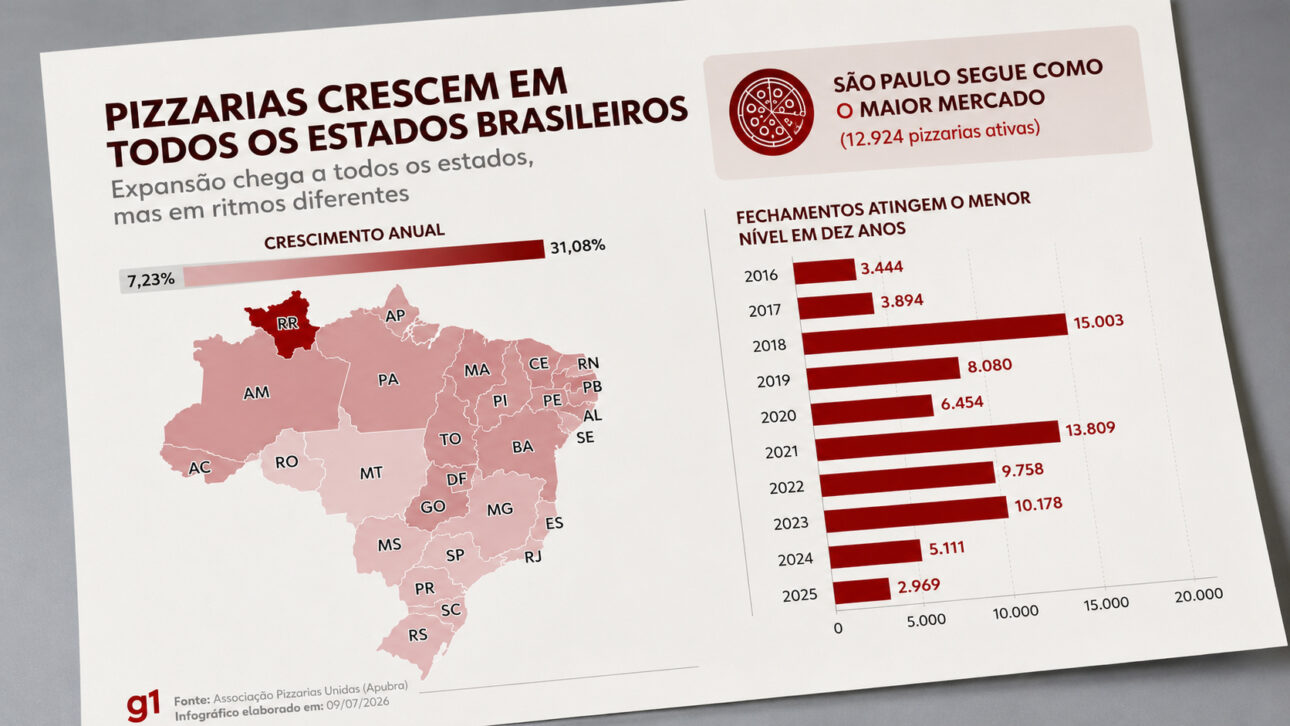
The Brazilian pizzeria market grew 10.29% in 2025, according to Apubra data.
The same period showed the lowest number of closures in the last decade.
About 2,969 pizzerias closed down, a reduction of 43.8% compared to 2024.
The pace of openings remained strong in 2026.
Brazil gained 1,990 new pizzerias between January and May, a growth of 6.1% compared to the same previous period.
This result represents approximately one new pizzeria opened every two hours.
Expansion advances to North and Northeast
The Southeast still gathers 51% of Brazilian pizzerias. São Paulo remains the main center of the segment.
Three out of four establishments opened in 2026, however, emerged outside the state of São Paulo.
North and Northeast led the proportional growth, showing that the sector is advancing into less consolidated markets.
Gustavo Cardamoni, president of Apubra, assesses that consolidation will depend on efficient management, differentiation, and knowledge of the local market.
Pizza Day, therefore, reveals two realities.
The number of pizzerias is growing and closures are decreasing. However, the increase in costs makes the dish less accessible for some consumers.
In your opinion, will the sector be able to maintain this growth even with pizza weighing more and more on family budgets? Leave your comment!