Portuguese
  Spanish


The trajectory of Zhang Xin connects factory, economy abroad, Chinese real estate market, commercial buildings, modern architecture, and urbanization in Beijing, showing how the expansion of Chinese cities also involved companies, offices, and large urban projects.
At 14 years old, Zhang Xin worked in a factory in Hong Kong before studying economics abroad and entering the Chinese real estate market. Later, her name became associated with SOHO China, a company involved in prominent commercial buildings in Beijing and Shanghai.
The information was published by The Wall Street Journal, an international newspaper on economics and business. The information helps to understand how a career that started in industrial work ended up linked to the growth of commercial offices and the visual transformation of large Chinese cities.
The case matters because it shows a broader shift in China itself. The industry remained relevant, but cities like Beijing began to concentrate companies, services, investments, and commercial buildings with more striking architecture.
-
While NATO secured more than $10 billion in missiles and space surveillance at a single forum, Brazil still spends 1.1% of its GDP on defense and is stalling its own anti-aircraft system.

-
Corn ethanol attracts R$ 23 billion in 21 new plants and prepares for a nearly 50% jump in Brazilian production by 2027, even with high interest rates.
-
A newly opened terminal in the middle of the Amazon has begun transporting soy and corn through Amapá, eyeing the queue of ships that is congesting the ports in the South.
-
Tesla injected an additional $250 million into the German factory, doubled the battery cell target, and opened its own production line for startups.


Factory in Hong Kong, study of economics, and entry into a sector that grew along with Chinese cities
Zhang Xin went through a factory routine in Hong Kong and then studied at British universities. The education in economics helped to bring her career closer to a sector that depends on credit, land, construction, and companies willing to occupy offices.

Economics, in this case, is not just a course. It is the area that studies money, production, consumption, and market decisions. For the real estate sector, this matters because each commercial building involves construction costs, rent, location, and company demand.
The Wall Street Journal, an international newspaper on economics and business, detailed the key points of Zhang Xin’s education and her entry into the real estate sector. Her time at the University of Sussex and the University of Cambridge is mentioned as part of this journey before returning to China.
SOHO China was founded in 1995 and entered the commercial real estate market in Beijing and Shanghai
In 1995, Zhang Xin co-founded SOHO China with Pan Shiyi. The company became associated with the development of commercial real estate, especially in Beijing and Shanghai, two cities that gained office buildings and business centers in prime areas.


SOHO China itself, a Chinese urban commercial real estate company, presents its operations as focused on branded commercial properties in Beijing and Shanghai. This type of property includes workspaces, shops, circulation areas, and spaces designed for companies.
For the Brazilian reader, the explanation is simple. When a city receives more companies and more services, the demand for commercial buildings grows. These buildings change land use, attract workers, and increase the value of strategic areas.
Commercial buildings became part of the new urban landscape of Beijing
Beijing did not change only because of new avenues or more residents. The presence of commercial buildings with modern architecture also helped to alter the city’s image.
These buildings function as workspaces, but also as symbols of economic power. When a company chooses to set up offices in a region, it brings movement, services, transportation, and new businesses nearby.
In the case of SOHO China, architecture played an important role. Buildings with striking designs help to differentiate a development among other constructions and can transform an area into a landmark within the city.
Commercial architecture is not just appearance, it also affects money, circulation, and urban appreciation
A well-located commercial building can change the routine of a region. It attracts employees, visitors, shops, restaurants, and services. As a result, the surroundings become more vibrant and attract more interest from companies.
Modern architecture enters this process because it helps sell an image of innovation and value. For those not following the sector, just think of the building as a giant showcase. It houses businesses and, at the same time, communicates economic strength.
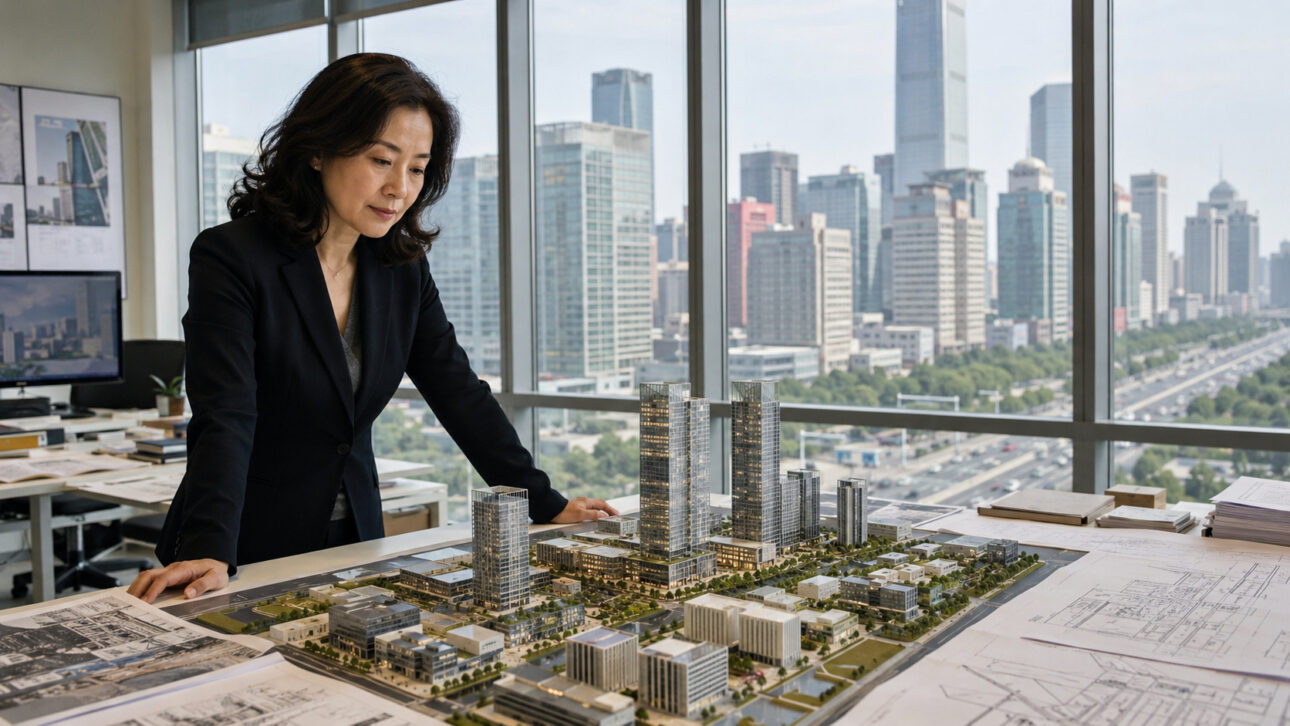
This logic explains why commercial projects in Beijing and Shanghai have gained attention. They are not just isolated constructions. They are part of a competition for urban space, companies, and investments in rapidly growing cities.
The main point is not individual achievement, but the connection between industry, capital, and Chinese urbanization
At 14 years old, factory work marks the starting point for Zhang Xin in Hong Kong. However, the economic center of the story appears later, when she enters the real estate sector and participates in a phase where Chinese cities received large commercial projects.
This movement unites three important parts of the modern economy. Industry forms workers and capital. Education in economics helps interpret markets. Construction transforms land into buildings used by companies, commerce, and services.
Therefore, Zhang Xin’s trajectory helps explain a larger phenomenon. China’s urban growth created space for companies like SOHO China, while Beijing gained buildings capable of changing its landscape and its weight as a business center.
For Brazil, the case shows why commercial buildings can change the course of an urban area
In Brazil, commercial buildings also tend to influence the value of neighborhoods, the flow of people, and the interest of companies. The difference lies in the scale and speed with which China underwent its urbanization.
When a set of offices arrives in a region, it can attract transportation, commerce, and services. At the same time, it can also pressure prices and change the lives of those who already occupied the surroundings.
Zhang Xin’s trajectory became known for the contrast between the factory in Hong Kong and the entry into the Chinese real estate market. But the most important impact is in the sector she helped to drive: commercial buildings, modern architecture, and urban transformation in Beijing.
The case shows how cities change when capital, construction, and demand for offices meet. Beijing’s landscape became a visible part of this process.
Do you believe that modern commercial buildings help a city grow, or can they also increase neighborhood costs and drive away small businesses? Share your opinion and share the article.